Geo Targeting SEO: Why Your Website Attracts Visitors from the Wrong Locations
Why growing organic traffic brings few sales-ready leads, and how to trace it with Search Console, GA4, and CRM data. Covers seven causes, market prioritization, regional landing pages without duplicates, and KPIs by region.

Organic Traffic Is Growing, but Leads Come from the Wrong Locations
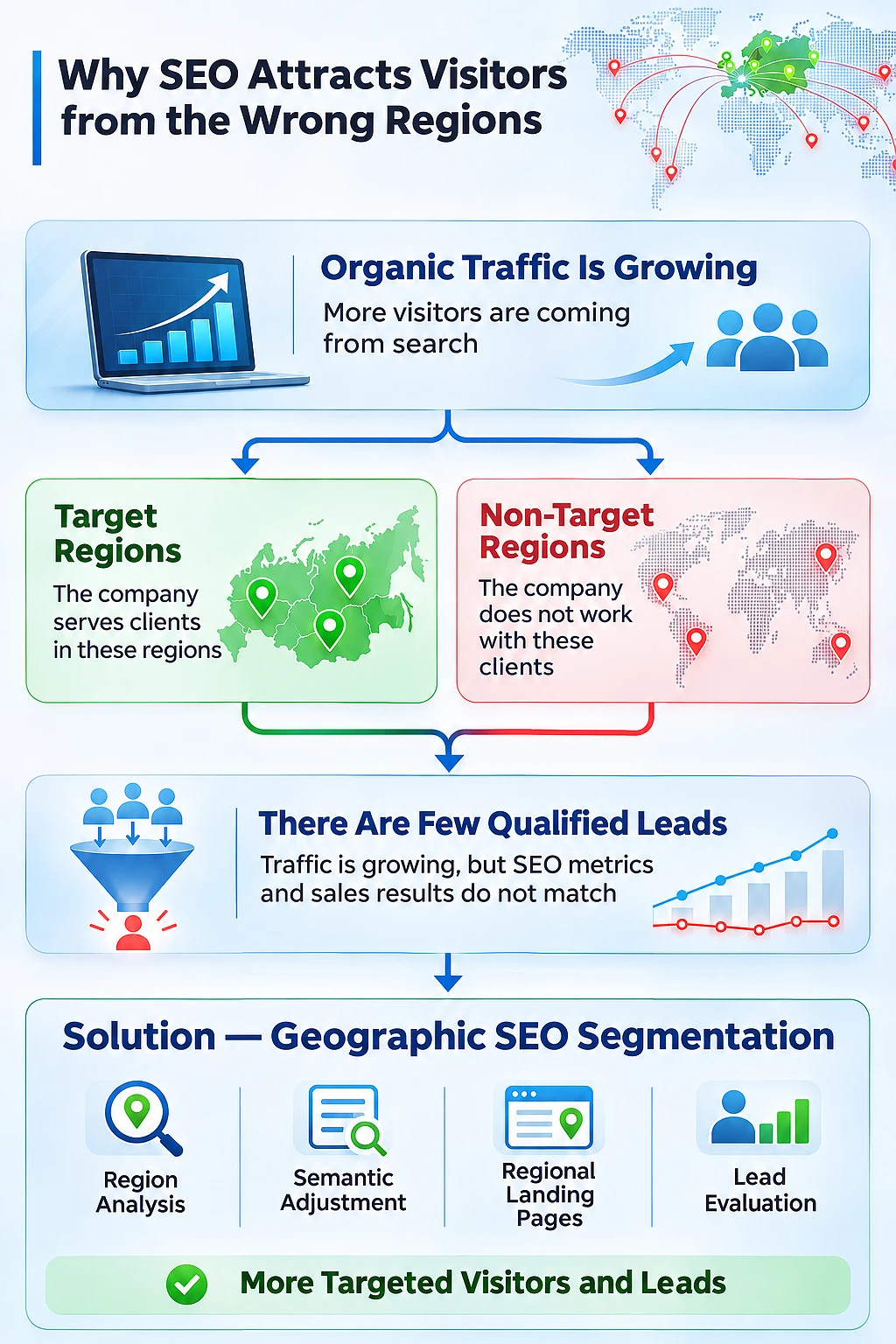
Growth in organic traffic does not mean growth in sales. If visitors come from cities and countries where your company does not operate, the sales team receives inquiries it cannot serve. In this situation, geo targeting SEO helps connect search demand with the markets your business actually serves. SEO cannot prevent your site from appearing in searches outside a region, but it can make the site more relevant to the right audience.
For B2B companies, the problem often looks like this: organic visits are growing, but the CRM contains few suitable leads. Sales representatives only learn where the project is located during a call and reject inquiries because of delivery restrictions or service limitations. A traffic report does not show these losses.
At Webdelo, we assess SEO through leads and deals. So we start with a question: which regions bring in customers the business is ready to serve? Below, we explain how to check this in your analytics, choose priority markets, and update pages without mass-producing city-specific duplicates.
What Is Geo Targeting SEO and Why Does It Matter for Your Business?
Geo targeting in SEO means aligning your keywords, site structure, and content with the markets you serve. No setting limits your site to a selected area. The business goal is to receive more suitable inquiries and spend less time on those that clearly do not fit.
We disagree with the idea that geography does not matter for B2B. Even when sales happen remotely, contract requirements, time zones, and support still matter. Geotargeting SEO should account for these constraints before you choose which keywords to target.
Geographic Demand and Service Area
Demand geography shows where people search from and which region they are searching about. Service area defines where a company can actually meet its commitments. These concepts overlap, but they are not the same.
For example, an executive in Chicago might search for a contractor for a New York branch. Their location does not make the inquiry unsuitable for a company operating in New York. When assessing the inquiry, the project address and service requirements matter more.
Location-dependent queries are searches where location affects how useful the answer is. The query does not have to include a city name. That is why search engine optimization should be planned around demand and service capabilities, not just a list of place names.
How to Identify Organic Traffic from the Wrong Regions
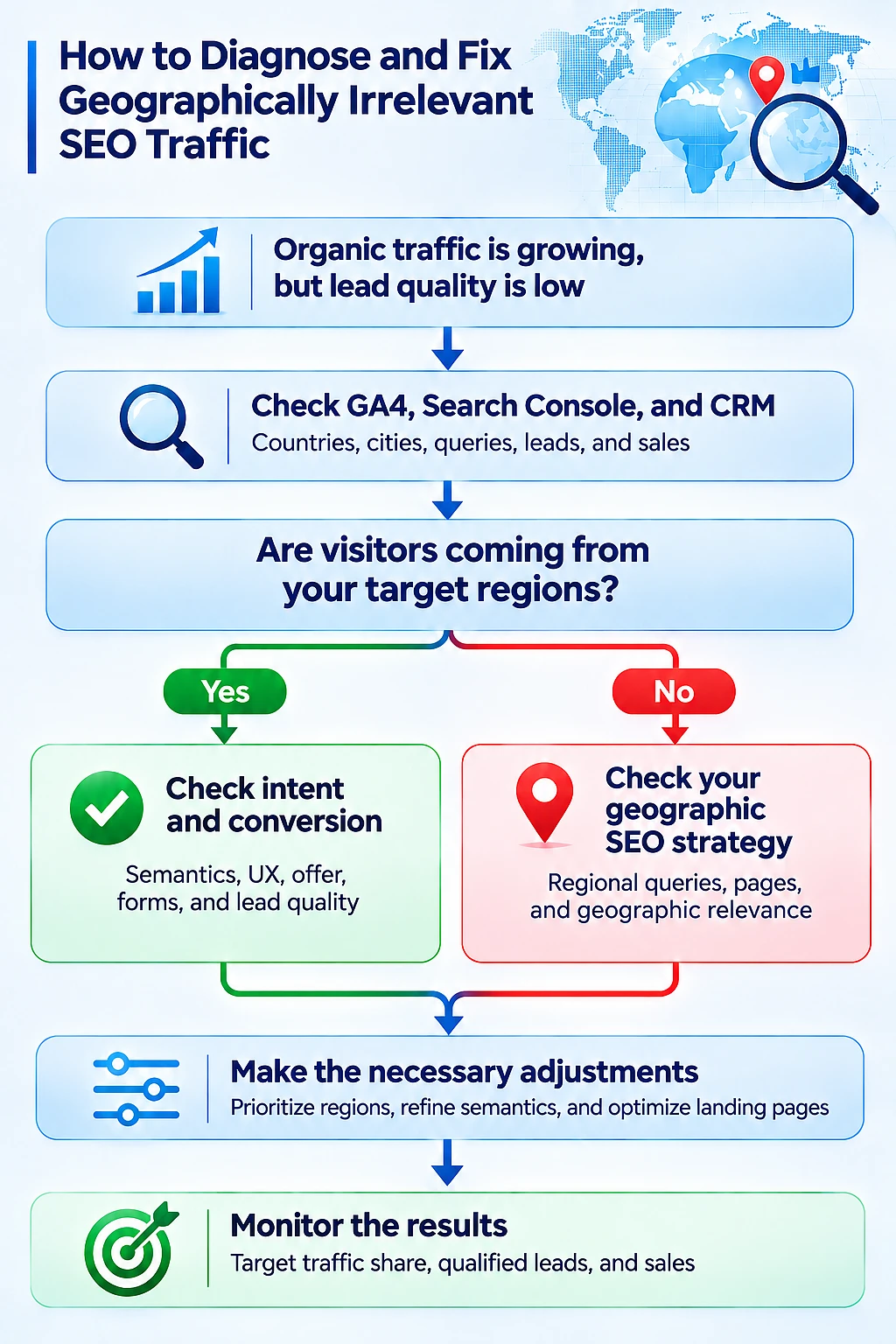
Irrelevant SEO traffic becomes apparent when traffic volume and lead quality diverge. Organic sessions grow, but qualified leads from the regions you serve do not. Geography becomes a likely cause if sales representatives regularly reject inquiries specifically because of the project location.
For an initial check, compare a few signals:
- The rejection reason "we do not serve this region" appears repeatedly in the CRM.
- The share of organic visits from non-priority countries is increasing.
- The share of sessions that generate an inquiry is falling, even as total traffic grows.
- New inquiries require more clarification but rarely progress to a project discussion.
Analytics location data is approximate. For example, a VPN or corporate network can distort IP-based city identification. Look for a consistent trend and confirm the region in the inquiry. If visitors come from the right markets, also examine user intent and the offer on the page as potential causes of low conversion.
7 Reasons Your SEO Strategy Attracts Visitors from the Wrong Locations
Search traffic geography depends on the queries your site covers and the offer visitors see. A mismatch often comes from several decisions at once: broad keyword targeting, unclear service terms, and judging performance solely by traffic. It helps to separate these causes because each requires a different fix.
Keywords and Search Intent
1. Overly broad keyword targeting. A keyword set is the collection of search queries you build your site around. A general guide to choosing equipment can attract readers from different countries, even if the supplier serves only one region. This content makes sense if it supports a future purchase in the target market.
2. Mismatched search intent. Search intent is the goal behind a person's query. A visitor might be looking for training or a free template rather than a paid implementation service. Adding a city name to the text will not fix a mismatch between intent and service.
Site Structure and Geographic Signals
3. An unclear service area. The page provides no information about the regions served or delivery terms. Visitors submit inquiries and only learn about the restrictions from a sales representative.
4. One page for different offers. The company sells in several regions, but timelines and service processes differ. A generic page hides those differences and makes choosing harder.
5. A confusing section and URL structure. Regional content has no clear connection to services. The problem is not the absence of a city name in the page address: a URL itself does not determine where a page appears in search. What matters is whether the structure helps people find the offer for their market.
Offers and KPIs
6. An offer that does not account for the market. For example, a company promises an on-site specialist visit but does not explain where it is available. The customer evaluates the service without knowing an important part of the terms.
7. KPIs that reward any traffic. KPIs are the metrics used to assess performance. If success is measured only in sessions, expanding informational keyword coverage looks worthwhile even without suitable leads. Checking these causes should be part of an SEO website audit, alongside technical analysis.
How to Analyze Organic Traffic by Country, City, and Lead Quality
Analyzing organic traffic by country, city, and lead quality requires several sources. Search Console shows search demand by country, GA4 shows visits and on-site actions, and the CRM shows lead quality and sales outcomes. Compare their data to make decisions, but do not combine it into a single metric.
| Source | What to Measure | What to Decide |
|---|---|---|
| Google Search Console | Impressions and clicks by country, query, and page | Which queries and pages attract demand from non-priority countries |
| GA4 | Organic sessions by country and city, inquiry submissions | Where visitors move on to an inquiry and where they only visit |
| CRM | Project region, lead qualification, deals, and recorded amounts | Which markets generate suitable inquiries and sales |
| Regional search results | Competing pages and offer terms | What content the selected market needs |
Use the same date ranges and a consistent list of regions for comparisons. Record changes to the site and sales terms separately. Otherwise, a seasonal downturn or discontinued delivery service could be mistaken for an SEO problem.
Search Console: Queries, Countries, Impressions, and Clicks
In the search performance report, select a country, then examine pages and queries. Start with pages that have gained clicks from non-priority countries. Check what kind of demand they serve: commercial or informational.
The combination of "page + query + country" helps identify what to change. If an article attracts useful informational searches outside your market, that alone is not a reason to delete it. First, assess its role in attracting target customers.
Search Console does not provide a city breakdown or data on leads or revenue. Google clicks are also not the same as GA4 sessions: the systems have different measurement rules and coverage. To compare specifically with Google, select the corresponding source of organic sessions in GA4.
GA4: Organic Sessions by Country and City
In GA4, filter sessions to the Organic Search channel and add a country and city breakdown. Use the session-scoped channel dimension to analyze current organic visits. The first user acquisition source answers a different question.
Next, check inquiry submission tracking: the event should fire after a successful submission, without duplicates. Opening a form or clicking a button does not yet count as an inquiry. To assess conversion, compare the share of sessions with a successful inquiry submission in each region.
A city in GA4 is an approximate location, not a confirmed project location. Track unknown values separately. When inquiry volume is low, it is better to draw conclusions at the country level or across a larger market you serve.
CRM: Lead Qualification and Deals by Region
To check lead quality, your CRM system must store the inquiry source and project region. Sales representatives also need consistent qualification statuses and rejection reasons. Without these fields, lead geography remains a marketing assumption.
Separate the head office address from the service location. For a company with multiple locations, they may be in different countries. The value of a won deal, expected sales, and payments actually received must also be tracked separately.
Complement the analysis by checking search results for the target region. Compare the terms competitors explain and the pages commercial queries lead to. A single check from your own computer does not represent all regional search results.
How to Prioritize Geographic Markets by Lead Quality
Prioritize target regions based on your ability to serve customers and the economics of sales. Traffic helps assess demand but does not replace that decision. We recommend working with the head of sales to divide markets into current target markets, potential markets, and non-target markets.
- Current target regions. The company already fulfills its commitments here. Check whether commercial pages provide complete information and assess inquiry quality.
- Potential regions. The business is willing to consider entering these markets but needs to clarify service terms. Assess demand and service readiness first, then expand SEO.
- Non-target regions. Serving these markets is impossible or not economically viable. Their search queries are not a priority for SEO.
A qualified lead is an inquiry that meets criteria agreed in advance. For B2B, this might mean a suitable project, a region the company serves, and a realistic budget. Use the same criteria across the markets you compare. We explain how marketing and sales can agree on these criteria in our article on B2B lead quality.
Assess the share of these leads, their progression to deals, and the sales time they require. A market with many inquiries may take a long time to process and generate few sales. Meanwhile, a small number of substantive inquiries may justify exploring a new market.
Building a Regional SEO Strategy Around Your Service Areas
A regional SEO strategy starts with choosing markets, followed by mapping keywords to pages and refining the offer. Next, add accurate service information and check the results through inquiries.
Keyword Clustering and Priority Market Selection
Clustering means grouping queries that reflect similar user needs. For a regional strategy, it helps to record several attributes for each cluster:
- The service or product the potential customer is looking for.
- Whether the query includes a place name or the answer depends on location.
- Commercial or informational intent.
- Relevance to a current or potential market.
Develop commercial clusters for the regions you serve first. Keep informational topics where they help people make a purchase decision. High search volume alone does not make a broad query a priority.
Mapping Keywords to Pages
Assign a primary landing page to each priority cluster. This helps avoid having several pieces of content answer the same commercial query and make it harder to choose the right offer. If an existing page fits, improve it first.
SEO for multiple regions requires separate content where service terms differ. A single service with the same terms can be described on a shared page with a clear service area. A separate section, such as location landing pages, is needed when customers genuinely require different information.
Before changing URLs, check whether content and navigation can solve the problem. Renaming URLs alone does not create regional relevance. When moving pages, preserve working links and set up correct redirects from old addresses.
Genuine Geographic Signals, Links, and Monitoring
Geographic signals are accurate details that help people understand where a company operates. State your service regions and delivery or on-site service terms. Add office addresses and regional projects only when they exist and can be published.
Mentions on genuine partners' websites and in relevant regional industry sources can help people find your company. Choose them based on their connection to the market and your business. Mass link placement around a city name is no substitute for a useful offer.
Monthly traffic analysis by region helps reveal changes in demand and measurement errors. Include regular checks of forms and regional pages in your website support plan. It is best to assign responsibility for technical reliability and SEO performance assessment separately.
Diagnosis should lead to different actions. If the geography is right, check visitor intent and the path to an inquiry. If unsuitable markets dominate, review keyword targeting and page content.
When to Use Location Pages SEO and Regional Landing Pages
In geo targeting SEO, regional landing pages make sense when there is distinct demand and regional content that is useful to customers. Replacing a city name does not create a new offer.
When a Regional Page Is Justified
Before creating a page, check three conditions:
- The region has search demand for the service with commercial intent.
- The company operates in this market or has prepared to enter it.
- The page can explain specific regional terms that matter when choosing a supplier.
For example, an equipment supplier might have useful regional differences in commissioning availability and maintenance procedures. The page should help customers assess whether the project is feasible before they inquire. A verified example of work in the region can complement it if those details can be shared.
When a Separate Page Is Not Needed
If the terms are the same and there is little distinct demand, a main service page listing the areas served is enough. A separate landing page is also premature for a future market without a ready offer. The business must first determine exactly what it can deliver.
Large numbers of nearly identical city pages create a risk of doorway pages: pages built primarily to capture similar search queries. The absence of an office does not make a page a doorway page on its own. For SEO location pages, the test of usefulness is whether a page provides real answers for a customer who needs the service in that region.
How to Measure Geo Targeting SEO Performance and Lead Quality
Assess regional SEO quality by how visits translate into suitable inquiries and sales. This requires a set of GA4 and CRM metrics with agreed calculation rules.
| KPI | Source and Calculation | How to Use It |
|---|---|---|
| Share of organic sessions from target regions | GA4: organic sessions from target regions / all organic sessions × 100% | Shows how visits are distributed relative to the selected markets |
| Share of qualified leads | CRM: qualified organic leads / all organic leads × 100%, calculated separately by region | Shows how well inquiries meet sales criteria |
| Organic conversion rate by region | GA4: organic sessions with a successful inquiry submission / all organic sessions in the region × 100% | Allows comparison of the progression from visit to inquiry |
| SQLs by region | CRM: number of organic leads accepted by sales under agreed criteria | Shows the volume of inquiries ready for the next stage of sales |
| Open deal value | CRM: total value of open deals attributed to organic search, by region | Shows potential sales value, not revenue received |
An SQL, or Sales Qualified Lead, is a lead the sales team has deemed suitable for further follow-up. Document the criteria for this transition so that individual sales representatives do not interpret it differently. Open deal value also requires a consistent rule for entering amounts.
For conversion, use sessions with an inquiry rather than the total number of event triggers: one visitor may submit a form more than once. Decide in advance how the CRM will handle repeat inquiries and which source to assign to a deal. Attribution, the rule for assigning an outcome to a channel, must remain consistent when comparing periods.
Check the share of target traffic alongside the absolute number of qualified leads. The share can rise because traffic from other countries falls, even when useful inquiries do not increase.
For B2B, it makes sense to assess quarterly trends while accounting for the length of the sales cycle. A long sales cycle will require a longer observation period.
Common Geotargeting SEO Mistakes That Reduce Lead Quality
Duplicate pages and attempts to replace market-focused work with technical geographic filtering get in the way of qualified inquiries. Assessing changes solely by session counts is another risk.
Duplicate Regional Pages
Pages with identical content and different city names make it harder to identify the main landing page. Merge them or add genuine service terms. Before merging, check the queries and inquiries for each page so you can preserve useful content.
Misunderstanding hreflang and Geographic Filtering
hreflang identifies language and regional alternatives of a page. It helps indicate the corresponding versions, but it does not prevent the page from appearing for users in other countries. It is not designed for a list of US cities.
Automatic IP-Based Redirects
A forced IP-based redirect may open the wrong version of a site. For example, an employee abroad searches for a supplier for a US division, but the site sends them to a different market. Offering a region selector and allowing users to switch gives them more control.
Traffic KPIs Instead of Business Metrics
A traffic-only report does not show whether the company can serve the people it attracts. Include qualified inquiries and deal progression by region in your SEO assessment. Also account for losses after the inquiry: unavailable products or slow sales responses require separate action.
Frequently Asked Questions About Geo Targeting SEO
Can geo targeting SEO limit my website to a single city or region?
No. Organic search has no setting that allows your site to appear only in one city or country. Geo targeting SEO makes the site more relevant to the market you serve: you prioritize commercial location-dependent queries and clearly state your service area and terms on your pages. Success is measured by qualified leads from the regions you serve, not by the complete absence of visitors from elsewhere.
Why does my website get impressions and clicks in countries where we don't operate?
Search engines show a page to anyone it is relevant to, not just to people in your region. The usual causes are overly broad or informational keywords, missing information about your service area, and a single page covering different markets. Check the page, query, and country combination in the Search Console performance report. Don't delete an article just because of foreign clicks: first assess whether it helps attract target customers.
How do I analyze organic traffic by country and city?
Use three sources separately. Search Console shows impressions and clicks by country, query, and page, but has no city breakdown and no lead data. GA4 shows organic sessions by country and city plus successful form submissions, while your CRM confirms the project location, lead qualification, and deals. Compare the same time periods, but never combine Search Console clicks and GA4 sessions into a single metric.
Do I need separate location pages for every region I serve?
A regional landing page is justified when three conditions are met: there is commercial search demand in the region, your company operates there or is ready to enter, and the page can explain genuine regional terms such as timelines or service options. If your terms are the same everywhere, one main service page listing the areas you serve is enough. Mass-produced location pages that only swap the city name risk being treated as doorway pages and give customers nothing new.
Can hreflang block traffic from countries we don't serve?
No. hreflang tells search engines which language and regional alternatives of a page exist so users see the appropriate version. It does not prevent your pages from appearing in other countries, and it is not meant for separating cities within one country. Forced IP-based redirects are not a solution either: it is better to let users choose their region and keep the option to switch.
How do I measure lead quality by region from organic search?
First, agree with your sales team on consistent criteria for a qualified lead, such as a suitable task, a served region, and a realistic budget. In your CRM, record the project location separately from the headquarters address, along with qualification statuses and reasons for rejection. Track the qualified lead rate, SQLs, and open pipeline value by region, keeping in mind that open deals reflect potential, not revenue received. Don't automatically dismiss a visitor from another city: what matters is where the project will be delivered.
Make Your SEO Traffic More Relevant to Your Business
Regional SEO traffic becomes more useful when selected markets are connected to page content and lead qualification criteria. Start with regions where the company can meet its commitments.
- Use Search Console to analyze queries, pages, and countries.
- In GA4, check organic sessions and successful inquiry submissions, accounting for approximate location data.
- In the CRM, confirm the project region and reasons for qualification or rejection.
- Create separate regional pages where demand and meaningful differences in the offer justify them.
Request an audit of your organic traffic geography and SEO strategy from Webdelo. We will compare the available Search Console, GA4, and CRM data, check measurement accuracy, and identify which markets and pages to develop.
A visitor from another city can become a customer, while growth in local traffic alone does not prove success. The project region and the inquiry's progress toward a sale provide the answer.
Frequently Asked Questions
Can geo targeting SEO limit my website to a single city or region?
No. Organic search has no setting that allows your site to appear only in one city or country. Geo targeting SEO makes the site more relevant to the market you serve: you prioritize commercial location-dependent queries and clearly state your service area and terms on your pages. Success is measured by qualified leads from the regions you serve, not by the complete absence of visitors from elsewhere.
Why does my website get impressions and clicks in countries where we don't operate?
Search engines show a page to anyone it is relevant to, not just to people in your region. The usual causes are overly broad or informational keywords, missing information about your service area, and a single page covering different markets. Check the page, query, and country combination in the Search Console performance report. Don't delete an article just because of foreign clicks: first assess whether it helps attract target customers.
How do I analyze organic traffic by country and city?
Use three sources separately. Search Console shows impressions and clicks by country, query, and page, but has no city breakdown and no lead data. GA4 shows organic sessions by country and city plus successful form submissions, while your CRM confirms the project location, lead qualification, and deals. Compare the same time periods, but never combine Search Console clicks and GA4 sessions into a single metric.
Do I need separate location pages for every region I serve?
A regional landing page is justified when three conditions are met: there is commercial search demand in the region, your company operates there or is ready to enter, and the page can explain genuine regional terms such as timelines or service options. If your terms are the same everywhere, one main service page listing the areas you serve is enough. Mass-produced location pages that only swap the city name risk being treated as doorway pages and give customers nothing new.
Can hreflang block traffic from countries we don't serve?
No. hreflang tells search engines which language and regional alternatives of a page exist so users see the appropriate version. It does not prevent your pages from appearing in other countries, and it is not meant for separating cities within one country. Forced IP-based redirects are not a solution either: it is better to let users choose their region and keep the option to switch.
How do I measure lead quality by region from organic search?
First, agree with your sales team on consistent criteria for a qualified lead, such as a suitable task, a served region, and a realistic budget. In your CRM, record the project location separately from the headquarters address, along with qualification statuses and reasons for rejection. Track the qualified lead rate, SQLs, and open pipeline value by region, keeping in mind that open deals reflect potential, not revenue received. Don't automatically dismiss a visitor from another city: what matters is where the project will be delivered.