B2B Lead Quality: Why Marketing and Sales Disagree
Marketing celebrates more leads while sales complains about their quality. This framework uses five funnel stages, a diagnostic table, seven KPIs, and a CRM setup to show where leads stall and who should act.

Different Targets Create Conflicting Reports
B2B lead quality disputes often start with different scorecards: marketing tracks lead volume and cost per lead, while sales tracks closed revenue. Neither team is automatically right. The answer depends on where leads stop progressing through the funnel.
A familiar management problem looks like this: inquiries increase, the pipeline stays flat, and the CEO receives two incompatible reports. Marketing sees stronger acquisition. Sales sees more contacts who are not ready to buy.
Our position at Webdelo is to examine the complete path from first contact to a won deal. That requires shared qualification criteria, recorded rejection reasons, and feedback in the CRM, the system that manages customer relationships. Without those foundations, neither report explains the business outcome.
The framework below gives both teams a shared lead definition, a diagnostic table, seven metrics, and a practical CRM setup. A hypothetical financial example shows how improving acquisition numbers can hide weaker revenue performance.
What a High-Quality B2B Lead Actually Is
A high-quality B2B lead fits the business you can serve and shows credible buying potential. Evaluate that potential through progression across five stages: Lead, MQL, SQL, Opportunity, and Won. Across a group of leads, conversion and revenue reveal whether qualification decisions were useful.
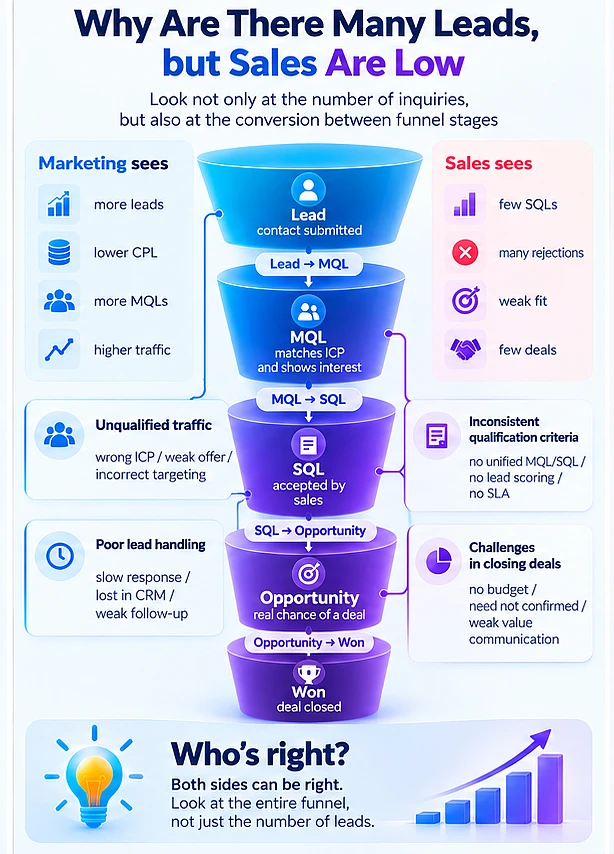
- Lead: a contact who submitted details or made an inquiry. Marketing records the source and checks the initial data.
- Marketing qualified lead, or MQL: a contact who matches the ideal customer profile and shows relevant interest. Marketing owns this qualification decision.
- Sales qualified lead, or SQL: a contact whose buying situation sales has checked through a qualification conversation.
- Opportunity: an active potential deal with a defined need and an agreed next step. Sales owns its progression.
- Won: a deal that meets the company's documented closing condition, such as a signed contract.
The ideal customer profile, or ICP, describes the organizations your offer serves well. Assess individual contacts against four signals:
- Company fit: industry, size, geography, and relevant operational requirements.
- Role and influence: involvement in the problem and access to the buying process.
- Relevant need: a problem your product or service can realistically solve.
- Buying intent: behavior that suggests an active evaluation rather than general curiosity.
MQL vs SQL: Where Responsibility Changes Hands
An MQL represents marketing's judgment that a contact deserves sales attention. An SQL represents sales' confirmation that a credible buying situation exists. A content download alone does not establish that distinction.
BANT criteria provide a starting checklist: budget, authority, need, and timing. Use them to guide discovery rather than automatically rejecting a relevant contact whose purchasing process is still developing. Record unknown information separately from confirmed disqualification.
Define whether an SQL has completed an initial qualification call or a deeper discovery meeting. This prevents the same conversation from being counted differently by different teams.
Who's Right: Four Diagnostic Scenarios
The stage where conversion weakens identifies where to investigate first. Early losses suggest targeting problems, handoff losses suggest qualification disagreements, and later losses require examination of sales execution and the offer. These are diagnostic hypotheses, not proof of fault.
Many Leads, Few MQLs: Review Targeting
If most contacts fall outside your ICP, marketing owns the first investigation. Review actual submissions for mismatches in company size, industry, or role. Check whether campaign messaging attracts people with problems your offer does not solve.
We would connect that review to digital marketing decisions about audiences, messaging, and form questions. Changing sales scripts will not resolve a campaign that consistently reaches unsuitable businesses.
Many MQLs, Few SQLs: Review Shared Criteria
A weak MQL to SQL conversion rate can reveal disagreement about what qualifies a contact for sales. Marketing may count a relevant job title and a download, while sales expects an active purchasing project. Review rejected contacts together before tightening either definition.
Many SQLs, Few Meetings: Review Follow-Up
If qualified contacts fail to attend the next substantive meeting, inspect response times and scheduling follow-through. Distinguish unanswered outreach from declined invitations and missed meetings. Each requires a different corrective action.
Many Meetings, Few Opportunities or Wins: Review Sales Execution
Meetings that produce few opportunities warrant a review of needs discovery and next-step agreements. Opportunities that rarely close require win/loss analysis, including objections to the offer and purchasing constraints. Weak targeting and inconsistent follow-up can coexist, so avoid forcing every loss into one department's category.
Why Leads Don't Turn Into Sales: A Diagnostic Table
Every funnel symptom should lead to a hypothesis, a CRM check, and a corrective action. This diagnostic table turns a disagreement about sales lead quality into a review of observable evidence. Start with data completeness before assigning responsibility.
| Symptom | Hypothesis | What to check | Action |
|---|---|---|---|
| Many Leads, few MQLs | ICP or targeting mismatch | Company characteristics and inquiry relevance by source | Refine audiences, messaging, and form questions |
| Many MQLs, few SQLs | Inconsistent qualification criteria | Marketing's qualification evidence against sales rejection reasons | Agree on MQL and SQL entry conditions |
| Many SQLs, few meetings | Slow handling or weak follow-up | Response timestamps, contact attempts, and meeting outcomes | Set response deadlines and escalation rules |
| Many meetings, few opportunities | Incomplete needs discovery | Discovery notes, business problem, and agreed next step | Improve discovery and opportunity requirements |
| Many opportunities, few wins | Offer or sales-process problems | Loss reasons, objections, and stalled deal stages | Review won and lost deals and revise the offer where justified |
| Lead sources unknown | Missing source capture | UTM campaign parameters and their transfer into CRM records | Repair tracking and retain an explicit unknown-source category |
| Rejections without reasons | Incomplete CRM records | Rejected records with missing or unusable explanations | Require a standardized rejection reason |
Unknown sources and unexplained rejections limit every other conclusion. If sales rejects contacts without recording why, marketing cannot distinguish poor fit from unsuccessful outreach. If sources disappear during transfer, neither team can evaluate campaign performance reliably.
Separate acquisition quality from data hygiene. Identify duplicates and invalid or bot-generated submissions before calculating funnel conversion. Preserve a record of exclusions so that cleaning the database does not silently change the reported lead count.
Seven Metrics to Measure B2B Lead Quality
Seven B2B sales funnel metrics reveal acquisition cost, qualification losses, sales progression, and customer acquisition economics. Read them together: a lower cost per lead does not establish better performance if fewer contacts become customers.
| Metric | Formula | What it shows | Owner |
|---|---|---|---|
| Cost per lead, or CPL | Marketing spend ÷ leads acquired | Acquisition cost before qualification | Marketing |
| Lead to MQL conversion | Leads reaching MQL ÷ leads in the cohort × 100% | Fit and interest among acquired contacts | Marketing |
| MQL to SQL conversion | MQLs reaching SQL ÷ MQLs in the cohort × 100% | Qualification agreement and handoff effectiveness | Marketing and sales |
| SQL to Opportunity conversion | SQLs reaching Opportunity ÷ SQLs in the cohort × 100% | Progression into active deals | Sales |
| Opportunity to Won conversion | Won opportunities ÷ opportunities in the cohort × 100% | Closing effectiveness | Sales |
| Time to first response | First substantive sales response timestamp minus lead receipt timestamp | How long contacts wait for sales engagement | Sales |
| Customer acquisition cost, or CAC | Total attributable marketing and sales acquisition costs ÷ new customers | Combined acquisition investment per customer | Marketing and sales, supported by finance |
A cohort is a group of leads acquired during the same period and followed through subsequent stages. Do not divide this month's wins by this month's inquiries when those customers entered the funnel earlier. For each report, show the cohort's start period and the date through which outcomes were observed.
Long B2B sales cycles require patience. Compare cohorts at a similar age and keep open opportunities visible rather than treating them as losses. Benchmark against your own comparable cohorts before adopting an external conversion target.
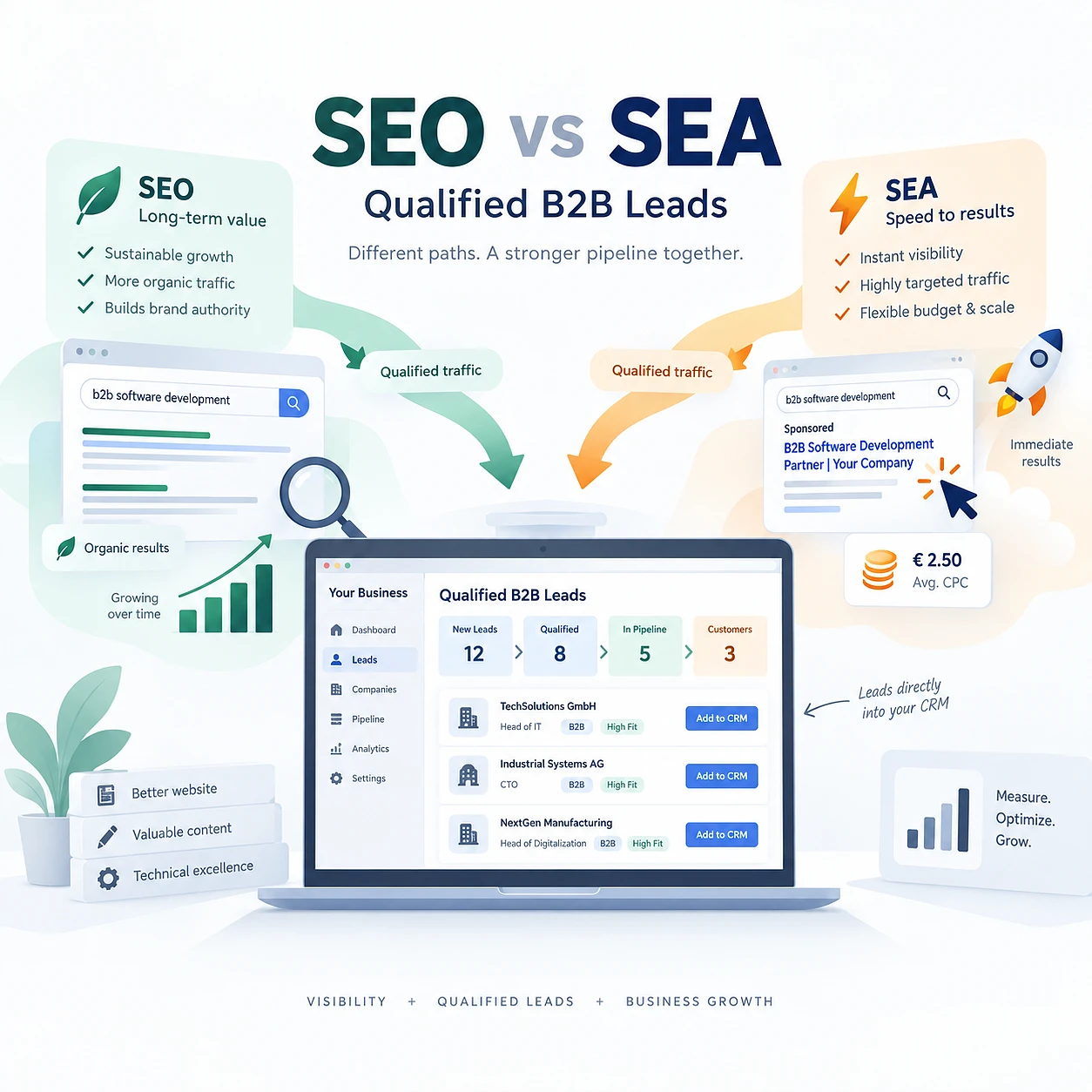
Apply the same logic to seo: evaluate organic inquiries by qualified opportunities and eventual customers, alongside the relevant acquisition costs. Separating sources prevents a change in channel mix from looking like a sudden change in sales performance.
For response time, distinguish an automatic acknowledgment from substantive sales outreach. For CAC, document how shared costs and acquisition periods are allocated. Marketing spend per customer is useful, but it is not full CAC.
How to Align MQL and SQL Criteria and a Sales SLA
Sales and marketing alignment starts with written lead qualification criteria and a shared service-level agreement, or SLA. The criteria define which contacts move forward. The SLA defines what each team must do after the handoff.
Make qualification observable. For an MQL, specify the acceptable company profile, relevant role, and interest signal. For an SQL, record evidence of the need, budget situation, buying authority, and timing, including any accepted unknowns.
The SLA should document:
- Marketing commitments: agreed MQL delivery targets and the information required for handoff.
- Sales commitments: response deadlines, contact attempts, and follow-up ownership.
- Coverage: working hours and routing arrangements for different regions.
- Disposition: accepted, rejected, or returned for nurturing, with a recorded reason.
- Escalation: who handles unassigned leads and missed response deadlines.
A relevant company without an active project may belong in nurturing rather than permanent rejection. Keep that status separate from poor fit. Otherwise, marketing learns to exclude future buyers simply because they were not ready immediately.
Review criteria and rejection patterns together, for example monthly. Examine individual records behind a disputed category and update the definition when necessary. Record the change date so that reports remain interpretable.
How to Set Up CRM Lead Scoring and Feedback
The CRM should connect marketing, sales, and analytics through a continuous feedback loop. Every lead needs a source, stage, owner, and outcome. Sales feedback must remain available to marketing so that acquisition decisions reflect what happens after submission.
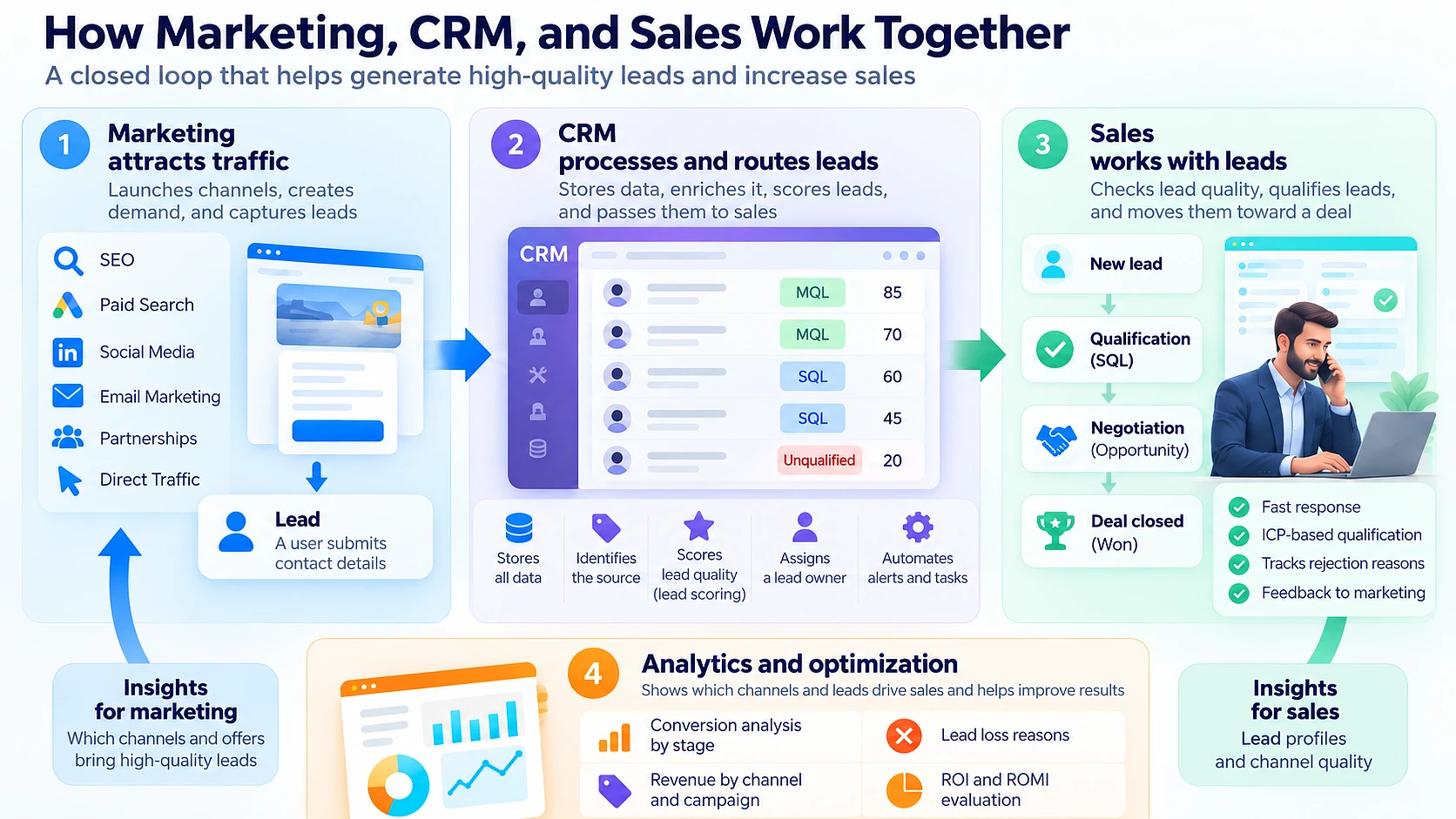
Start with fields that support diagnosis:
- Acquisition source: original source and UTM campaign parameters, where available.
- Qualification: current stage and the evidence supporting MQL or SQL status.
- Ownership: the person or queue responsible for the next action.
- Timestamps: creation, handoff, first substantive response, and stage transitions.
- Rejection reason: a required selection when a lead is rejected, with optional explanatory notes.
- Commercial outcome: linked opportunity, closing date, and won deal amount.
Our implementation priority is source capture and usable rejection reasons before complex scoring. These fields explain where leads came from and why they stopped. A sophisticated score cannot recover information that was never recorded.
A CRM lead scoring model can then prioritize contacts using agreed fit and intent signals. Keep those signals distinguishable: frequent activity should not conceal a clear company-profile mismatch. Treat a score as a routing aid, not proof of purchasing readiness.
For custom crm development and integrations, make qualification decisions traceable. Preserve stage history, route leads to named owners, and trigger alerts when the agreed response deadline passes. Test that rejection and nurturing paths work as reliably as the successful handoff.
Security maintenance also belongs in the implementation plan because lead capture processes personal and commercial information. For a PHP-based integration, our analysis of the October 2026 PHP security vulnerabilities is a separate technical resource for that review. Security checks address system risk, while qualification rules address buying potential.
Build reports by both source and cohort, linking contacts to opportunities and customers. Count each customer consistently when several contacts belong to the same buying organization. Otherwise, account-level deals can distort contact-level conversion.
Worked Example: More Leads, Less Revenue
In this hypothetical model, Month B produces 50% more leads on the same $10,000 marketing budget, yet generates $15,000 less revenue. This is an illustrative teaching example, not a Webdelo case. Sales costs are excluded, so the customer-cost calculation is not full CAC.
Treat Month A and Month B as acquisition cohorts observed long enough to compare their outcomes. Each new customer generates $5,000 in revenue in this model.
Month A: Leads 200
Month B: Leads 300
Month A: MQLs 80
Month B: MQLs 90
Month A: SQLs 40
Month B: SQLs 30
Month A: New customers 8
Month B: New customers 5
Source: hypothetical teaching model. Opportunity counts are not specified.
Month B's acquisition report looks stronger, but its advantage disappears during qualification:
- CPL: $10,000 ÷ 200 = $50 in Month A, compared with $10,000 ÷ 300 = $33.33 in Month B.
- Lead to MQL: 80 ÷ 200 = 40% in Month A, compared with 90 ÷ 300 = 30% in Month B.
- MQL to SQL: 40 ÷ 80 = 50% in Month A, compared with 30 ÷ 90 = 33.3% in Month B.
- Marketing spend per new customer: $10,000 ÷ 8 = $1,250 in Month A, compared with $10,000 ÷ 5 = $2,000 in Month B.
- Revenue: 8 × $5,000 = $40,000 in Month A, compared with 5 × $5,000 = $25,000 in Month B.
The model shows weaker commercial outcomes, but it does not establish their cause. Investigate targeting and the MQL-to-SQL handoff first, then examine downstream losses. Without opportunity counts and rejection reasons, blaming either department would go beyond the available evidence.
A 30-Day Plan to Improve Lead Quality
A 30-day plan can establish reliable data, shared definitions, and a working review process. It is a practical starting sequence, not a promise of closed revenue within a month. The aim is to improve qualification without abruptly removing viable pipeline.
- Week 1: Audit the evidence. Check sources, missing fields, duplicates, and unexplained rejections. Build the current funnel by cohort and identify which conclusions the data cannot yet support.
- Week 2: Agree on definitions. Bring marketing, sales, and leadership together to approve MQL and SQL criteria. Document the SLA and assign an owner to each handoff.
- Week 3: Implement the CRM changes. Configure fields, source capture, scoring, routing, and response alerts. Test representative records from submission through closure or rejection.
- Week 4: Run the first joint review. Use the diagnostic table and seven KPIs to select the next corrective action. Record its owner and the evidence needed to evaluate it.
Change targeting or sales handling gradually enough to understand the effect. Keep suitable but early-stage contacts in a separate nurturing flow. Review pipeline creation alongside qualification rates so that stricter filtering does not become an end in itself.
How Webdelo Helps Audit Your Lead Funnel
Webdelo helps B2B companies connect lead acquisition, CRM workflows, and sales reporting. A lead-quality audit should identify where contacts are lost, which data is missing, and what each team needs to change first. The scope depends on the existing systems and the reliability of their records.
Our B2B software and integration work provides the technical foundation for examining the complete handoff. The review can cover:
- Funnel progression by cohort and acquisition source.
- MQL and SQL definitions and supporting evidence.
- Rejection reasons and nurturing decisions.
- Response speed, routing, and ownership gaps.
- Tracking and integration requirements for dependable reporting.
Where implementation is needed, we can support CRM development, integrations, lead capture, and analytics setup. The practical output is a prioritized action plan that separates data repairs from qualification and sales-process changes.
Request a B2B lead-quality and CRM funnel audit and consultation with Webdelo to identify the gaps in your funnel and agree on the next steps.
Let Funnel Evidence Decide Responsibility
Neither marketing nor sales wins by default. Shared criteria and reliable funnel records reveal where to investigate, while deals and revenue show the commercial outcome. Lead volume alone cannot settle the dispute.
Assign responsibility to a specific action supported by evidence: repair source capture, revise qualification, improve follow-up, or examine lost opportunities. Review mature cohorts and full acquisition costs before deciding whether the change worked. That gives leadership a basis for allocating investment instead of choosing between competing reports.
Frequently Asked Questions
Who is right when marketing reports more leads but sales says they are low quality?
Neither team is right by default. The answer depends on the funnel stage where leads stop progressing. Early losses point to targeting. Losses between MQL and SQL point to disagreement about qualification criteria. Later losses point to follow-up, needs discovery, or the offer. Treat these patterns as hypotheses to check in CRM data, not as proof that one department is at fault.
What is the difference between MQL and SQL in B2B?
A marketing qualified lead (MQL) is a contact that marketing judges to match the ideal customer profile and to show relevant interest. A sales qualified lead (SQL) is a contact whose buying situation sales has confirmed in a qualification conversation, for example by checking need, budget, authority, and timing. A content download alone does not make a contact an SQL. Both teams should agree in writing which evidence moves a lead from one stage to the next.
Which metrics show B2B lead quality?
Use seven metrics together: cost per lead (CPL), the conversion rates from Lead to MQL, MQL to SQL, SQL to Opportunity, and Opportunity to Won, time to first substantive sales response, and customer acquisition cost (CAC) covering both marketing and sales costs. Calculate conversions by cohort, meaning leads acquired in the same period and followed through later stages, because B2B deals often close long after the first inquiry. A lower CPL is not an improvement if fewer contacts become customers.
Why can more leads and a lower cost per lead result in less revenue?
In a hypothetical model with the same $10,000 marketing budget, Month B brings 300 leads instead of 200 and cuts CPL from $50 to $33.33. However, it produces only 5 new customers instead of 8, so revenue falls from $40,000 to $25,000 and marketing spend per customer rises from $1,250 to $2,000. The losses appear in the qualification stages. This is why lead volume and CPL alone cannot measure lead quality.
What should a lead SLA between marketing and sales include?
A lead SLA should define marketing's MQL delivery targets and the information required for handoff, along with sales' response deadlines, contact attempts, and follow-up ownership. It also covers working hours and routing across regions, plus disposition rules: each lead is accepted, rejected, or returned to nurturing with a recorded reason. Add an escalation path for unassigned leads and missed deadlines. Review it jointly, for example monthly, and record the date of every change.
How should a CRM be set up to track lead quality and lead scoring?
Every lead needs an acquisition source with UTM parameters, a current stage with qualification evidence, an owner, and timestamps for creation, handoff, first response, and stage transitions. It also needs a mandatory rejection reason and a linked commercial outcome. Set up source capture and usable rejection reasons before complex lead scoring, because no score can recover data that was never recorded. Treat the score as a routing aid, not as proof that a contact is ready to buy.
How long does it take to improve B2B lead quality?
A 30-day plan can put reliable data and shared rules in place. In week 1, audit sources, duplicates, and unexplained rejections. In week 2, agree on MQL and SQL criteria and the SLA. Week 3 is for CRM changes, and week 4 for the first joint review. This is only a starting sequence, not a promise of closed revenue within a month. Because B2B sales cycles are long, judge the results on mature cohorts.