
How missed search demand becomes your competitors' leads
Competitors can win Google leads when they appear for the commercial queries buyers use and their landing pages turn those visits into inquiries. SEO competitor analysis identifies the gaps behind that advantage and helps prioritize fixes. Any revenue estimate represents potential, not a verified loss. Competitor traffic estimates cannot reveal how many customers those businesses actually win.
At Webdelo, we start with commercial intent and sales economics. A ranking report becomes useful when it answers a business question: which relevant searches reach competing vendors while giving buyers little opportunity to consider you?
This analysis connects search demand to specific pages and actions. It helps you:
- Identify commercial queries where your business has weak visibility.
- Find the page or technical issue behind each gap.
- Estimate possible additional visits, leads, and revenue.
- Prioritize work by business value, effort, and dependencies.
The result is a focused investment decision. It does not replace a general website audit or a full SEO forecast.
Who your real search competitors are
Your search competitors are the domains that repeatedly appear for your commercial queries in a specific market. Start with three to five. They may include smaller vendors, marketplaces, and directories that your sales team rarely encounters in deals.
We separate search competition from sales competition because they answer different questions. A major enterprise vendor may dominate your sales team's shortlist while a specialist consultancy occupies the Google results for your most relevant service.
- Choose 15-30 queries that express a buying need, such as "custom CRM development company" or "CRM integration services for manufacturers."
- Review the top 10 organic results using a consistent target country, language, and device setting.
- Record recurring domains and the pages that rank.
- Select three to five recurring competitors for detailed analysis.
A shorter list keeps the comparison actionable. Include directories in your notes, but distinguish them from direct providers. A relevant directory listing may be a more practical route to buyers than trying to displace the directory.
Run separate comparisons for the US and Germany. Our digital support for entering new markets connects this research with localized messaging and product readiness. Translating a US keyword list alone does not establish German commercial demand.
Comparing commercial search visibility and organic share of voice
Compare organic visibility within one market and a fixed set of commercial queries. Organic share of voice estimates how much of the modeled search opportunity each domain captures. It describes visibility within your chosen query set, not a company's overall market share.
Use different sources for different questions:
- Google Search Console: your site's impressions, clicks, click-through rate, and average position by query and landing page.
- Third-party SEO tools: competitor keyword analysis, estimated traffic, ranking pages, and referring domains.
- Analytics and CRM: landing-page conversions, lead quality, sales outcomes, and deal revenue.
CTR, or click-through rate, is the percentage of impressions that produce clicks. Search Console reports your observed CTR. An SEO tool's competitor CTR or traffic figure is modeled, not access to that competitor's private analytics.
For a consistent share-of-voice calculation, estimate clicks for every tracked domain using the same query volumes and CTR assumptions. Divide each domain's modeled clicks by the total across the tracked domains. Document the denominator, because adding another competitor changes the percentage.
Separate branded searches from nonbranded vendor discovery. Also keep market and device settings consistent. Authority Score is a tool-specific metric, not a Google score or proof that a domain deserves to rank.
Within our digital marketing work, this comparison becomes more useful when connected to qualified inquiries. High estimated traffic from unrelated informational searches can distract from a smaller, commercially valuable gap.
Keyword gap and content gap analysis for commercial queries
A keyword gap analysis identifies relevant searches where competitors rank and your site is missing or weak. A content gap analysis identifies missing pages or unanswered buyer questions. Together, they connect search demand to a concrete publishing or improvement task.
Keyword gaps that matter to sales
Filter by commercial search intent before sorting by volume. Prioritize service searches, pricing questions, vendor comparisons, industry-specific needs, and relevant locations. An informational query belongs near the top only when there is a credible path from that topic to a purchase.
Group the remaining queries into three practical buckets:
- Missing visibility: competitors rank, but your site has no visible result in the tracked range.
- Weak visibility: your relevant page ranks below the top 10.
- Weak click capture: your page appears, but its observed CTR warrants investigation.
Assign a target page to every query cluster. For example, a competitor might have a dedicated CRM integration page for manufacturers while your site has one general development page. That suggests a page-level opportunity, subject to whether manufacturing is genuinely part of your offer.
Content gaps in buyer answers
Compare the pages that actually rank. A competitor website analysis should examine the offer and supporting evidence, not just headings or word count.
- Does the page explain scope and exclusions?
- Does it address industry-specific requirements?
- Does it explain process and timing dependencies?
- Does it provide relevant proof or case material?
- Does it make the next step clear?
A stronger page may need a precise explanation of integration responsibilities rather than another thousand words. Avoid creating near-identical pages for every keyword variation. Several related searches can belong to one useful landing page.
Why competitors outrank you on Google: five causes
Commercial ranking gaps usually require investigation across five areas: search intent, page quality, indexing, user experience, and links. We check indexing blockers first, then assess whether the page answers the buying need. UX and relevant links complete the diagnosis, but neither compensates reliably for an inaccessible or irrelevant page.
Google's guide to debugging search traffic drops provides a framework for investigating changes in organic traffic. A decline deserves a technical and demand check before being attributed to a competitor's content.
Intent mismatch is often visible directly in the results. If Google mostly shows service pages for a query, a broad educational article may serve a different need. Likewise, a small specialist can outrank a larger company with a page that addresses the buyer's requirements more precisely.
Diagnostic table for commercial gaps
| Problem | How to detect | Likely cause | Action | Priority |
|---|---|---|---|---|
| No ranking for a commercial query | Check tracked results and identify the intended landing page. | Missing page or intent mismatch. | Map the query cluster to a suitable page, then create or revise it. | High when the query matches a valuable service. |
| Ranking below the top 10 | Compare the ranking page with leading results. | Incomplete buyer answers, weak internal linking, or stronger competing pages. | Improve the offer, evidence, and internal links. | Depends on commercial value and effort. |
| Ranking but low CTR | Segment Search Console by query, country, device, and page. | Unclear title, weak relevance, or competing search features. | Improve the title and page summary, then measure changes. | Early opportunity when relevant impressions already exist. |
| Traffic without inquiries | Test the inquiry path and review analytics alongside CRM records. | Low-intent traffic, confusing offer, form friction, or tracking failure. | Validate measurement and fix the conversion path. | High for qualified traffic reaching a broken journey. |
| Page not indexed | Inspect the URL and indexing reports in Search Console. | Indexing restrictions, canonical issues, access problems, or insufficient page value. | Resolve the diagnosed issue and verify the result. | Blocking dependency for a priority page. |
| Competitor has stronger relevant links | Compare referring sites after checking intent and page quality. | Stronger relevant coverage, mentions, or established resources. | Develop useful resources and pursue legitimate industry coverage. | After accessibility and page relevance are addressed. |
A focused SEO site audit can investigate the causes identified here. Link counts alone cannot establish why a competitor wins, and low CTR does not automatically mean your title is wrong.
Some fixes require engineering ownership. For those discussions, Webdelo CTO Andrew Popov represents the architecture perspective: rendering or routing changes need assessment for their wider product impact.
How to estimate additional visits, leads, and revenue
Estimate possible additional visits by multiplying monthly search volume by the gap between a modeled competitor CTR and your baseline CTR. Apply your conversion rate, close rate, and average deal revenue to estimate the downstream opportunity. The result is possible additional revenue, not profit or a verified amount of lost organic leads.
This step makes SEO competitor research useful for investment decisions. It connects a visibility gap to business economics while exposing the assumptions behind the number.
Formulas and data reliability
| Metric | Formula or method | Data source | Reliability |
|---|---|---|---|
| Monthly search demand | Relevant query volume in the target market. | Keyword research tool. | Estimated demand, subject to grouping and seasonality. |
| CTR gap | Modeled competitor CTR minus your aligned baseline CTR. | Ranking data, CTR curve, and Search Console. | Approximate, sensitive to search layout and impressions. |
| Possible additional visits | Positive CTR gap × monthly search volume. | Keyword tool and CTR assumptions. | Scenario output, not measured competitor traffic. |
| Possible additional leads | Additional visits × visitor-to-lead conversion rate. | Analytics and CRM. | Depends on traffic quality and conversion tracking. |
| Possible additional revenue | Additional leads × close rate × average revenue per deal. | CRM and sales records. | Sensitive to qualification, sales cycle, and deal mix. |
The CTR inputs need compatible definitions. Search Console CTR uses your actual impressions, while keyword volume estimates all searches in a market. If your page appears for only some searches, subtracting its observed CTR directly from a modeled competitor CTR can distort the result.
Use an aligned CTR model for both sites when possible, then compare its baseline with observed clicks. Treat a negative gap as no positive opportunity within this calculation, rather than offsetting unrelated opportunities.
Illustrative example: four B2B CRM queries
Consider four fictional B2B CRM queries in one market. Every search volume and CTR below is illustrative, not data from clients, actual competitors, or Webdelo projects.
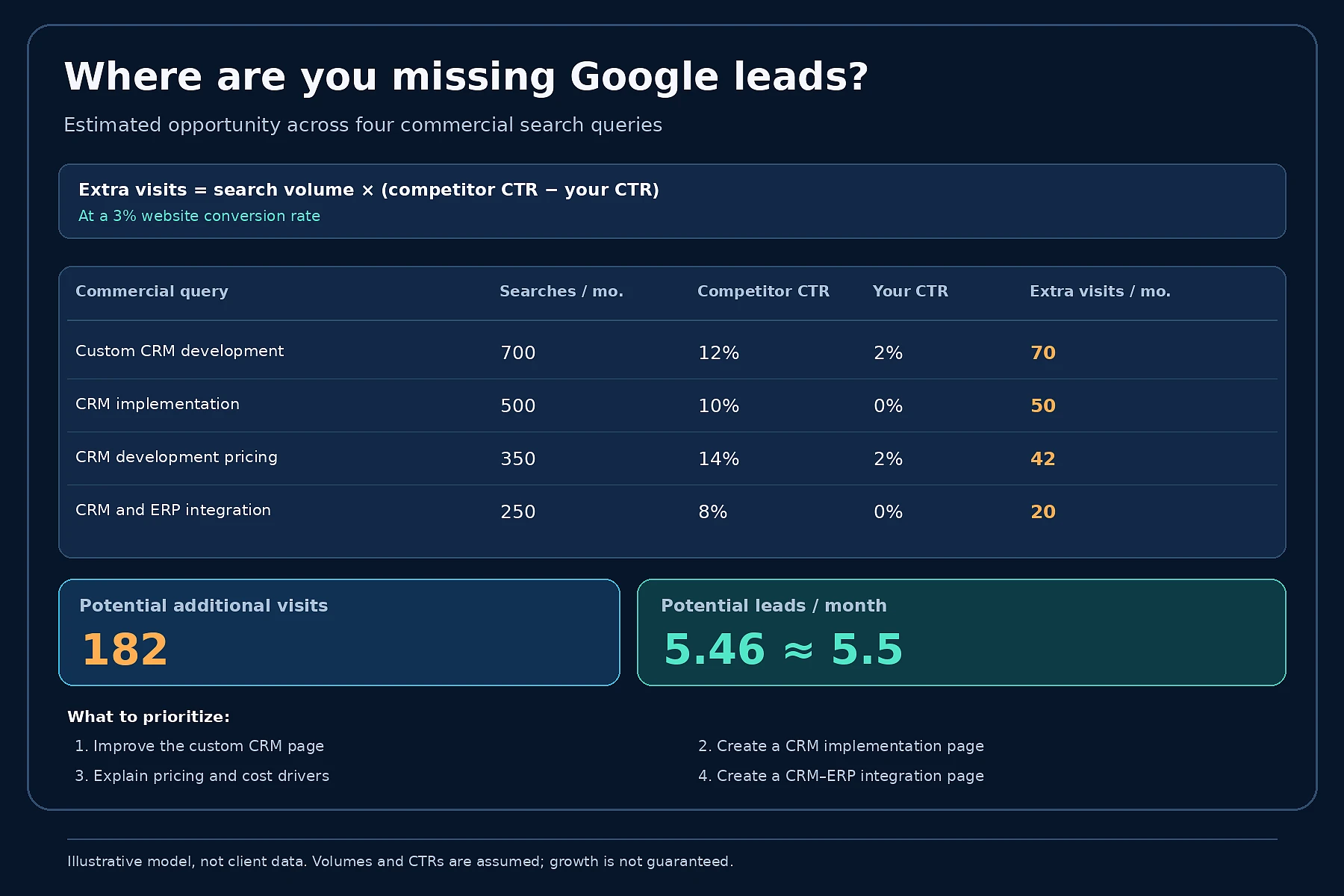
The chart shows each calculation. Its percentages represent the assumed competitor CTR minus the assumed site CTR, with compatible exposure assumed for this simplified example.
Custom CRM development: 700 searches × (12% - 2%) 70 visits
CRM integration services: 500 searches × (10% - 0%) 50 visits
CRM development for manufacturers: 350 searches × (14% - 2%) 42 visits
Custom CRM development pricing: 250 searches × (8% - 0%) 20 visits
Hypothetical inputs only. CTR gaps are 10, 10, 12, and 8 percentage points. Total: 182 possible additional visits per month.
At an assumed 3% visitor-to-lead conversion rate, 182 × 3% = 5.46 potential leads per month. We round that to about 5 leads for discussion. The decimal is a mathematical expectation, not a fractional inquiry.
Assume a 20% close rate and $10,000 in average revenue per deal. Keeping the unrounded lead estimate gives 5.46 × 20% × $10,000 = $10,920 in possible additional revenue associated with a month's modeled leads. A B2B sales cycle can delay that revenue beyond the month those leads arrive.
Limits that change the estimate
Use the calculation to compare opportunities, then test conservative and stronger scenarios. The main sources of uncertainty are:
- CTR curves: ads, AI answers, brand familiarity, and other result features change click behavior.
- Query overlap: tools may group close variants, and buyers may search repeatedly. One page ranking for multiple distinct queries is not itself double counting, but overlapping demand estimates can be.
- Attribution: organic search may introduce a buyer who later converts through another channel. Do not claim the same revenue independently across channels.
- Lead quality: new query clusters may convert and close differently from your existing organic traffic.
Use aggregated CRM outcomes where possible. Our guidance on protecting customer data when working with IT contractors is relevant when sharing conversion evidence. Customer names and detailed deal records are generally unnecessary for this model.
Six steps from competitor research to prioritized actions
The diagnosis follows six linked steps: choose competitors, measure visibility, find gaps, check causes, estimate opportunities, and prioritize actions. Each step produces an input for the next. This prevents a keyword export from turning straight into an expensive content backlog.
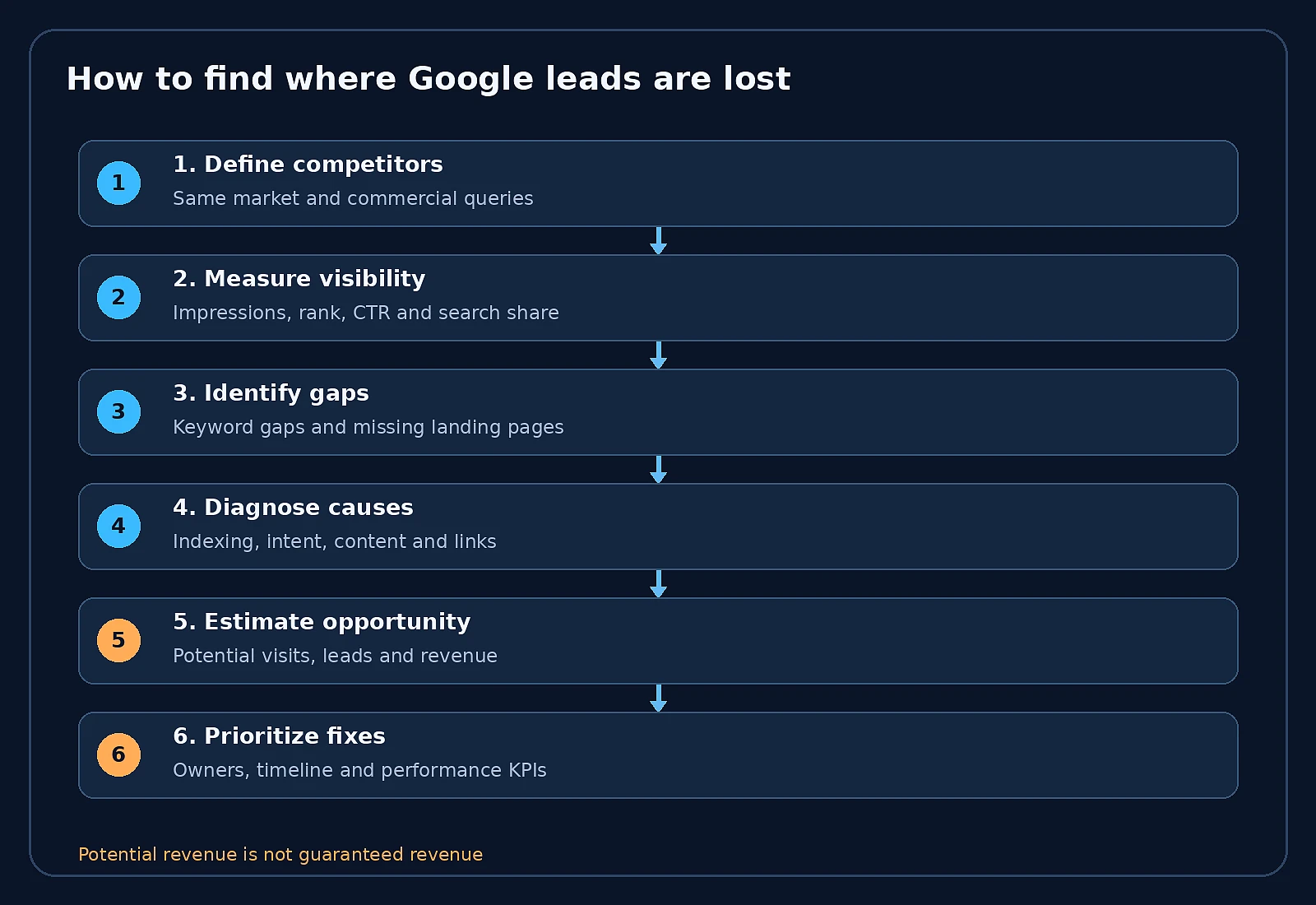
- Choose competitors. Record three to five recurring domains for one market.
- Measure visibility. Establish a baseline on a fixed commercial query set.
- Find gaps. Map missing or weak query clusters to landing pages.
- Check causes. Assign a supported diagnosis using the diagnostic table.
- Estimate opportunities. Document traffic assumptions and sales economics.
- Prioritize actions. Compare potential value, effort, confidence, and dependencies.
Keep the final report practical. Each row should identify the query cluster, target page, evidence, proposed action, owner, and success measure. Separate observed facts from modeled estimates.
AI search visibility can be a supplementary check. Record whether your company appears in relevant answers, but keep that observation separate from traditional organic rankings. Without a defensible click model, do not add AI mentions to the revenue estimate.
A prioritized 90-day plan without growth guarantees
Use the first 90 days to remove blockers, improve high-value commercial pages, and establish reliable measurement. This is a planning horizon, not a growth promise. Rankings and qualified leads may take longer to respond.
Days 1-30: remove blockers and validate measurement
- Resolve confirmed indexing and technical issues affecting priority pages.
- Improve unclear titles and summaries where relevant impressions already exist.
- Test forms and connect organic landing pages to CRM outcomes.
Use the segmentation approach in Google's traffic-drop guidance to distinguish broad changes from page-specific problems. Fix the diagnosed cause rather than treating every decline as a content shortage.
Infrastructure issues may require Webdelo DevOps and Infrastructure involvement. Assign deployment and rollback responsibilities before making production changes.
Include recurring checks in the operating budget. Understanding what website maintenance includes helps separate ongoing upkeep from one-time SEO improvements. For business-critical failures, document support and incident-response commitments in the agreed service scope.
Keep measurement access limited to the work required. Review our data security practices when agreeing how analytics and CRM information will be handled.
Days 31-60: build or improve commercial pages
- Create missing service or industry pages supported by genuine capabilities.
- Improve existing pages with clearer scope, process, and relevant proof.
- Add internal links and a clear inquiry path.
Prioritize by estimated value and confidence, not volume alone. A modest-demand page closely aligned with your ideal customer may deserve investment before a broader topic.
Days 61-90: strengthen authority and reassess
- Pursue relevant industry listings and editorial coverage.
- Compare Search Console results with the original baseline.
- Review qualified inquiries and update assumptions.
Separate completed work from outcomes. A published page is a deliverable. Improved visibility and qualified leads are results to measure over time.
Expert view: start from queries that bring clients
Andrei Jumatii, Webdelo SEO & Marketing expert, connects competitive search analysis to landing pages and sales economics. Rankings help locate the gap. Commercial relevance determines whether closing it deserves investment.
"In competitive SEO analysis, it is important to look beyond the positions of websites in Google. The main business question is which commercial queries bring clients to competitors but do not yet bring them to you. When we map these queries to landing pages, conversion and sales economics, it becomes clearer where the most valuable growth opportunities are."
That principle shapes how we connect competitive analysis with technical work and content decisions. The recommendation should explain what to change, why it matters commercially, and which evidence will show whether it helped.
Order a competitive analysis from Webdelo's SEO team to identify missed commercial queries and receive a ranked set of priorities. The opportunity assessment should make its assumptions visible alongside the recommended work.
Make the next SEO investment evidence-led
Search competitors reveal specific opportunities to investigate. Compare a small, relevant group on a consistent query set, diagnose the causes, and estimate commercial potential before committing resources. Use a 90-day plan to organize delivery, then judge progress through qualified demand and sales evidence rather than rankings alone.
Frequently Asked Questions
What is SEO competitor analysis and how is it different from a general SEO audit?
SEO competitor analysis compares your site with three to five recurring search competitors on a fixed set of commercial queries in one market. It shows which buying-intent searches bring visitors to competitors but not to you, and why. A general audit checks the overall health of a website, while competitor analysis links specific visibility gaps to landing pages, sales economics, and a prioritized action list.
How do I find my real search competitors on Google?
Pick 15-30 queries that express a buying need and review the top 10 organic results with the same country, language, and device settings. Record the domains that keep appearing and select three to five for detailed analysis. Your search competitors may be specialist vendors or directories your sales team rarely meets in deals, and US and German markets need separate comparisons.
Why do competitors outrank me on Google for commercial queries?
Commercial ranking gaps usually trace back to five areas: search intent mismatch, weak or missing commercial pages, indexing problems, user experience, and relevant links. Check indexing blockers first, then whether your page actually answers the buying need. Strong links or good UX rarely compensate for a page Google cannot index or one that serves a different intent.
How can I estimate lost organic leads and revenue from a keyword gap?
Multiply monthly search volume by the positive CTR gap between a modeled competitor and your site to get possible additional visits. Multiply visits by your conversion rate for possible leads, then by close rate and average deal revenue for possible revenue. In an illustrative model, 182 extra visits at a 3% conversion rate give 5.46 potential leads per month. The result is a scenario of potential revenue, not profit and not a verified loss.
How reliable are competitor traffic and CTR estimates from SEO tools?
They are modeled figures, not access to competitors' private analytics. CTR curves shift with ads, AI answers, and brand familiarity, keyword tools may overlap close variants, and organic visits often convert later through other channels. Use these estimates to compare opportunities and test conservative and stronger scenarios, not to claim exact numbers.
What can realistically be achieved in the first 90 days after SEO competitor research?
The first 90 days are a planning horizon: fix indexing and measurement in days 1-30, build or improve commercial pages in days 31-60, and pursue relevant listings and reassess in days 61-90. Published pages and fixed blockers are deliverables you can control. Rankings and qualified leads may take longer, so no honest plan guarantees growth within 90 days.
What data do I need to share for a competitive SEO analysis?
Useful inputs are Google Search Console access, analytics data on landing-page conversions, and aggregated CRM figures such as close rate and average deal revenue. Customer names and detailed deal records are generally unnecessary for the model. Limit access to what the work requires and agree in advance how analytics and CRM information will be handled.