Custom Catalog Website Development

145+
5,0

WebDelo designs and develops catalog websites around business logic, SEO, performance, integrations, and future scalability, keeping the platform easy to use and reliable as the product or service offering grows.

The WebDelo team includes more than 50 specialists with hands-on experience and deep B2B expertise. We have successfully delivered hundreds of projects.

WebDelo makes growth predictable.

Blue magnifying glass icon on a light-blue background — audit SEO Built Into the Site Structure

We design the website architecture around search demand from the start, creating a strong foundation for organic traffic growth.

Light blue checklist icon with checkmarks inside a circle Scalable, Future-Ready Architecture

We build solutions that can scale over time without requiring the system to be rebuilt from scratch.

Purple node diagram or branching icon inside a circle Full-Cycle Expertise Under One Roof

Development, SEO, and ongoing support are handled by a single integrated team.

Andrei Jumatii, Webdelo founder and marketing director, and Timofey Kabanov, operations coordinator, outdoors Get to Know Us

The essentials about our team and how we work.

Who Is a Catalog Website Right For?

A catalog website is a good fit for businesses where customers need to quickly find the right product, service, or listing among a large number of options.

Manufacturers – to showcase product lines, specifications, documentation, and collect inquiries.
Distributors and suppliers – to manage large product catalogs, keep information up to date, and handle B2B inquiries.
Companies with complex products – when the right choice depends on specifications, configurations, intended use, or other parameters.
Businesses without fixed pricing – when pricing is calculated individually and customers need to request a quote or commercial proposal.
Companies with growing product lines – when new products, categories, and business areas are added regularly.
SEO-driven projects – when it is important to attract organic traffic to category pages, product pages, curated selections, and other landing pages.

A catalog website makes it easier for customers to find the right option while helping businesses generate more qualified inquiries, manage their product offering systematically, and support sales growth.

Functionality

Catalog Website Features

The functionality of a catalog website depends on the size of the offering, product specifics, and the sales process. A project can include:

Categories and multi-level navigation

– to organize large product or service catalogs in a clear, user-friendly way.

Search, filters, and sorting

– to help users find the right option faster.

Product or listing pages

– with specifications, images, documents, and relevant calls to action.

Quote or pricing requests

– for B2B companies and products with custom pricing.

SEO-friendly structure and landing pages

– to attract organic traffic across different search demand segments.

Expandable functionality

– with the ability to add new sections, services, a shopping cart, and online payments as the project grows.

A catalog website does more than showcase your offering. It makes the selection process easier for customers, reduces manual workload for your team, and creates more opportunities to attract traffic from search.

Automation

Catalog Integrations and Automation

System Integration

We integrate catalog websites with CRM, ERP, and PIM systems, as well as platforms such as NetSuite, Microsoft Dynamics 365, SAP, and Acumatica, so product data, pricing, inventory, inquiries, and customer information can be updated automatically without manual data entry.

Automated Data Import

We set up imports from Excel, CSV files, and existing systems, configure synchronization via APIs and webhooks, enable bulk product data updates, and automate lead transfer to your CRM.

Process Optimization

As a result, the catalog becomes an integrated part of your business processes, while your team spends less time maintaining data and handling repetitive tasks.

Services

What We Do

We cover the entire web project lifecycle: analyzing business requirements, planning the architecture, developing the website, strengthening its SEO foundation, and identifying growth opportunities. This approach helps launch websites with a solid foundation for traffic acquisition, sales, and future scalability.

Service What’s Included Timeline Price
Catalog Website Development Catalog structure, product pages, search, filters, SEO architecture, and integrations Upon request Request a Consultation
Business Website and E-Commerce Development Product pages, shopping cart, online payments, and SEO architecture From 4–6 weeks Upon request Request a Consultation
Website Design for Corporate Sites and Catalogs Up to 7 unique pages plus a set of UI components for further development From 20 business days From €990 Request a Consultation
Landing Page Development Homepage + 1–2 internal pages From 10 business days From €499 Request a Consultation
Comprehensive Website Audit Evaluation of user experience, marketing, SEO, and the website’s technical performance From 9 hours Upon request Request a Consultation
Cases

Our Success Stories

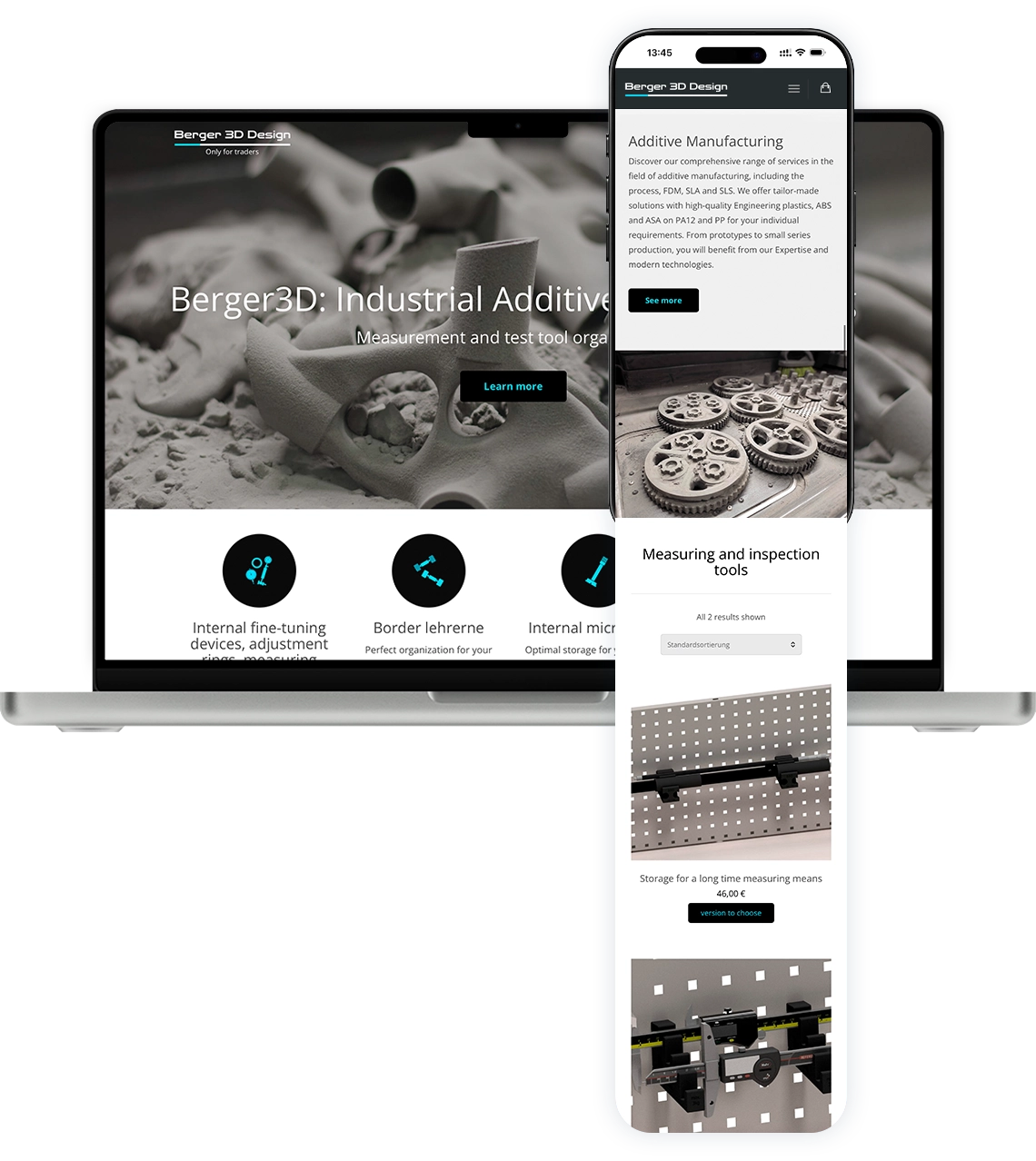
Presentation of the English version of the Berger 3D Design website on a laptop and smartphone

Berger 3D Design

For the Berger 3D Design project, we developed a B2B catalog tailored to the client’s business processes and compliant with German legal requirements.

We created an intuitive product browsing experience and implemented shipping cost calculations.

We also built a strong SEO foundation and made the catalog scalable, allowing it to expand without additional code changes.

CRM integration enabled the client to start accepting B2B orders immediately after launch and grow sales without technical limitations.
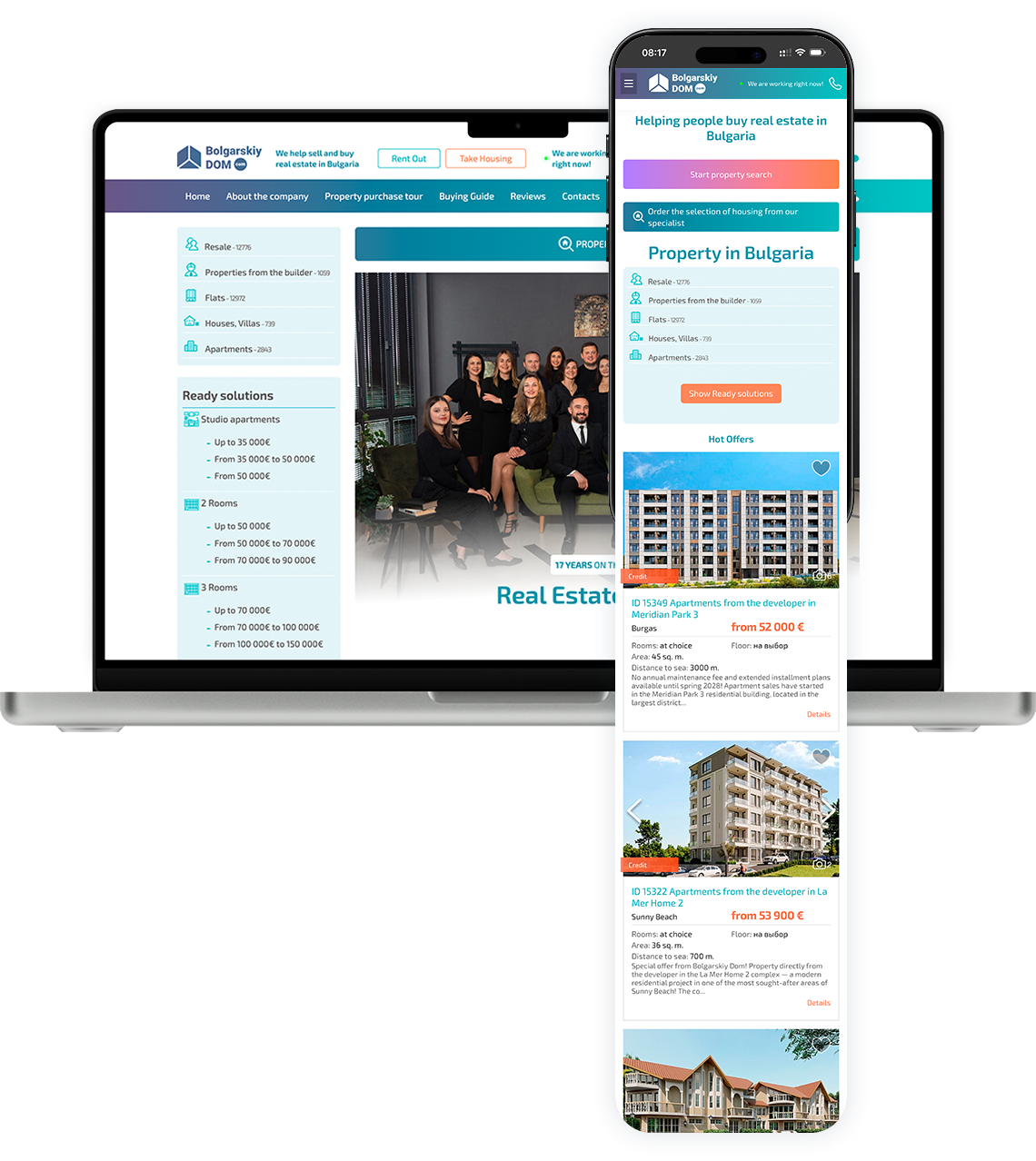
Bolgarskiy Dom real estate website on laptop and smartphone screens

Bolgarskiy DOM

We transformed the real estate agency website into a sales tool. Users can search properties using 22 criteria, browse residential complexes and curated selections, and submit a request for a consultation with a manager.

We integrated AmoCRM, maps, and automatic content translation into five languages. We also streamlined property publishing and lead processing.

We reworked the SEO strategy, helped the website recover from search engine penalties, and created dedicated landing pages for cities, budget ranges, and property types.

As a result, organic search became the company’s primary customer acquisition channel, and the website consistently generates qualified leads.

Bolgarskiy DOM
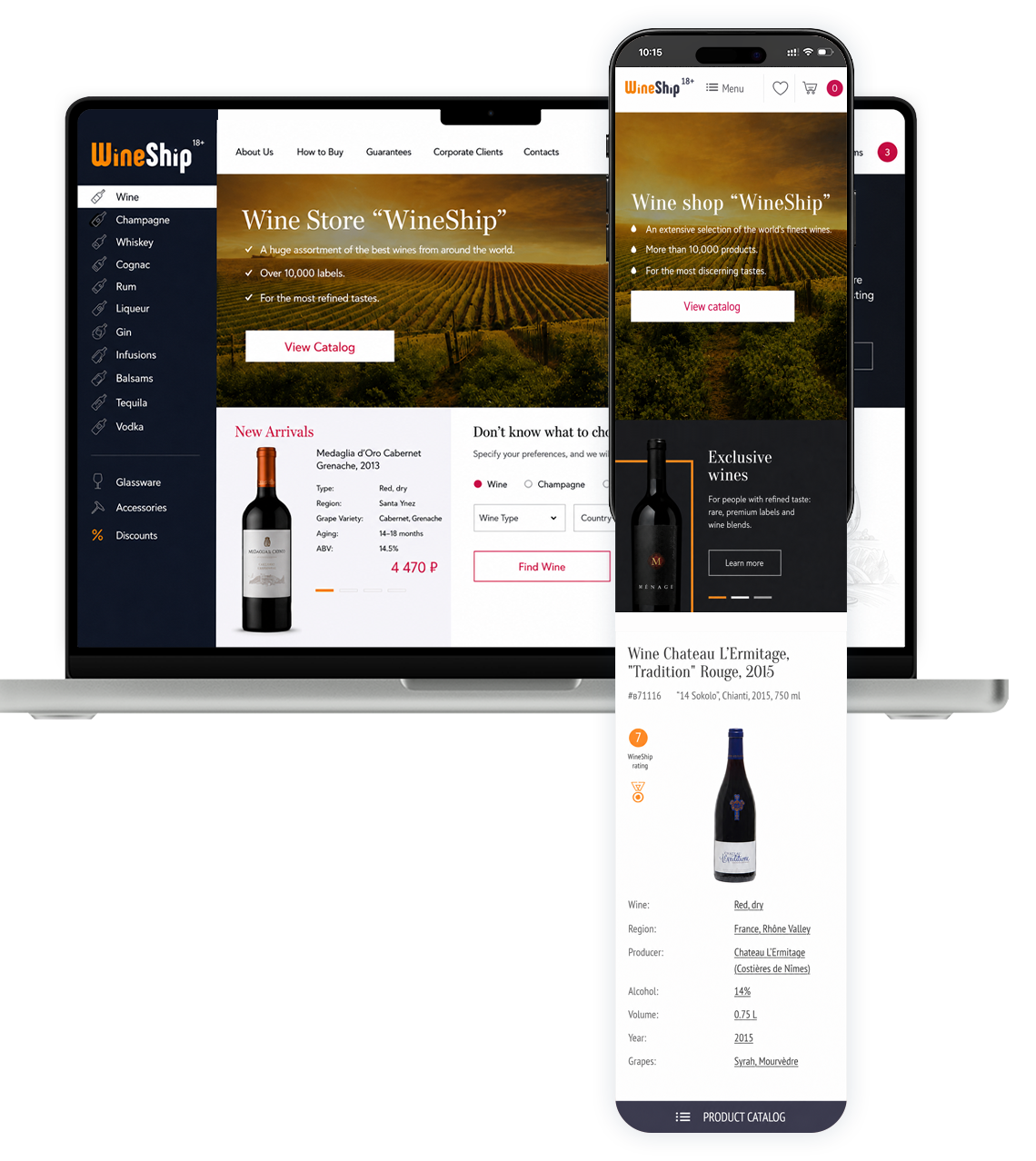
WineShipEN

WineShip

For WineShip, we developed a catalog with more than 2,000 wines and designed a structure that supports different bottle sizes, vintages, prices, and stock levels.

We created user-friendly product pages and flexible filters so customers can quickly narrow down the selection and find the right wine.

We connected product attributes with landing pages and internal linking, laying a solid SEO foundation for scaling the catalog.

As a result, even with a large assortment, users can easily navigate from product selection to checkout.

WineShip
Stages

Catalog Website Development Process

Development starts with the architecture and data model and continues through testing, launch, and system stabilization.

Stage 1
Project Analysis and Requirements Definition
We analyze the market and competitors, define project goals, and determine the catalog structure, data model, and key user journeys.
From 3 business days
Stage 2
Information Architecture
We define the product and category hierarchy, filtering system, and attributes, then structure navigation and SEO so users can find the right items faster and the catalog is easier to promote in search.
From 5 business days
Stage 3
UX/UI Design
We design user journeys and catalog interfaces, create prototypes for key pages, and develop the final responsive design for different devices.
From 7 business days
Stage 4
Backend Development
We build the system’s business logic, APIs for data exchange, admin panel, product data processing, import functionality, and database integrations.
From 15 business days
Stage 5
Frontend Development
We build the catalog interface, including pages, filters, product cards, search, sorting, and responsive layouts.
From 10 business days
Stage 6
Content Population and Data Migration
We upload and structure product data, normalize it, and migrate it from existing systems so large catalogs do not have to be created manually.
From 5 business days
Stage 7
Testing
We test functionality, search, filters, key user journeys, technical SEO, and performance to reduce the risk of issues after launch.
From 5 business days
Stage 8
Post-Launch Support
After release, we monitor catalog performance, identify and resolve errors and bugs, and help maintain system stability.
At least 1–2 weeks
of active post-launch stabilization
Technology

Technology Stack for Catalog Website Development

We select the technology stack based on catalog size, expected traffic, integrations, and future development plans. This helps avoid overinvesting in unnecessary infrastructure while maintaining performance, stability, and the flexibility to scale the system without rebuilding it from scratch.
Backend – Laravel, Go, PHP
We choose technologies based on business logic and expected load so the catalog can reliably handle large product volumes, complex filters, and high numbers of requests.
DevOps – Docker, Kubernetes, CI/CD
We automate deployment and updates, speed up releases, and reduce the risk of errors when changes are introduced.
Frontend – Vue.js, HTML, Tailwind, SCSS
We build fast, responsive interfaces for complex navigation, filtering, and dynamic data.
Architecture and Integrations – Event-Driven Architecture, Webhooks, AI
We design system components so changes in one area have less impact on others. This makes it easier to expand functionality and reduces risks during updates.
Databases – PostgreSQL, MongoDB, ClickHouse
We select data storage solutions based on data type and volume to maintain fast search and stable performance as the catalog grows.
Design and Quality Assurance – UX/UI, QA
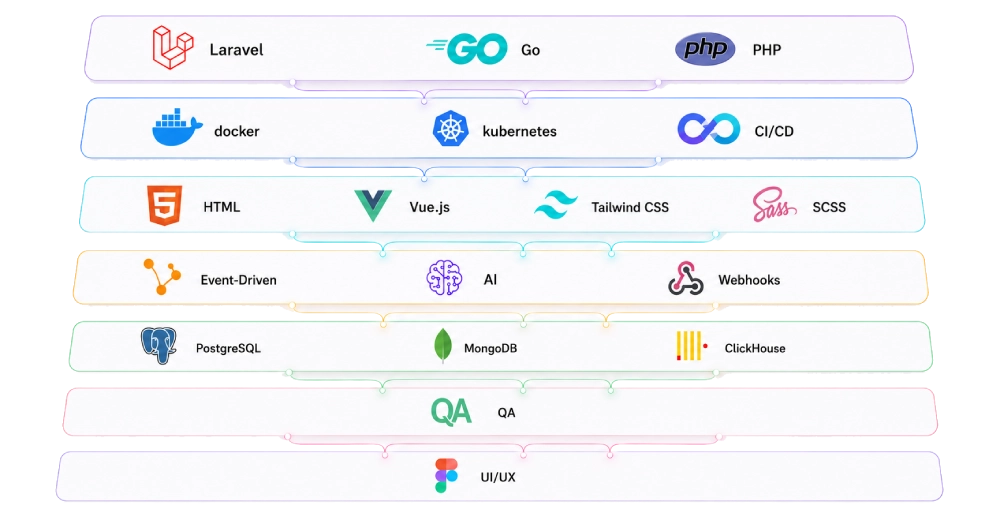
We test key user journeys, interfaces, and system stability to reduce post-launch issues and make the path to conversion as smooth as possible.
technologies
Industries

Industries

Catalog websites serve different purposes across industries. Manufacturers may need detailed technical specifications and documentation, distributors may prioritize fast product updates, while B2B companies often require quote requests and custom terms. We adapt the catalog structure to the product, sales process, and user roles.

Our team has successfully delivered more than 200 projects across a wide range of industries and multiple continents.

Real Estate Real Estate
Dentistry Dentistry
Equipment repair
Crypt
Medicine
IT and SaaS projects
Beauty Beauty
E-commerce
E-commerce
Construction
Tourism
Development

Catalog Website Development in 2026

A modern catalog is no longer just a product database. AI helps personalize search results, automate processes, and identify system issues faster.
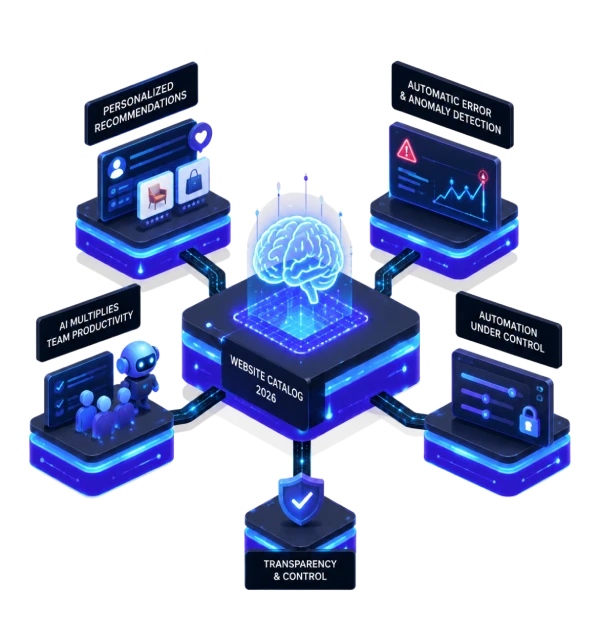
Personalized Recommendations
AI analyzes user behavior, interaction history, and context to deliver more relevant recommendations. This increases engagement, improves the user experience, and helps drive higher conversion rates.
AI-Powered Team Productivity
AI can speed up routine processes by 5–20x, allowing specialists to focus on product design, development, and growth.
Predictive Analytics
Using AI to analyze demand, user behavior, and market trends helps businesses adapt to change faster, keep their offerings relevant, and improve overall efficiency.
Human-in-the-Loop Automation
Developers retain control over key decisions, while AI serves as an assistant. This approach speeds up development while maintaining process transparency and full control over the final result.
Predictive Monitoring
The system monitors service performance for anomalies, helps identify the root causes of failures, and detects potential risks early. This reduces diagnostic time and speeds up issue resolution.
Security

Legal Compliance and Technical Security

We design and develop solutions in line with applicable laws and requirements for data protection and infrastructure security. Our approach is adapted to the client’s jurisdiction. Development processes are structured to reduce legal and operational risks during launch and ongoing operation.

NDA and Confidentiality

All projects are covered by a non-disclosure agreement. Access to repositories, data, and infrastructure is restricted to authorized team members. We use controlled access levels and secure communication channels.

GDPR

For projects targeting the EU market, we follow GDPR principles, including data minimization, clearly defined purposes and retention periods, protection of user rights, secure data processing, and proper handling of analytics and backup systems.

FAQ

Frequently Asked Questions

Before starting a project, clients most often ask about the difference between a catalog website and an e-commerce store, development timelines, pricing, integrations, and how product data will be updated. Below are answers to the main questions that can help determine the right development approach.

How is a catalog website different from an e-commerce store?
A catalog website is designed to present and organize a large number of products, services, or listings in a user-friendly way. Unlike an e-commerce store, it can operate without a shopping cart or online payment functionality. Users can choose an option, submit an inquiry, request pricing, or contact a sales representative.
Who is a catalog website right for?
Catalog websites are a good fit for companies with large or complex offerings where users need to compare options based on specific characteristics. This includes B2B companies, manufacturers, suppliers, distributors, real estate agencies, and service providers.
How much does catalog website development cost?
Pricing is calculated individually after evaluating the website structure, functionality, and data volume. The cost depends on the number of page and product types, the complexity of search and filtering, design requirements, integrations, data migration, multilingual functionality, and SEO requirements.
Can you migrate existing product data and integrate external business systems?
Yes. We migrate products and their attributes from Excel, existing websites, and systems such as NetSuite, Microsoft Dynamics 365, SAP, and Acumatica. We also integrate catalog websites with CRM, ERP, PIM, and other business systems to automate data exchange. If needed, we structure and normalize the data before migration.
How will employees update the catalog after launch?
Through the admin panel. Employees can add and edit products, attributes, categories, images, and other content without involving a developer. For large data volumes, we can also set up bulk imports or automated synchronization.
Can we hide prices and collect requests for quotes instead?
Yes. Instead of displaying a fixed price, the website can include a button to request pricing, a quote, or a consultation. This approach is common in B2B projects and in cases where pricing depends on configuration, order volume, or delivery terms.
Can we add a shopping cart later and turn the catalog into an e-commerce store?
Yes, but this should be planned into the project architecture from the start. This makes it possible to add a shopping cart, checkout, online payments, customer accounts, and other e-commerce functionality later without rebuilding the entire website.
How is a catalog website prepared for SEO?
SEO is built into the project from the planning stage. We define the category and landing page structure, URLs, internal linking, metadata, and indexing rules. We also account for filters and catalog parameters to avoid creating large numbers of duplicate or low-value technical pages.
How is post-launch support handled?
After launch, we monitor catalog stability, fix any issues that are identified, and verify that key functionality works as expected. Ongoing support can then continue with system updates, feature development, and adaptation to new business requirements.
Do you monitor website performance and loading speed?
Yes. We aim for very fast system response times, up to 300 milliseconds for most operations, so interactions with the website stay fast and responsive.
Do you provide warranty support for catalog websites?
Yes. We follow a Service Level Agreement (SLA) for support and maintenance of the released product. In the event of a service outage, our team typically responds within approximately 20 minutes, with recovery targeted within 4 hours. Once the system is stabilized, we perform an in-depth root cause analysis and prepare a plan to help prevent similar incidents from recurring. Hosting, servers, and third-party APIs remain the client’s responsibility.
Contacts

Ready to Discuss Your Project?

Tell us about your product offering, current systems, and what you need the future catalog to accomplish. We’ll recommend an approach to the site structure, integrations, and SEO, estimate the timeline, and prepare a development cost estimate.

One of our specialists will contact you within two hours of submitting your request to discuss the project requirements. Following the conversation, we’ll prepare a proposal outlining the estimated cost and project timeline.

TERMINOLOGY

Glossary

Throughout this discussion of online catalog development and technical architecture, we used the following key terms:

*
SEO (Search Engine Optimization) — the process of improving a website’s visibility in search engines and increasing organic traffic.
*
B2B (Business-to-Business) — a business model in which a company sells products or services to other businesses rather than directly to consumers.
*
CRM (Customer Relationship Management) — a system used to manage customers, leads, inquiries, communications, and sales processes.
*
ERP (Enterprise Resource Planning) — a system used to manage core business processes such as finance, purchasing, inventory, sales, and resource planning.
*
PIM (Product Information Management) — a system for centrally managing product data, including attributes, descriptions, images, and other catalog information.
*
API (Application Programming Interface) — a connection that allows a website to exchange data with CRM, ERP, PIM, and other business systems.
*
Webhooks — a mechanism that automatically sends data from one system to another when a specific event occurs.
*
CSV (Comma-Separated Values) — a file format commonly used to import and export structured data such as product lists, prices, and inventory.
*
UX/UI (User Experience / User Interface) — the design of user journeys and interfaces to make a website intuitive, clear, and easy to use.
*
Backend — the server-side part of a website responsible for business logic, data processing, integrations, and database operations.
*
Frontend — the user-facing part of a website, including pages, product cards, filters, search, navigation, and other interactive elements.
*
Information Architecture — the way website content, categories, navigation, and pages are organized so users and search engines can easily understand the structure.
*
Data Model — the structure that defines how products, attributes, categories, and other types of data are organized and connected within the system.
*
Data Migration — the process of transferring data from existing websites, files, or business systems to a new platform.
*
Responsive Design — an approach that adapts website layouts and interfaces to different screen sizes and devices.
*
DevOps — practices and processes used to automate deployment, updates, and reliable system operation.
*
CI/CD (Continuous Integration / Continuous Delivery) — automated processes for testing, building, and releasing new software versions.
*
Event-Driven Architecture — an architecture in which system components respond to events and exchange information without being tightly dependent on one another, making integrations and scaling easier.
*
QA (Quality Assurance) — the process of testing functionality, usability, stability, and overall product quality before launch and during future updates.
*
AI (Artificial Intelligence) — technology used to support tasks such as automation, data analysis, personalization, recommendations, and system monitoring.
*
Human-in-the-Loop — an approach in which AI supports or automates certain tasks while important decisions and final oversight remain with human specialists.
*
Conversion — a desired action completed by a website visitor, such as submitting an inquiry, requesting a quote, or completing a purchase.
*
GDPR (General Data Protection Regulation) — the European Union regulation governing the collection, processing, and protection of personal data.
*
NDA (Non-Disclosure Agreement) — a legal agreement used to protect confidential and non-public information.
*
SLA (Service Level Agreement) — an agreement that defines service and support standards, such as response and recovery times.
cookies We use Cookies

We use cookies to improve website performance, personalize content, and analyze traffic. You can choose which categories of cookies to allow. For more information, please see our Cookie Policy. You can change your preferences at any time.

Essential (Required)

Ensure the website functions properly (navigation, access to secure areas). Always enabled and can only be changed in your browser settings.

Analytics

Help us understand how you use the website so we can improve our services. Do not collect personal data. We use several analytics tools for this purpose.

Advertising

Used to deliver personalized ads and measure the effectiveness of advertising campaigns.

On this site we also use the OpenAI measurement pixel for ChatGPT Ads. It stores a first-party identifier named __oppref in your browser. When you send us an enquiry, a hashed form of your email address and phone number may be transmitted to OpenAI in the USA so that the enquiry can be attributed to the ad you clicked; we never transmit them in readable form.