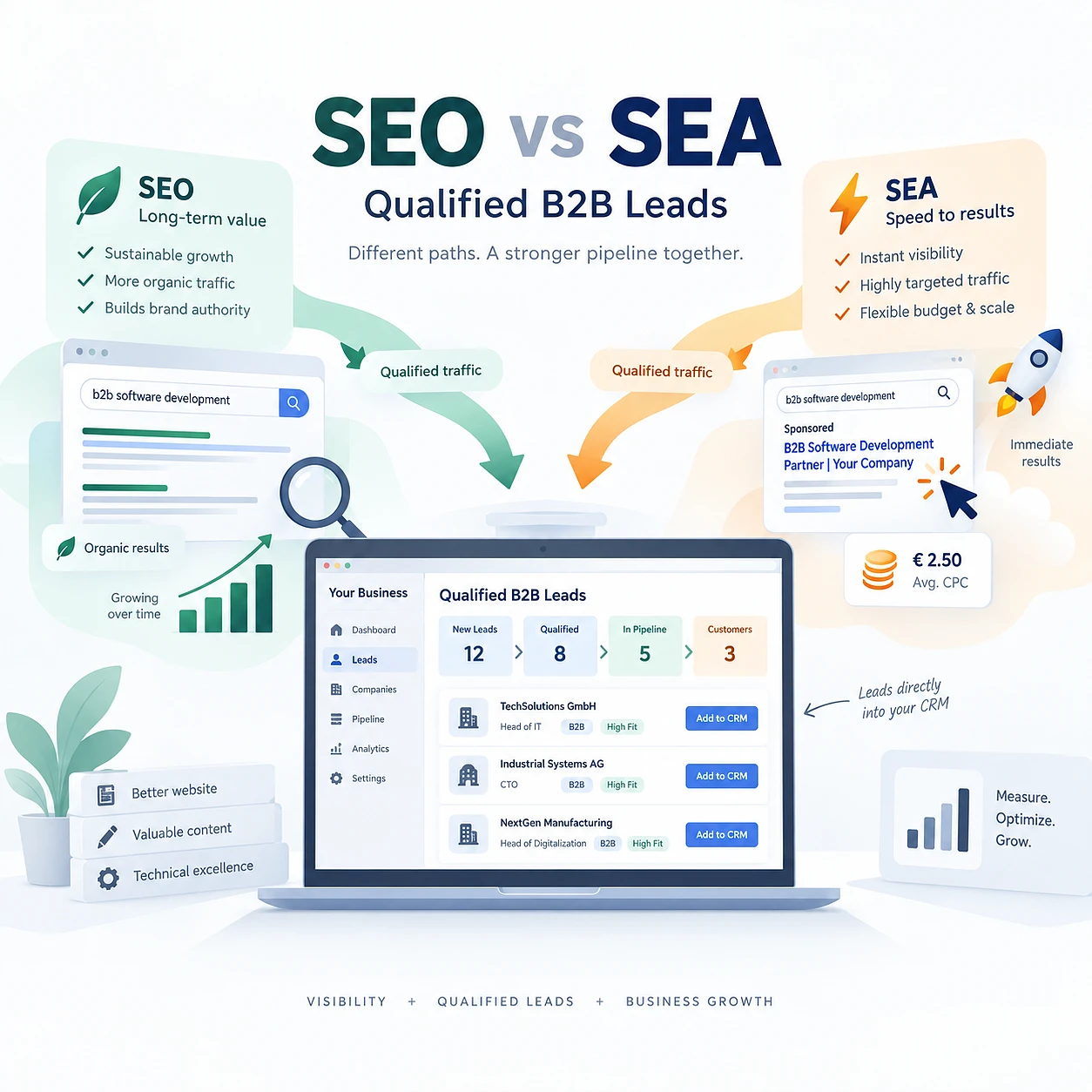
How to Evaluate an SEO Agency: KPIs & Results
Positive SEO reports but flat sales? This review method checks five levels, from delivered work to profit, with a reporting checklist, CPQL math, 15 agency questions, and a CRM cross-check to show where results stall.

Start With Evidence Behind the Report
An SEO agency review should check four things in order: proven work, non-branded traffic to commercial pages, qualified leads, and closed deals. This is how to evaluate an SEO agency when its reports look positive but sales stay flat. Rankings and traffic help diagnose performance. The agency shares responsibility for sales with your website and sales team.
A rising traffic chart alongside an unchanged sales pipeline is a reason to investigate. It does not prove poor work. At Webdelo, our approach to reviewing seo connects the agency's deliverables to website behavior and customer records.
The goal is to find where progress stops. You can then decide whether to keep the agency, change its priorities, or replace it.
Why Rankings and Traffic May Not Lead to Sales
Search visibility creates opportunities for visits, but sales depend on what happens next. Buyer intent, landing pages, lead tracking, and sales follow-up all affect the result. Seasonality and long B2B buying cycles also delay the connection between a search visit and revenue.
- Wrong intent: an article explaining what inventory software does may attract students and researchers. A page about inventory software integration is closer to a purchasing decision.
- Weak landing pages: visitors cannot tell whether the product fits their needs or how to request a consultation.
- Broken handoffs: a form submits successfully, but the inquiry never reaches the sales team.
- Slow follow-up: a suitable prospect contacts the business and receives no useful response.
- Timing: a prospect researching this quarter may not sign until a later budget cycle.
The conversion path also depends on the website's purpose. A corporate website may need to explain complex services before a buyer requests a proposal. An ecommerce website may need clear account terms and a working checkout before a business customer can order.
AI Overviews and other search features can answer questions without a website visit. Work on geo, or generative engine optimization, concerns visibility in AI-generated answers, which needs separate evaluation. If organic visits fall, compare organic conversions year over year in Google Analytics 4 (GA4) before concluding that SEO has failed.
Five Levels of SEO Performance and Responsibility
For longer sales cycles, see our guide to B2B SEO strategy.
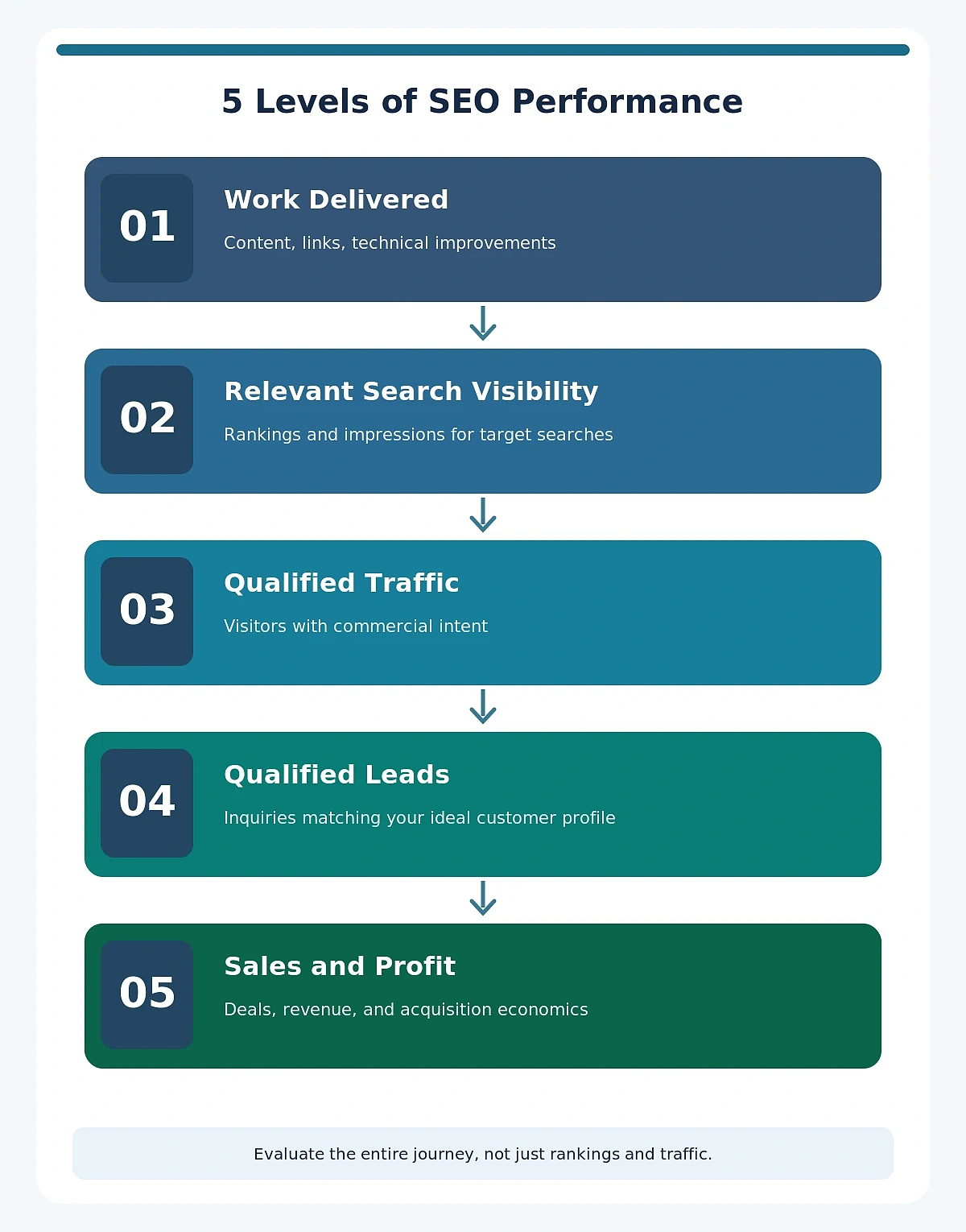
SEO performance connects delivered work to business outcomes through several measurable stages. The agency controls its own deliverables and influences search visibility and relevant traffic. Lead quality, sales, and profit depend on the website and sales process as well.
Judge delivery against the agreed scope. An agency can provide a sound recommendation while implementation waits for approval or a development release. Record who owns the next action, including any Web Development work needed to make the change live.
Many reports stop at completed tasks and rankings. We want to see how far the evidence extends toward revenue. Non-branded traffic means visits associated with searches that do not name your company or brand, but traffic alone still cannot confirm that visitors are suitable buyers.
Check the five levels in order: work delivered, search visibility, qualified traffic, qualified leads, and sales and profit. Find the first stage where progress breaks down before assigning responsibility for the stages above it.
What Monthly SEO Reporting Must Include
A useful monthly SEO report connects completed work to relevant traffic, inquiries, and lead status. It explains why the numbers changed and identifies next month's priorities. A dashboard export without interpretation leaves the business to do that work itself.
| Metric in the report | What to check | Data source |
|---|---|---|
| Rankings | Relevant commercial queries, target locations, and landing pages. Separate branded searches from searches for your services. | Search Console and the agreed rank-tracking tool |
| Traffic | Organic visits to commercial pages and non-branded search clicks. Compare equivalent periods and explain seasonal changes. | GA4 for visits, Search Console for queries and clicks |
| Leads | Form submissions and calls, duplicates, qualification status, rejection reasons, and resulting opportunities. | GA4, form or call records, and CRM |
| Articles | Published URLs, intended audience, search intent, and relevant next steps for readers. | Live pages, content briefs, and Search Console |
| Links | Live linking pages, relevance, acquisition method, and destination URLs. | Source pages and the agency's link records |
| Work delivered | What changed, whether it is live, and what remains blocked or awaits approval. | Tickets, changelogs, release records, and live URLs |
Proof should make a claim easy to verify. "Updated service pages" needs URLs and a record of the changes. "Fixed lead tracking" needs a successful test from the form through to the customer relationship management system, or CRM.
Keep direct access to Search Console and GA4 so you can inspect progress between reports. Question a package that repeats the same tasks regardless of results. A "proprietary method" is not a sufficient explanation for withholding information about work performed on your website.
Measuring SEO ROI and Qualified Leads
For more on budgeting, read how much SEO costs.
SEO ROI measurement requires agreed costs, qualified leads, and profit from attributable customers. Cost per lead shows inquiry volume relative to spending. Cost per qualified lead adds a quality check, while acquisition cost and return require enough time for deals to close.
Define qualification with sales before measuring SEO lead quality. A marketing-qualified lead (MQL) meets agreed marketing criteria. A sales-qualified lead (SQL) has passed the sales team's assessment. Choose which stage your report uses and apply it consistently in your crm.
CPL, CPQL, and CAC in Plain Terms
- CPL, cost per lead: SEO cost divided by all leads attributed to SEO.
- CPQL, cost per qualified lead: SEO cost divided by qualified leads attributed to SEO.
- Simplified SEO acquisition cost: SEO cost divided by new customers attributed to SEO. Full customer acquisition cost (CAC) also includes other relevant marketing and sales costs.
A low CPL can hide a poor result if most inquiries fail qualification. CPQL helps reveal that problem. Keep rejection reasons such as wrong geography or unsuitable requirements so the agency can adjust its targeting.
A Hypothetical Example of Simple SEO ROI
The following numbers are made up for illustration. They are not a Webdelo client case or a full ROI calculation. Assume the leads and customers belong to the same tracked group of visitors and have had enough time to convert.
| Metric | Value |
|---|---|
| SEO cost | $3,000 |
| Visits | 10,000 |
| Leads | 40 |
| Qualified leads | 8 |
| Customers | 2 |
| Gross profit before SEO cost | $5,000 |
| CPL | $75 |
| CPQL | $375 |
| Simplified CAC, SEO cost only | $1,500 |
| Simplified return | 66.7% |
The simplified return is ($5,000 - $3,000) / $3,000 × 100 = 66.7%. It uses gross profit rather than revenue and subtracts only the stated SEO cost. Additional acquisition costs would change the result.
Attribution and Time Lags
Attribution means deciding which interactions receive credit for a conversion. A buyer may discover you through organic search, return through an ad, and contact sales during a direct visit. Last-click attribution can give the final visit all the credit and hide SEO's earlier contribution.
Connect SEO reporting with your wider digital marketing measurement. Preserve the original source and later interactions where tracking and consent allow. Compare quarterly lead groups through to closed deals rather than dividing this month's spending by customers first acquired months ago.
15 Questions That Make SEO Agency Performance Verifiable
Ask your agency for evidence across strategy, reporting, analytics, leads, and management. Strong answers identify specific pages, records, and decisions. These questions also expose where your own team needs to supply information or remove a blocker.
Strategy
- Which commercial queries and pages are the priority, and why do they match our buyers?
- What are the three main tasks for next month, and what problem will each address?
- How do you analyze competitors' keywords and account for intent, location, and relevance?
The University of Arkansas small business center's evaluation guidance highlights competitor keyword research and search intent. A keyword list needs a business rationale beyond search volume.
Reporting
- What changed this period, and what evidence supports your explanation?
- Where can we verify the published content, implemented fixes, and other completed work?
- How often will we receive updates, and which decisions should each report support?
Analytics
- Do we own and have full access to Search Console, GA4, and the website?
- Which actions count as conversions, and how have you tested them?
- How do you separate branded and non-branded search performance, and what data is missing?
Leads
- Which leads from last quarter can we reasonably attribute to SEO?
- Which landing pages contribute to revenue, and what query-level evidence supports your targeting?
- How do our margins, buying cycle, and buyer profiles affect your recommendations?
Management
- Who performs the work, and can we discuss decisions with that person?
- How do you earn links and authority without purchasing ranking links or using private blog networks?
- Is any work happening on satellite or white-label sites rather than our own domain, and who owns those assets?
A private blog network, or PBN, is a group of sites used to manipulate rankings through links. Also be cautious about precise revenue claims for individual search queries. Standard Search Console and GA4 reports do not provide a direct query-to-customer connection.
How to Audit an SEO Agency Against Independent Evidence
An independent SEO agency review checks the monthly report against delivered work, Search Console, website analytics, and CRM sales records. Its purpose is to separate agency performance from website and sales problems. The evidence should support one of three decisions: continue, revise KPIs, or change agency.
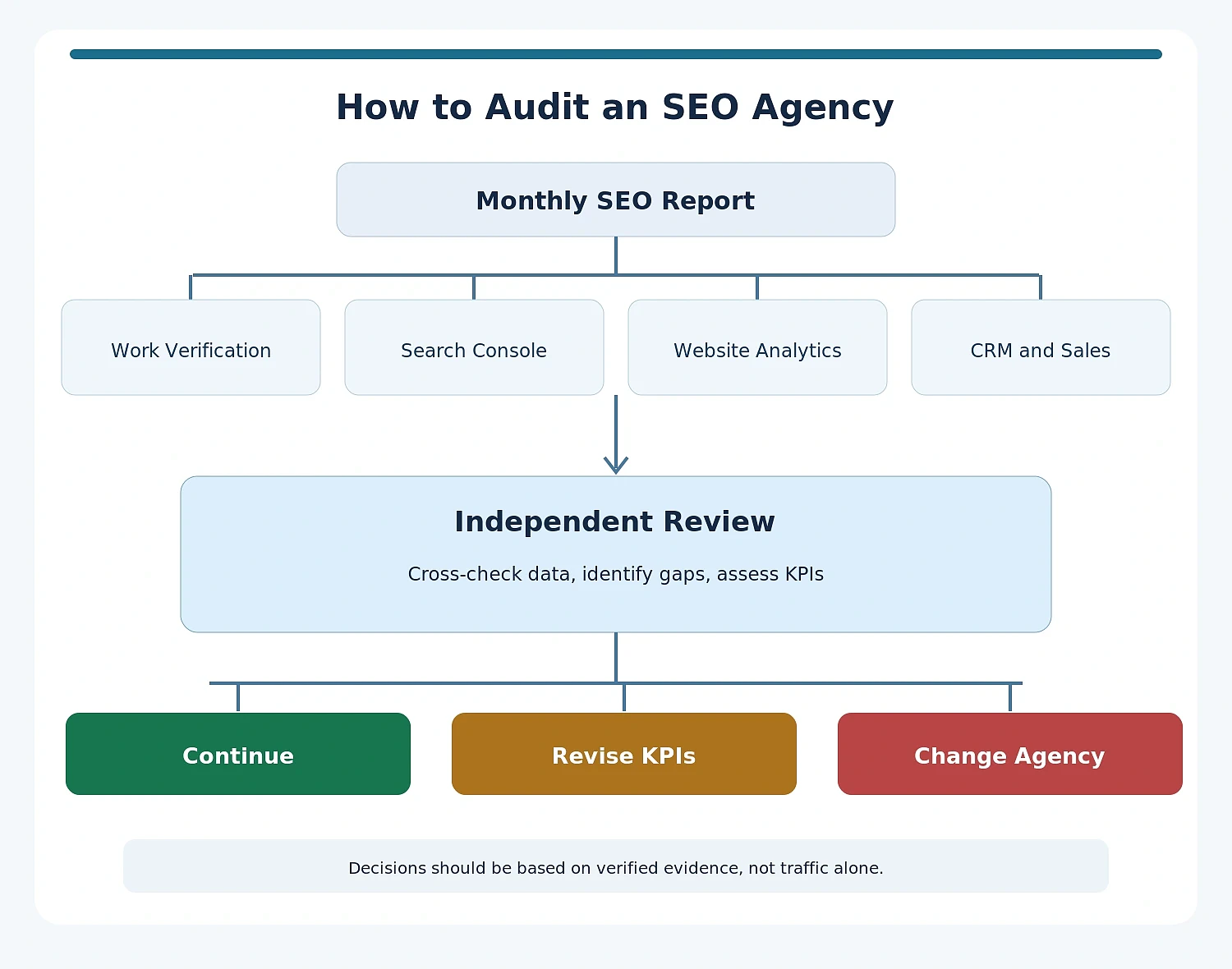
Verify the Delivered Work
Open the URLs and tickets listed in the report. Confirm that content and fixes are live on your domain. Separate recommendations, approved tasks, and deployed changes so unfinished implementation is visible.
Check ownership of any separate landing pages or white-label sites. The University of Arkansas guidance on agency transparency specifically raises these assets and client access to analytics as review points. Establish what your business retains if the relationship ends.
Technical blockers need a named owner. A deployment or hosting issue may require capabilities such as Webdelo DevOps and Infrastructure. Record that dependency separately from the SEO recommendation so the review identifies the actual source of delay.
Check Search Console and GA4
In Search Console, inspect clicks and impressions for commercial pages. Exclude known brand terms and spelling variants when reviewing non-branded queries. Some query data is unavailable, so treat the split as an estimate.
In GA4, compare organic conversions year over year using equivalent definitions. Test important key events, the actions marked as valuable in analytics. Confirm that one successful inquiry does not generate duplicate events.
Search Console clicks and GA4 sessions measure different things, so their totals need not match. Investigate unexplained changes rather than forcing the figures into agreement.
Match Analytics With the CRM
If existing software cannot connect leads to deals, assess whether CRM development or integration is needed.
Trace a sample of organic inquiries from submission to CRM record, qualification, and deal outcome. Check duplicates and missing source fields. If the records disagree, fix the measurement gap before making a performance judgment.
For suitable leads that did not close, inspect response times and rejection reasons with sales. If the website-to-CRM connection fails, involve a technical owner. Our leadership team includes Webdelo CTO Andrew Popov, reflecting the engineering responsibility behind these integrations.
When Missing Sales Are Explainable and When to Intervene
Missing sales can be understandable early in an engagement or during a long buying cycle. Waiting is reasonable when work is verifiable and earlier stages show relevant progress. Missing evidence, restricted access, or risky tactics require intervention regardless of the campaign's age.
A three-to-six-month window is a rough planning reference for initial SEO progress, not a promise of revenue. Seasonal comparisons and the length of your sales cycle matter more than a fixed deadline. Falling traffic with stable qualified leads also deserves a different interpretation from falling traffic and falling demand.
- Review progress: relevant pages gain visibility, implementation moves forward, and the agency explains what remains blocked.
- Reset priorities: traffic grows mainly on topics unrelated to your buyers, or lead rejection reasons show poor targeting.
- Intervene immediately: the agency withholds account access, promises a guaranteed number-one ranking, or uses hidden text and manipulative links.
Before assigning blame for missing leads, submit the forms yourself and check the handoff to sales. A broken form can make useful traffic appear worthless.
Keep the Agency, Reset SEO KPIs, or Change Partners
Your decision should follow the evidence from the review. Keep an agency that delivers transparent work and relevant progress. Reset its goals when targeting is wrong, and change partners when transparency or trust breaks down.
- Keep: agree on lead-quality key performance indicators (KPIs) and review quarterly CRM outcomes together. Assign owners to website and sales blockers.
- Reset: replace ranking-only goals with non-branded traffic to commercial pages, qualified leads, and CPQL. Specify the qualification standard and review period.
- Change: secure ownership and access before terminating the relationship. Retain content, analytics history, website credentials, and records of completed work.
Document the decision in a short action plan. Each issue needs an owner, a next step, and evidence that will show whether the change worked.
Expert Opinion: Reports Should Explain What to Do Next
For a deeper technical review, use the Webdelo SEO audit checklist.
Andrei Jumatii, Founder and Marketing Director at Webdelo, treats rankings and traffic as diagnostic tools. Lead quality completes the assessment and helps executives decide where to invest or intervene.
"A good SEO report should explain three things to an executive: what has changed, how it has affected the acquisition of potential customers, and what decisions should be made next. Rankings and traffic help diagnose the situation, but without data on lead quality they do not give a complete picture of SEO performance."
At Webdelo, this means ending the review with the decisions it supports. A repeated objection from qualified prospects may call for clearer service pages. Missing inquiries in the CRM call for a tracking or integration fix.
To get an independent view, discuss your current SEO, analytics, lead quality, and strategy with Webdelo through our seo site audit service. Agree on the review scope and available CRM evidence before work begins.
Evaluate Progress From Delivered Work to Profit
Judge your agency by proven work, relevant traffic, qualified leads, and business results. Check the five levels in order and assign responsibility where progress stops. The agency, website team, and sales team each influence the outcome.
Use CPQL and CRM records to test lead quality over an appropriate sales cycle. Then choose whether to continue, reset priorities, or change agencies based on evidence you can verify.
Frequently Asked Questions
How do you evaluate an SEO agency when reports look good but sales stay flat?
Check four things in order: proven work, non-branded traffic to commercial pages, qualified leads, and closed deals. Find the first stage where progress stops before you assign responsibility. Rising traffic with a flat pipeline is a reason to investigate, not proof of poor work.
Is an SEO agency responsible for sales?
Not alone. The agency controls its deliverables and influences search visibility and relevant traffic. Lead quality, sales, and profit also depend on landing pages, lead tracking, and how quickly the sales team follows up. A fair review separates agency work from website and sales problems.
Which SEO KPIs and metrics should a monthly report include?
A useful report shows completed work with proof, non-branded traffic to commercial pages, inquiries, and their CRM qualification status. It should explain why numbers changed and list next month's priorities. Rankings are diagnostic; better KPIs are qualified leads and cost per qualified lead (CPQL), using a qualification standard agreed with sales.
Why does SEO traffic grow but bring no leads or sales?
Common causes are content with the wrong search intent, weak landing pages, forms that never reach sales, slow follow-up, and long B2B buying cycles. Seasonality and AI answers in search can also change visit numbers. Before blaming the agency, submit your own forms and check that inquiries arrive in the CRM.
How do you use the CRM to check SEO lead quality?
Trace a sample of organic inquiries from submission to CRM record, qualification, and deal outcome, checking for duplicates and missing source fields. Record rejection reasons such as wrong geography so the agency can adjust targeting. Compare quarterly lead groups through to closed deals instead of matching this month's spend to customers acquired months ago.
When should you change your SEO agency?
Intervene immediately if the agency withholds account access, guarantees a number-one ranking, or uses hidden text, manipulative links, or private blog networks. If the work is transparent but targets the wrong topics, reset KPIs instead of switching. Before ending the contract, secure content, analytics history, website credentials, and records of completed work.
How do you run an independent review of an SEO agency?
Compare the monthly report with four independent sources: live URLs and tickets, Search Console, GA4, and CRM sales records. Confirm that changes are live on your domain, review non-branded clicks to commercial pages, and test key events in GA4. The result should support one decision: continue, revise KPIs, or change agency.