



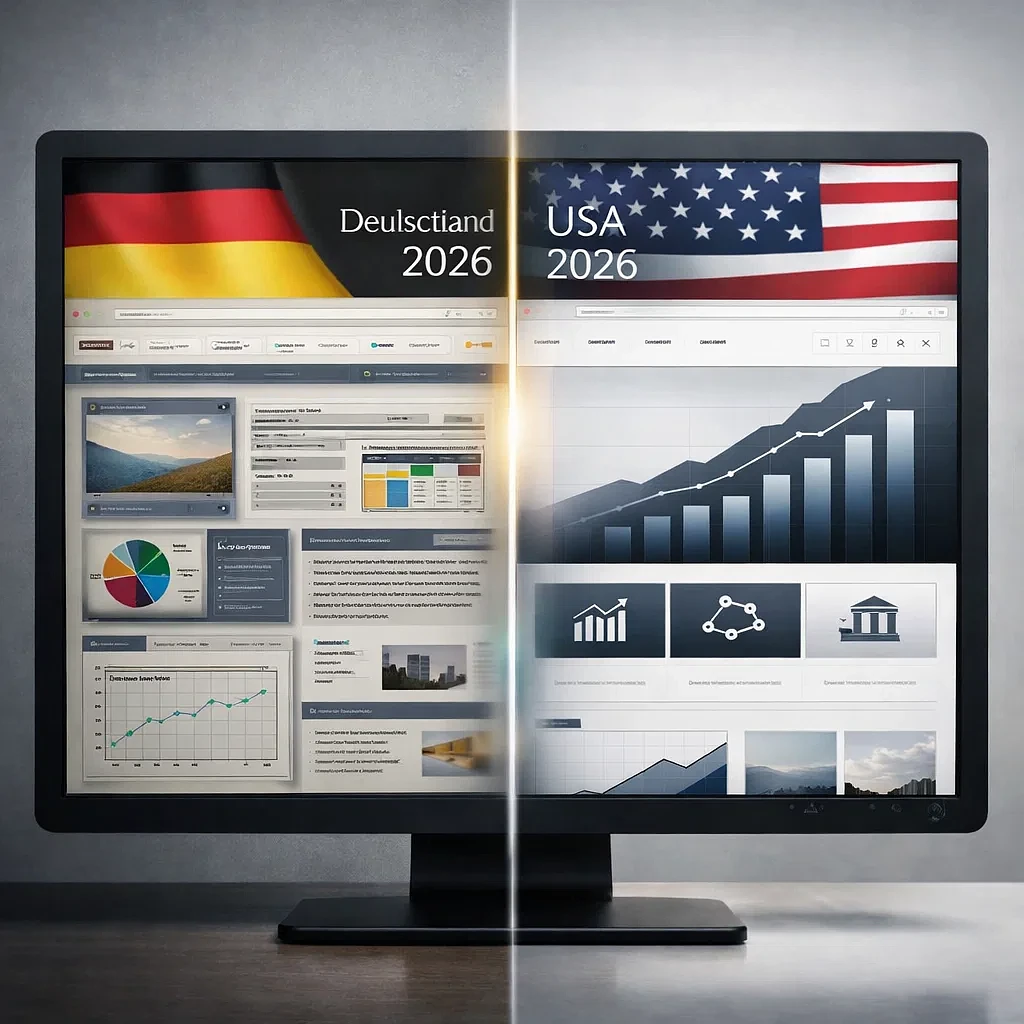
Introduction
One of the most common mistakes when entering a new market is translating the website and waiting for results. The translation is done, the budget is spent, but no leads come in. The problem is not the language. The problem is that the site still speaks to the audience by the rules of a different market.
Adapting a B2B website for Germany or the US is not a language task. It is about how the audience makes decisions, what they trust, which legal elements they expect to see, and how quickly they are ready to take the next step. Both Germany and the US are mature markets with a solvent B2B audience. But they operate on fundamentally different buying logic.
According to McKinsey (2024), about 80% of the B2B buyer's journey is completed before first contact with the sales team. The website is the first and often the most important evaluation moment. 6sense (2025) confirms that the vendor who wins the shortlist stage becomes the final deal winner in 77% of cases. This means the website either works or fails - long before a sales rep picks up the phone.
At Webdelo, we are locally present in both Germany and the US, operate in both legal systems, and serve clients in German, English, and other languages. In this article, we share what we see in practice: how B2B buyer logic differs between the two countries, what specifically needs to change on a website for each market, which mistakes to avoid, and which laws to account for.
Why the Same Website Does Not Work in Both Germany and the US
When a company enters a new market, the website becomes its first representative. And here is where the problem starts: what works in one context can actively hurt in another.
A German B2B buyer builds trust gradually. They read carefully, look for details, check legal transparency, and want to understand the process before taking a step. The sales cycle in Germany averages 6 to 12 months. An American buyer acts differently: they expect a clear value proposition within seconds, are ready for self-service evaluation, and make decisions faster. The sales cycle in the US is 3 to 6 months.
These are not cultural stereotypes. These are observable behavioral patterns that directly affect how a website should be structured. A German buyer landing on an American conversion-focused page with a large CTA and minimal detail will see it as superficial and unreliable. An American buyer opening a detailed German site with long descriptions and cautious wording will not understand the value quickly and will leave.
McKinsey's B2B Pulse study (2024) identifies the "rule of thirds": at any buying stage, roughly one-third of B2B buyers prefer offline contact, one-third prefer remote interaction, and one-third prefer digital self-service. The website has become a full sales channel, not just a company brochure. This means the site must work without a sales rep - and it must work differently for different markets.
The International Trade Administration (ITA) defines website localization as adapting a web resource for a specific market, accounting for language, culture, legal requirements, and audience behavior. This is not page translation - this is changing the logic of the site.
| Parameter | Germany | US |
|---|---|---|
| Sales cycle | 6-12 months | 3-6 months |
| Trust is built through | Details, legal transparency, process | Social proof, quick value understanding |
| CTA expectations | Contextual, after trust is established | Direct, early, self-service |
| Communication style | Formal, precise, fact-oriented | Direct, results-oriented |
| Main website goal | Prove reliability and competence | Communicate value and simplify the next step |
How the German B2B Audience Differs from the US Audience
Understanding your audience means understanding who exactly you are talking to on the website. A common mistake when entering a new market is projecting the image of your home-market buyer onto a market where that image does not work.
Germany: The Mittelstand Market
According to Destatis (the German Federal Statistical Office), 99.3% of companies in key sectors of the German economy are small and medium-sized enterprises (Mittelstand). 53% of all employees work in them. This means the typical German B2B buyer is not a corporate procurement officer at a huge enterprise but a practical manager or owner of a mid-sized business. They make decisions carefully, often personally, with accountability for the outcome.
German buyers value predictability and specificity. They read the details - process descriptions, project scope, implementation examples. Hype and marketing superlatives ("best," "revolutionary," "fastest") trigger skepticism, not interest. Another important point: logos of well-known international companies in a "our clients" section do not work well - German buyers trust recognizable local names more.
According to Destatis (2024), 83% of internet users in Germany made online purchases. The German audience is digitally mature, and precisely because of that, it is demanding: they know how to spot signs of an unreliable website.
US: A Fragmented Market
The picture in the US is fundamentally different. According to the SBA Office of Advocacy (2024), there are 34.8 million small businesses in the United States. The American market is far more segmented: the definition of "small business" varies by industry - sometimes by employee count, sometimes by revenue (SBA Size Standards). There is no unified Mittelstand - there are many industry segments with different buying logic.
The American B2B buyer is used to a faster pace. They expect to understand the value proposition in seconds, compare you with alternatives, and quickly find a path to the next step - whether it is a demo, trial, or short form. Social proof works differently here: specific numbers ("37% conversion growth"), recognizable client logos, and testimonials with real names and titles matter.
| Parameter | Germany | US |
|---|---|---|
| Market structure | Homogeneous Mittelstand (99.3% SMEs) | Fragmented, 34.8M businesses, by industry |
| Typical buyer | Cautious mid-market business leader | Fast-evaluating decision-maker |
| Attitude toward details | Reads carefully, values depth | Scans, looks for a quick "what do I get" answer |
| Social proof | Local names, specific process | Logos, numbers, testimonials with names |
| Online activity | 83% made online purchases (mature audience) | Accustomed to digital self-service |
Trust on a Website: What It Looks Like in Germany vs. the US
Trust is what makes a buyer stay on the site, dig deeper into the content, and ultimately submit a request. The problem is that trust signals in Germany and the US are literally different things.
How Trust Is Built in Germany
The German market trusts legal transparency. If the site lacks a proper Impressum (mandatory company information page) or the Datenschutzerklarung (privacy policy) looks like a placeholder, that is an immediate signal: the company either does not understand the German market or is hiding something. Neither builds trust.
Next come process details: what exactly is included in the service, what a typical project looks like, the steps, timelines, and formats. A German buyer does not want to guess. They want to understand who they are dealing with before leaving their contact information.
Technical signals matter too. Fast loading, no errors, clean layout - this is not just UX, it is a direct signal of professionalism in the German perception. A slow or broken site says: "things are not working properly inside either."
How Trust Is Built in the US
In American B2B, trust is built differently. Social proof - client logos, testimonials with names and titles, case studies with concrete results - is the baseline. Without them, the site looks like "a newcomer with no track record."
A clear value proposition is also a trust signal: if a company cannot clearly explain what it does and for whom, that suggests a lack of maturity. The American buyer is used to strong headline copy and expects it.
From our experience with projects spanning both markets: an American company entering Germany often arrives with a site that has a perfectly built conversion layer for the US - and is surprised by poor results in Germany. The German audience does not respond to CTAs until trust is established. And trust requires details, transparency, and legal diligence.
| Trust signal | Germany | US |
|---|---|---|
| Legal page | Required (Impressum, Datenschutz) | Important but less formalized |
| Process description | Detailed, with scope and steps | Brief, focused on results |
| Social proof | Local names, realistic claims | Logos, numbers, real people's names |
| Technical quality of the site | Direct signal of reliability | Important but less critical |
| Tone of voice | Formal, restrained | Direct, confident, friendly |
Website Structure, Messaging, and CTAs: What Works in Germany vs. the US
Page architecture and how elements are emphasized is one of the key factors in adaptation. No translation will help if the website structure was built for a different audience.
Content Depth
In Germany, a website can and should go deeper. Detailed service pages with methodology descriptions, timelines, examples of deliverables, and answers to expected questions - this is not "too much text." This is what a German buyer looks for to make an informed decision.
In the US, the pattern is different. A page should quickly answer the question "why do I need this" - ideally within 5 to 10 seconds. A short hero block with a specific value proposition, then a problem-solution structure, proof elements, CTA. Modular navigation where each block is self-contained.
Calls to Action (CTA)
This is perhaps the most visible difference.
In Germany, an aggressive CTA like "Start now - it's free!" will almost certainly lower conversion if trust has not been established yet. A German buyer responds to a contextual, non-pushy prompt after a thorough explanation: "Want to discuss your project?" or "Request a consultation." The path to action should be a logical continuation, not an interruption.
In the US, a different logic applies. According to Directive Consulting (2026), personalized CTAs convert 202% better than generic ones. A single CTA per page is 32% more effective than multiple CTAs. First-person phrasing ("Start my free trial" instead of "Start your free trial") delivers a meaningful increase in clicks. An early, direct CTA is standard for an American website.
Lead Forms
In the US, reducing a form from 4 fields to 2 doubles conversion. Chatbots and chat-based CTAs convert 3 times better than standard forms. Form minimalism is a sign of respect for the buyer's time.
In Germany, a bit more context around the form is acceptable: an explanation of what happens after submission, who will reach out, and within what timeframe. This is not verbosity - it is the predictability that the German market values.
Content Structure
| Element | Germany | US |
|---|---|---|
| Hero block | Thorough, with details and context | Brief, with a strong value proposition |
| Service pages | Detailed - scope, process, steps | Brief - benefits, results, proof |
| CTA | Contextual, after trust | Early, direct, personalized |
| Form | Some context around the form is appropriate | Minimum fields, chat as alternative |
| Case studies | Detailed, explaining the approach | Brief, highlighting result numbers |
| FAQ | Long, with detailed answers | Short, with quick answers |
Legal Requirements for Websites in Germany in 2026
The legal layer of a website in Germany is not just compliance. It is part of trust. A German buyer notices missing pages or incorrect content before a sales rep even gets a chance to call.
Impressum: Mandatory Company Information Page
Under DDG Section 5 (Digitale-Dienste-Gesetz, the Digital Services Act that replaced TMG in May 2024), certain information about the digital service provider must be easily recognizable, directly accessible, and permanently available to the user. The Impressum must include: full company name, legal address, responsible person, and contact details (at minimum, email).
This requirement applies to commercial websites, including foreign companies serving German users. The fine for a missing or incorrect Impressum is up to 50,000 euros. The Impressum must be accessible within one click from any page - typically in the footer.
GDPR and Privacy Policy
GDPR (General Data Protection Regulation) applies to all personal data, including business emails and names. This is a common misconception in B2B: companies assume GDPR only applies to consumers. It does not.
For a website, this means: the privacy policy must explain every data collection tool - analytics, forms, advertising pixels. Each must have a stated legal basis for processing. Pre-checked consent checkboxes are explicitly prohibited by GDPR (Recital 32-33). The cookie banner must offer a real choice with an option to decline - not just an "Accept" button.
The company must be able to prove who consented, when, and to what - meaning consent logs with timestamps are required.
BFSG: Website Accessibility
The BFSG (Barrierefreiheitsstarkungsgesetz, the Accessibility Strengthening Act) took effect on June 28, 2025. It implements the European Accessibility Act and applies to e-commerce services aimed at consumers (B2C elements).
Technically, purely B2B websites are exempt from BFSG. But the boundary is blurred: if your site has forms for a broad audience, consumer-facing interfaces, or public portals, the B2B exemption may not apply. It is better to check the specific site's audience composition before ignoring BFSG.
Practical Checklist for a German B2B Website in 2026
| Element | Requirement | Source |
|---|---|---|
| Impressum | Required, accessible within 1 click | DDG Section 5 |
| Datenschutzerklarung | Detailed, for each tool | GDPR |
| Cookie banner | Real choice, option to decline | GDPR |
| Consent logs | Timestamp and method of consent recorded | GDPR |
| BFSG / WCAG | Required if B2C elements present | BFSG (effective 06/28/2025) |
| Site language | German (not legally required, but critical for trust) | Industry practice |
| Advertising claims | No misleading statements | UWG |
Legal Requirements for Websites in the US in 2026
The American legal environment for websites is structured differently from Germany. There is no single GDPR-style regulator. Instead, there is a set of federal requirements and a rapidly changing patchwork of state laws.
ADA: Accessibility Without a B2B Exemption
Unlike Germany's BFSG, the American ADA (Americans with Disabilities Act) does not include a B2B exemption. Official ADA.gov guidance lists WCAG and Section 508 Standards as recommended technical benchmarks for web accessibility.
For businesses, this is both a risk management issue and a competitive advantage. ADA-related lawsuits targeting websites are a real practice in the US. At the same time, an accessible website improves the user experience for the entire audience, not just people with disabilities.
Privacy: A Patchwork of State Laws
There is no single federal privacy law in the US. Instead, there is a growing set of state-level laws. The IAPP (International Association of Privacy Professionals) tracks dozens of enacted and pending laws. Privacy Rights Clearinghouse (2026 edition) reports that data breach notification laws cover all 50 states and the District of Columbia, with some states setting specific numerical notification deadlines.
In practice, this means: a privacy policy for a US website should account for at least CCPA (California Consumer Privacy Act) for California-based users - and that is a huge part of the American B2B market. A flexible legal page architecture is better than a single rigid document.
FTC: Advertising and Claims
The FTC (Federal Trade Commission) applies truth-in-advertising rules online. According to the .com Disclosures guide, material terms - limitations, exceptions, costs - cannot be hidden in fine print or buried behind asterisks.
This is especially important for B2B SaaS and service companies: bold claims about results, AI features, and guarantees must be either substantiated or accompanied by clear disclosures. The FTC actively enforces these rules.
Practical Checklist for a US B2B Website in 2026
| Element | Requirement | Source |
|---|---|---|
| Privacy Policy | Accounts for CCPA and state laws | IAPP, Privacy Rights Clearinghouse |
| Terms of Service | Accurate, matching the offers | Standard practice |
| ADA / WCAG | Recommended, reduces legal risk | ADA.gov |
| Advertising claims | Supported by evidence or disclosures | FTC .com Disclosures |
| Data breach policy | Notification procedures per state laws | Privacy Rights Clearinghouse 2026 |
| Cookie / tracking | Less strict than GDPR, but CCPA covers tracking | CCPA |
Advertising, Lead Generation, and Forms: Germany vs. the US
Customer acquisition logic in digital marketing differs across the two markets just like everything else. Trying to transfer an American performance marketing model to Germany - or a German cautious approach to the US - almost always produces weak results.
Advertising in Germany
Ad campaigns in Germany operate within stricter privacy boundaries. GDPR means retargeting requires explicit user consent. Without proper cookie consent, there is no legal retargeting. This limits standard performance tactics.
Landing pages for the German audience need to look substantial. An aggressive conversion-style landing page with minimal information and a large CTA button often lowers conversion in Germany: the buyer did not find what they needed to make a decision and left. A page that answers expected questions before the form works better.
Paid search in Germany is also regulated by rules against misleading advertising (UWG). Competitor comparisons and superiority claims are risky without concrete evidence.
Advertising in the US
In the US, performance marketing can be significantly more aggressive. Retargeting without EU restrictions, A/B testing of conversion pages, direct CTAs at any funnel stage - this is standard practice. The key is to follow FTC rules: advertising claims must be honest and not misleading.
Chatbot-generated leads convert significantly better than standard forms. Short forms - 2 fields instead of 5 - double the number of leads. American buyers value speed and minimal friction.
Analytics
Both regions can use GA4, but with different configurations. In Germany, GA4 requires server-side analytics or a mode without IP identification - plus integration with cookie consent. Without this, a German DPA (Datenschutzbehorde, data protection authority) may deem the use of GA4 illegal.
In the US, analytics requirements are significantly less strict, but CCPA limits the sale of data to third parties for California-based users.
| Parameter | Germany | US |
|---|---|---|
| Retargeting | Requires explicit consent | No EU restrictions |
| Landing pages | Substantive, informational | Conversion-focused, minimalist |
| Ad CTAs | Conservative, no hype | Direct, results-oriented |
| Forms | Context around the form is appropriate | Minimum fields, chat as alternative |
| Analytics | GA4 with cookie consent, server-side | Standard GA4, CCPA compliance |
| SEO | Hreflang + separate domain/.de | Separate domain or directory |
Why Localization Is Not Translation
This is one of the most persistent misconceptions when entering a new market. A company translates the site, adds a language switcher, and considers the job done. In practice, that is only the first step, and often an insufficient one.
The ITA puts it clearly: website localization is adapting a web resource for a specific market. It is a strategic task built into the market entry business strategy, not a technical text translation. The ITA explicitly states that a website as a market entry tool must be integrated into the overall go-to-market strategy.
Three Levels of Adaptation
The first level is language and formats. This includes translation, adapting dates (DD/MM/YYYY in Germany), number formats (1.000,00 instead of 1,000.00), currencies, and units of measurement. This is the baseline without which it makes no sense to proceed further.
The second level is structure and content. This is what we discuss in this article: content depth, page architecture, CTA logic, types of proof, tone of voice, and communication pace.
The third level is legal and technical requirements. Impressum, GDPR mechanics, cookie consent, accessibility, and privacy policy under local laws. Without this level, the site either violates local regulations or signals a lack of market understanding.
In practice, we see that most companies stop at the first level, fewer reach the second, and almost none reach the third. This is exactly where conversion is lost.
Example: One Global Website for Two Markets
A company launches a single global page without market adaptation. The German audience finds the page through search and sees the right words in German - but senses something is off: no Impressum, the form looks American, service details are insufficient, and the tone is too salesy. The American audience sees a page with a solid German approach - but understands the value too slowly and cannot find a quick path to the next step.
The result: the page performs poorly in both markets. Not because the content is bad - because the website logic does not match either audience. An experienced web design agency can identify these structural mismatches before launch.
Common Mistakes When Adapting a Website for the German Market
From our experience with website adaptation projects for the German market, we see a set of recurring mistakes. Most of them are not about language but about misunderstanding audience expectations and the legal environment.
Mistake 1: Missing or Incorrect Impressum
The most common and simultaneously the easiest mistake to fix. A missing Impressum violates DDG Section 5, creates legal risk, and is an immediate distrust signal for any German buyer. The Impressum must be accessible from any page within one click and contain full company details. If you are a foreign company with a German-language website, you need an Impressum.
Mistake 2: English-Only Website Without a German Version
In the B2B segment, this is not an absolute prohibition, but it is a serious barrier. German buyers prefer the German language - it signals locality and respect for the market. Exceptions exist (for example, in technology niches with an international audience), but in most B2B scenarios, a German version is needed.
Mistake 3: American Conversion Style Without Established Trust
"Start for free right now!", "Revolutionary solution!", "The best choice for your business!" - these work in certain American contexts. In Germany, such phrasing triggers skepticism. German buyers look for substantive arguments, not marketing superlatives.
Mistake 4: GDPR Violations in Forms
Pre-checked consent boxes, missing explanations of why data is needed, and missing consent logs - these create both legal risk and loss of trust. German supervisory authorities actively review GDPR complaints.
Mistake 5: Cookie Banner That Is Just for Show
A banner with a single "Accept all" button and no option to decline violates GDPR. DPAs in several German states actively issue fines for this. A proper banner offers a real choice.
Mistake 6: Ignoring BFSG When B2C Elements Are Present
If the site has public forms, interfaces for a broad audience, or online services, check whether it falls under BFSG. Since June 28, 2025, this is an active law.
Mistake 7: Too Few Details About the Process
German buyers want to understand how working with you is structured before submitting a request. A "Our Services" page without a description of the process, stages, and expected outcomes is a weak point that lowers conversion.
Common Mistakes When Adapting a Website for the US Market
The American market has its own set of anti-patterns. The most common mistakes stem from transferring European thoroughness into an American context that demands speed and clarity.
Mistake 1: Heavy Content Without a Value Proposition Up Front
An American buyer decides whether to keep reading within the first few seconds. If the homepage starts with company history or a long introduction without a clear "what you get," most of the audience leaves before reading further.
Mistake 2: Long Forms
Five or more fields in a lead form is a serious barrier for American audiences. Name and email are a comfortable minimum. Each additional field lowers conversion. Additional data can be collected later during qualification.
Mistake 3: No Social Proof
Without client logos, specific testimonials, or case studies with numbers, the site looks like a startup with no track record. American buyers are used to evaluating social proof quickly - and they notice when it is missing.
Mistake 4: Ignoring ADA
Accessibility is not just an ethical matter. ADA-related lawsuits targeting websites are a real practice in the US. Meeting WCAG 2.1 AA standards reduces legal risk and improves UX.
Mistake 5: Privacy Policy Without Accounting for State Laws
Companies often publish a generic privacy policy that does not account for CCPA and other state regulations. When working with audiences in California, Texas, or Virginia, this is a real compliance risk.
Mistake 6: Overly Formal and Distant Tone
German-style "we are a professional organization specializing in providing comprehensive solutions" sounds detached in the American context. American audiences expect a more direct and human tone.
Mistake 7: Bold Claims Without Disclosures
"Guaranteed results," "10x faster," "Best in the industry" - without evidence or qualifiers, these violate FTC guidelines. Bold claims must be either substantiated or accompanied by proper disclosures.
Comparison Tables: Germany vs. the US - What to Adapt on Your Website
These tables help you make decisions before launching a website: what exactly needs to be created or changed for each market.
Table 1. B2B Buyer Expectations from a Website
| Parameter | Germany | US |
|---|---|---|
| Service description depth | Detailed, with process and scope | Brief, focused on results |
| CTA at the top of the page | Not recommended without context | Standard, especially in the hero block |
| Social proof | Local names, realistic descriptions | Logos, numbers, names with titles |
| Case studies | Detailed, describing the approach | Brief, with highlighted results |
| Tone of voice | Formal (Sie), restrained | Direct, friendly |
| Lead form | Context before the form is appropriate | Minimum fields, maximum simplicity |
| About page | Detailed: history, team, legal entity | Brief: mission, team, culture |
Table 2. Legal and Compliance Requirements
| Requirement | Germany | US |
|---|---|---|
| Required legal page | Impressum (DDG Section 5) | Privacy Policy (state laws) |
| Privacy regulator | GDPR / DSGVO | Patchwork of state laws (CCPA, etc.) |
| Cookie consent | Explicit opt-in, real choice | Less strict (but CCPA for California) |
| Accessibility | BFSG (effective 06/28/2025) for B2C elements | ADA (no B2B exemption) |
| Advertising | UWG, restrictions on comparisons | FTC guidelines, .com Disclosures |
| Retargeting | Requires explicit GDPR consent | No EU restrictions (CCPA applies) |
Table 3. What Changes When a US Company Enters Germany
| Element | What Needs to Be Done |
|---|---|
| Impressum | Create a compliant page per DDG Section 5 |
| Language | German version of the site |
| Privacy Policy | Rework for GDPR compliance |
| Cookie banner | Add real choice (opt-in/opt-out) |
| Tone of voice | Shift to more formal and fact-based |
| CTA | Move to the end after details, make less aggressive |
| Service pages | Add depth: process, scope, steps |
| Analytics | Switch to a GDPR-compliant configuration |
Table 4. What Changes When a German Company Enters the US
| Element | What Needs to Be Done |
|---|---|
| Hero block | Rework: clear value proposition in 5 seconds |
| CTA | Make earlier and more direct |
| Form | Reduce to 2-3 fields |
| Social proof | Add logos, named testimonials, case studies with numbers |
| Tone of voice | Make more direct and friendly |
| Privacy Policy | Add a CCPA section |
| ADA | Conduct a basic accessibility audit |
| Service pages | Shorten, bring results to the forefront |
Table 5. Risks of a Single Global Website Without Adaptation
| Risk | Germany | US |
|---|---|---|
| Legal | No Impressum - fine up to 50,000 euros | No CCPA section - compliance risk |
| Conversion | CTA without trust does not work | Heavy content lowers conversion |
| Reputation | Site is perceived as "not our market" | No social proof - no trust |
| Technical | GDPR violations in analytics | ADA risks |
How Webdelo Helps Adapt Websites for the German or US Market
At Webdelo, we work with B2B companies entering the German and US markets. Our position here is unique: we are locally present in both countries, operate within two legal systems, and serve clients in German, English, and other languages.
This is not abstract international expertise. It is the ability to see the difference in audience expectations from the inside, not from someone else's research. When we say "in practice, a German buyer responds to..." - we are speaking from the experience of real projects in that market.
What We Do During Website Adaptation
We start with an audit of the current website as part of our web design & development services. What works in the home market but creates barriers in the target market? This is a structural analysis: page architecture, CTA logic, content depth, legal layer, and analytics.
Next comes a gap analysis for the target market. What needs to be added, changed, or removed? In Germany, this most often involves legal elements plus content depth plus tone adaptation. In the US, it is structure simplification plus social proof plus CTA rework.
Then comes Web Development and implementation. We adapt content, structure, legal elements, analytics, and lead generation. We change the logic of the site to match how the specific market works.
After launch, we provide ongoing support. A website in a new market requires iterations: what works, what does not, how metrics are changing. We stay with the client after launch.
Who This Is Relevant For
If your company is considering entering the German or US market - or has already entered but the website is not delivering expected results - starting with an audit makes sense. Often the problem is not the product or the market, but the fact that the website is speaking to the audience in the wrong "language" in the broadest sense.
You can request a website audit or an initial consultation on adapting for the German or US market through the form on our website.
Conclusion
The website is the first point of contact with a buyer in a new market. In both Germany and the US, it works long before a sales rep says a word. According to McKinsey, 80% of the B2B buyer's journey is completed before the first sales conversation.
Germany and the US require different website logic. Different trust signals, different content depth, different CTAs, different legal elements, and different approaches to advertising and lead generation. The same website without adaptation either repels the German audience with a lack of legal transparency and superficiality, or loses the American audience because of a slow path to value.
Website localization is not translation. It is changing how the site works as a sales tool in a specific market. Three levels: language and formats, structure and content, legal and technical requirements. Most companies stop at the first level. The competitive advantage belongs to those who complete all three.
If you are planning to enter the German or US market, a good starting point is an audit of your current site from the perspective of the target market. This helps you understand what already works, what needs to be adapted, and where to begin.
SEO and Analytics When Launching a Website in a New Market
Adapting content and legal elements is important. But there is another practical question that is often overlooked when entering a new market: how to launch a new language version or regional site without losing the organic traffic you have already built.
URL Structure for a Multi-Market Website
There are three main approaches. A separate domain: company.de for Germany, company.com for the US - the clearest geotargeting signal for Google and the highest level of trust with local audiences. A subdomain: de.company.com - technically simpler but transfers less SEO weight. A subdirectory: company.com/de/ - easy to manage but provides weaker geotargeting than a separate domain.
For Germany, a separate .de domain is not just an SEO matter but also a trust signal: the local audience perceives .de as a sign of local presence and reliability.
Hreflang: Proper Markup for Different Languages and Regions
If you have multiple language versions, hreflang tags are required. Without them, Google may show the German audience the English version and vice versa. This loses both traffic and conversion.
Migration at Launch Without Losing Traffic
If you are adding a regional version to an existing site or transferring a domain, Google recommends following the site migration guidelines with URL changes (Google Search Central). Key steps: 301 redirects from old URLs, sitemap updates, and validation in Google Search Console. Mistakes during migration can lead to temporary or long-term ranking losses.
GDPR-Compliant Analytics
For the German audience, standard GA4 with IP tracking and no consent is a GDPR violation. DPAs in several German states have already ruled against standard Google Analytics usage. Solutions include server-side GTM, GA4 with consent mode v2, or privacy-friendly analytics (Matomo, Plausible with server-side setup).
For the American audience, requirements are less strict, but CCPA imposes restrictions on transferring data to third parties for California-based users. A flexible consent architecture is better than separate solutions for each state.
Local SEO
In Germany, Google.de remains the dominant search engine. Search semantics in German differ from English: German compound words (Komposita) often form unique queries with no direct English equivalents. SEO keywords need to be researched separately for German-language search rather than simply translating English queries.
In the US, Google.com and Bing are the main search engines. Voice search and GEO are gaining a larger share compared to Germany, making question-based keywords and featured snippets especially important for the American market.
How to Choose Your Priority: Germany First or the US First
This question often comes up for companies with ambitions for both markets but limited resources. There is no universal answer, but there are several practical criteria for making the decision.
When to Start with Germany
Germany is a good first choice for companies already operating in Europe or Eastern Europe. Language proximity (if the team includes German speakers), a familiar legal environment close to the European one, and high average deal values in B2B make the German market an attractive starting point for European expansion. Additionally, a successful German case opens the door to other German-speaking markets - Austria and Switzerland.
Germany requires more patience: a long sales cycle, high expectations for legal and content quality, and time to build reputation.
When to Start with the US
The US is an obvious choice for technology B2B companies and SaaS businesses, especially if the product was originally built in English. The American market is more receptive to a fast trial-and-convert approach, the sales cycle is shorter, and with the right digital strategy, you can see initial results faster than in Germany.
The US requires strong social proof and a clear value proposition. Competition in the American market is higher, so differentiation is needed from the very first pages of the site.
When to Launch Both Markets at Once
Some companies launch both versions in parallel - especially if the target segments do not overlap. This requires more resources but avoids the "queue" and lets you test hypotheses in two markets faster.
From our experience: a parallel launch works better when the company already has a strong base version of the site and clear positioning. If the product is still searching for product-market fit, it is better to focus on one market.
Did You Know
According to McKinsey B2B Pulse (2024), one-third of B2B buyers prefer digital self-service: they want to evaluate, choose, and initiate a purchase on their own, without a sales rep. Source
6sense (2025): the company that wins the shortlist stage becomes the final deal winner in 77% of cases. Buyers arrive already informed and with preferences formed. Source
In Germany, 99.3% of enterprises are small and medium-sized. 53% of all employees work in SMEs. This means the typical German B2B buyer is a mid-market business leader who is personally accountable for outcomes. Source
BFSG took effect on June 28, 2025. This German accessibility law for digital services covers e-commerce services with B2C elements. Source
DDG Section 5 requires that digital service provider information be easily recognizable, directly accessible, and permanently available. The fine for violations is up to 50,000 euros. Source
The US has 34.8 million small businesses (SBA 2024). The market is far more segmented than Germany's Mittelstand - by industry, size, and growth stage. Source
Privacy Rights Clearinghouse (2026): data breach notification laws cover all 50 US states and the District of Columbia. Requirements vary, with some states setting specific numerical notification deadlines. Source
Personalized CTAs convert 202% better than generic ones in American B2B. A single CTA per page is 32% more effective than multiple CTAs. Source
