Custom CRM systems tailored precisely to your business processes

145+
5,0

We develop custom CRM systems (systems for managing customer relationships and processes) that reflect the way your business actually works, instead of forcing your company into the limits of off-the-shelf software.

We automate day-to-day operations so you can focus on growing the business rather than monitoring processes manually.

AI-tools 40+ systems delivered

Experience in building reliable custom business solutions.

GDPR 11 jurisdictions in our portfolio

Knowledge of tax requirements in the EU and the United States.

2 $0 per-user licence fees

Growing your team does not increase the cost of the system.

Privacy Full ownership of the source code

We hand over the source code and protect your independence.

Connection

Our pre-project audit

During our first meeting, we analyse your business processes instead of giving you a standard sales presentation. By the end, you’ll know exactly whether you need a custom CRM or whether tweaking your current setup will do the job. A business analyst familiar with your market joins the conversation, so you won’t have to explain your industry from scratch.

Ways we communicate:

Short introductory call – on the day you contact us

In-person workshop in your city – arranged within 2-3 days

In-depth online meeting – at a convenient time for you (1-2 hours)

Tell us about your company in advance so we can get straight to the point at the first meeting:

We review your current systems - SaaS (cloud-based subscription services), Excel (spreadsheet software), and 1C (business software for accounting and management) - and design a safe migration plan

We map your sales logic, commission calculations, and financial accounting

We define employee role requirements: who’s in charge of contacts and documents, and who is allowed to view financial data

When a business requires a custom CRM system

Custom development is not always the right investment. A proprietary business system makes financial sense in the following situations:

The company has outgrown Excel: records are duplicated, agreements get lost when responsibility changes hands, and tasks stall between departments.
Unusual sales logic: multi-tier commissions, instalment payments, and complex document workflows cannot be handled by the basic plans of SaaS platforms.
Operations in the EU or the United States: the company needs built-in multi-currency support and automatic tax calculations under local rules.
Strict separation of access rights: customer data and contract terms must be protected from general staff - sales representatives see only their own contacts, while accounting sees only financial documents.
At least 20 employees: per-user fees for ready-made CRM solutions become a significant cost that grows with every new team member.
Deadlines

CRM development timeline and cost

We build custom CRM systems of any complexity - from entry-level solutions to enterprise-wide, multi-region platforms. The budget is calculated individually based on your business logic, role model, and required integrations. That is why we do not publish fixed prices.

Scope Weeks Price
MVP (Minimum Viable Product) - entry-level CRM basic sales pipeline, access-rights setup, single-currency accounting, email and messenger integration 8+ on request
B2B services CRM time tracking, contract templates, approval workflow, client portal 12+ on request
CRM for retail and e-commerce product catalogue management, inventory accounting integration, payment gateway connections, multi-currency support 14+ on request
FinTech CRM complex commission-calculation logic, KYC/AML checks, GDPR- and CCPA-compliant architecture 16+ on request
Enterprise systems for multiple jurisdictions cross-jurisdiction accounting, tax automation - including US sales tax and VAT - and consolidated reporting for multiple branches 20+ on request

Before acceptance, we run mandatory load tests using realistic volumes of your data. You receive a report confirming that all business logic works correctly. After launch, we provide technical support under a contractually defined SLA (Service Level Agreement) and monitor the stability of API integrations (interfaces for exchanging data).

Opportunities

What you gain by moving beyond off-the-shelf SaaS platforms

Standardised SaaS products often force companies to reshape their processes around fixed platform limitations. We build the system around your actual sales and financial logic. Your business gains:

An exact fit for your processes

The interface follows your real sales workflow - from first contact to closing. Irrelevant information does not get in the way.

Protection for your contact database

We strictly separate access rights: sales representatives cannot see other employees' customers. The activity log records every change, allowing data to be restored after an error.

Clear financial processes

The exchange rate is fixed at the time of payment. Commissions are calculated automatically according to your company's rules, including multi-tier structures and margin-based calculations.

Unrestricted data export

On standard platforms, exporting your own data is often a paid add-on. With your own CRM, you can export any data set you need without restrictions or approval.

Andrew Popov, CTO, Founder
Expert Opinion
A SaaS CRM is something you rent. A custom system is something you own.

Mass-market platforms are designed for average business models. Once your sales logic becomes more complex than the template, problems appear: integrations multiply, records are duplicated, and accounting spends hours reconciling reports. We adapt the architecture to your actual workflows instead of retraining your team. The result is a system that stores data securely on isolated servers and operates according to your company's standards.

Andrey Popov
CTO and company founder. 17 years of experience developing enterprise systems.
Contact Us
Industries

Industries we’ve worked with

We do more than write code; we prepare your company to operate more efficiently. Every CRM we implement is a step towards more manageable business processes.

Real Estate Real Estate
Dentistry Dentistry
Equipment repair
Blockchain
Medicine
IT and SaaS projects
Beauty Beauty
E-commerce
E-commerce
Construction
Tourism
INDUSTRY SOLUTIONS

Interfaces and features designed around your business model

We account for the specifics of your industry so employees can process inquiries faster without constantly switching between different systems.

CRM for B2B services and consulting

Service companies sell time and expertise. When projects run for months, the context of client conversations must not be lost. The system brings every client interaction into a single record and prevents information gaps when the responsible employee is away.
Features for service companies:
Separate access levels: employees handle only their own tasks, while managers control the budget
Automatic generation of contracts and acceptance certificates from templates
Time tracking and profitability calculations for every client

CRM for retail and e-commerce

In retail, fast enquiry handling and efficient management of large product catalogues are essential. The architecture is built around the catalogue, inventory, and accounting so sales representatives do not need to switch between tabs to check availability or payment status.
Tools for retail businesses:
Automatic invoicing as soon as an order is confirmed
Inventory and order synchronisation with the ERP (Enterprise Resource Planning) system
Automatic transaction-status updates through payment gateways such as Stripe and PayPal

CRM for FinTech and financial services

The financial sector is subject to strict regulatory requirements. Protecting personal data is a top priority. We build the system with isolated databases so it can pass a technical security audit on the first attempt.
A foundation for financial platforms:
Integration of customer and transaction screening modules (KYC/AML)
Data encryption and customer consent management under the GDPR (EU data protection law) and CCPA (California Consumer Privacy Act)
A complete user activity log (audit log) for regulatory reporting

CRM for logistics and international trade

In logistics, a single shipment can connect dozens of participants: freight forwarders, customs brokers, and warehouses. The system brings every stage of the supply chain into one shared timeline, where any deviation from the plan is immediately visible to both the operations team and the customer.
Modules for transport and logistics companies:
Multi-stage pipelines with linked records (order - cargo - carrier)
Integration with GPS trackers and fleet-monitoring systems
Automatic generation of freight invoices and shipping documents
Dmitrii Cercel Tech Lead
Expert Opinion
Why a custom CRM pays off

A custom system is a long-term investment. Before the project starts, we build out the full business case with you, so the operating costs you’ll face years from now are numbers you already know, not numbers you’ll find out later.

  • Reduce staffing costs. The team works faster and handles more enquiries. As sales grow, you do not need to hire additional sales staff immediately.
  • Create an intangible asset. You own the rights to the CRM, increasing your company's market value during a valuation or sale.
  • Typical payback period: 18-30 months. After that, you pay only for server operation and support - not for SaaS subscriptions that keep increasing as your team grows.

At the first meeting, we conduct an audit and prepare a preliminary TCO (Total Cost of Ownership) estimate. This allows you to assess the economics before signing a contract.

Dmitry Chertschel
CTO, with 18 years of experience developing IT systems.
Request an estimate
Architecture

The eight layers behind a WEBDELO CRM

A system's reliability depends on its architecture, not its interface. We structure the CRM in eight layers. Each one has a distinct role without disrupting adjacent areas during updates or scaling.

LAYER 1

Data layer

A central customer directory with a complete interaction history. Records are neither duplicated nor lost when cases are transferred between employees.

LAYER 2

Access control

Permissions are strictly separated. Employees access only their own cases; data exports and financial reports are reserved for management.

LAYER 3

Business logic

Sales pipelines and task automation. The system guides employees through the entire workflow and automatically reminds them about calls and document submissions.

LAYER 4

Financial layer

Multi-currency support and tax accounting based on the customer's jurisdiction. Payments are automatically matched to contracts, giving accounting ready-to-use figures without manual reconciliation.

LAYER 5

Document management

Automatic generation of contracts, delivery notes, and acceptance certificates. This reduces human error and prevents typos in master data for complex contracts.

LAYER 6

Integration layer

Connections between the CRM and external systems. We integrate IP telephony, ERP, and payment gateways through direct APIs, without unstable middleware.

LAYER 7

Audit and compliance

The activity log records every database change and links it to a user. The architecture accounts for GDPR and CCPA requirements.

LAYER 8

Infrastructure

The system is deployed on servers in the jurisdiction you choose. You receive the complete source code and can continue developing the product with any development team.

Advantages

Why WEBDELO is the right partner for your CRM development

We make the collaboration transparent: you control the budget, see interim results, and know the date of the final release.

Analysis and architecture

We study your business logic. Before development begins, we document every feature, role, and integration, along with clear acceptance criteria.

Sprint-based development

We work in short iterations. Every two weeks, we demonstrate working results. You can request adjustments before development of the next stage begins.

Data migration

We transfer your customer data gradually from spreadsheets or legacy systems, remove duplicates, and preserve historical links between contacts and cases.

Release and training

We launch the system and train your team. The legally binding transfer of all rights to the source code is documented in the contract.

SUPPORT AND FURTHER DEVELOPMENT

What happens after launch

CRM development is only the beginning. After launch, you can use our support service or hand the product over to your own team. You receive complete technical documentation and the source code.

Transparent SLA
The contract defines response times: up to four hours for critical incidents and up to eight hours for routine system requests.
Integration monitoring
We monitor external services so telephony, email, and payment gateways keep working after scheduled provider updates.
Security and audits
We conduct regular audits and update software modules, keeping your system protected as new digital threats emerge.
Scaling without unnecessary costs
The architecture is designed for growth. New branches or sales teams can be added without rebuilding the existing structure or interrupting business processes.
Legislation changes quickly: new ViDA requirements for digital VAT are coming into force in the EU, while US states are introducing privacy laws modelled on the CCPA. We monitor these changes and adapt the architecture before they become a problem.
Technologies

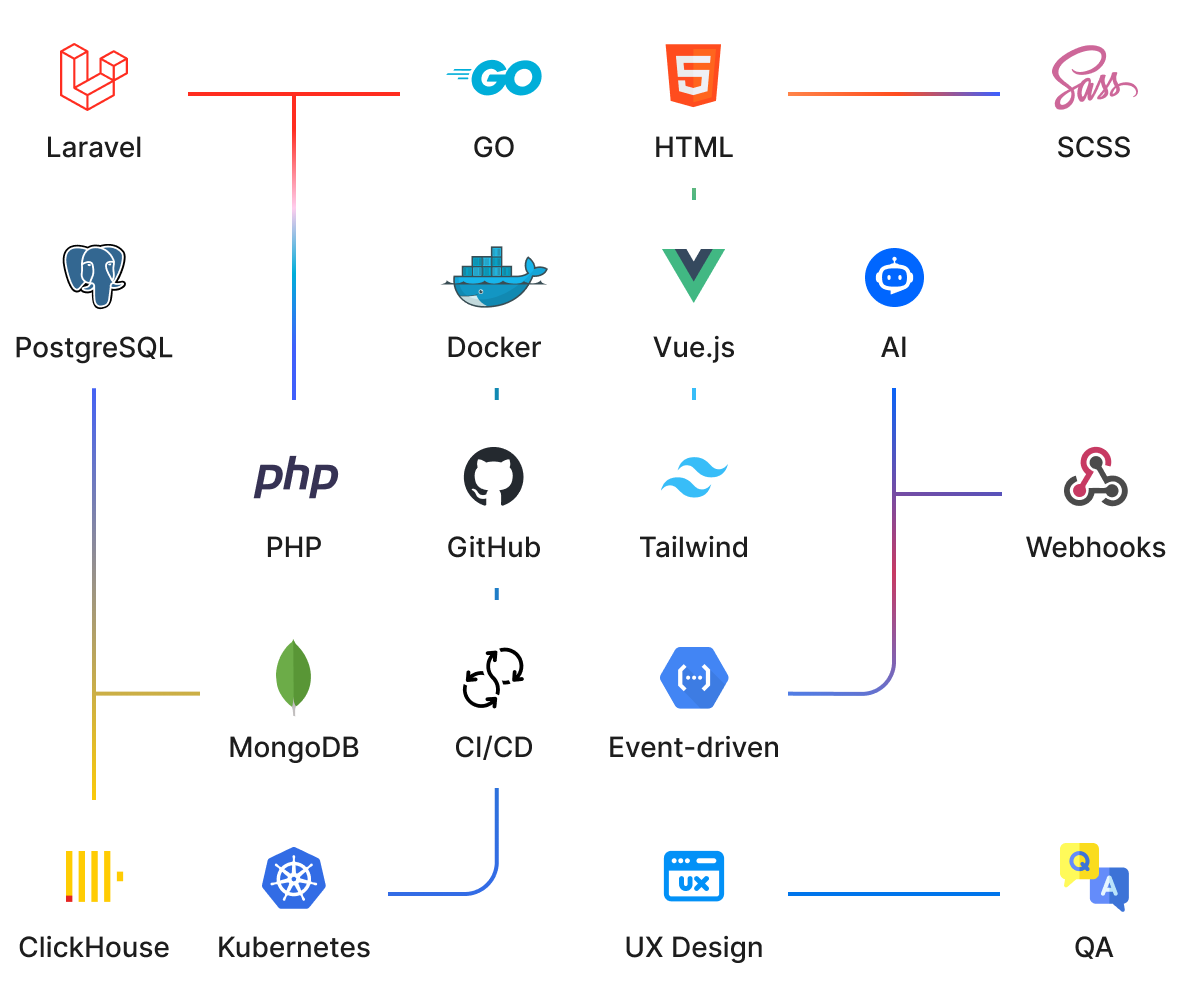
Technology stack and quality standards

We build CRM systems using proven engineering practices. This provides fast interfaces, secure data, and a product that can evolve for years without rewriting its architectural core.
Clean Architecture, SOLID, and DDD (Domain-Driven Design) – we isolate business-logic domains. Changes in one module do not cause errors in adjacent modules or create unnecessary technical debt.
Modular architecture – we separate the core system, billing, and API into independent services. An incident in one area does not bring down the entire CRM.
Checklist-based code reviews – every section of code is reviewed by at least two senior engineers. Quality standards apply down to individual lines of code.
CI/CD and DevOps automation – build, testing, and deployment are fully automated, reducing human error in the release process.
Test pyramid – we cover the system with unit tests for individual functions, integration tests for interactions between modules, and end-to-end (E2E) tests for the entire system. Logic is verified at every stage of development, not only before release.
Secure SDLC – security scanners and dependency checks are integrated directly into the development process. This protects the system from vulnerabilities before it reaches production.
SRE (Site Reliability Engineering) and observability – we monitor metrics and logs in real time. Anomalies are detected and resolved before they become critical incidents.
We measure development quality using objective DORA metrics: change failure rate, recovery time, and deployment speed. You receive a system that your team can continue developing independently.
CASE STUDIES

Our development projects in numbers

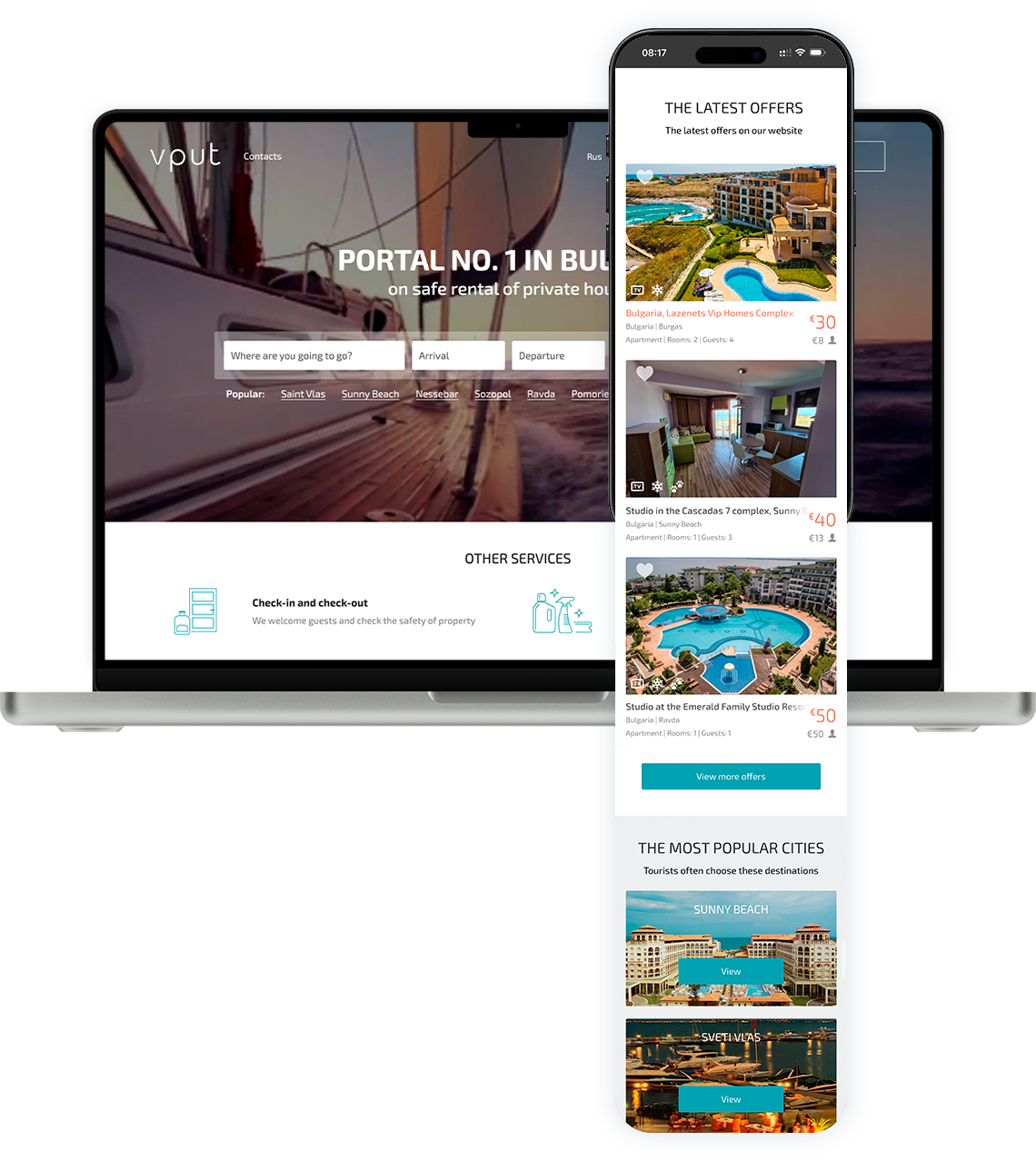
Vput property rental portal on laptop and smartphone screens

Vput – holiday rental aggregator

An international booking portal for private accommodation with a fully automated process, from publishing a property to receiving payment.

More than 14,300 properties

in a central database

11 core automations

implemented in the system

DELIVERED:
Stripe integration: multi-currency payments
Booking calendar with synchronised availability
Notification system: event-triggered emails and SMS
Property moderation module before publication
Vput case
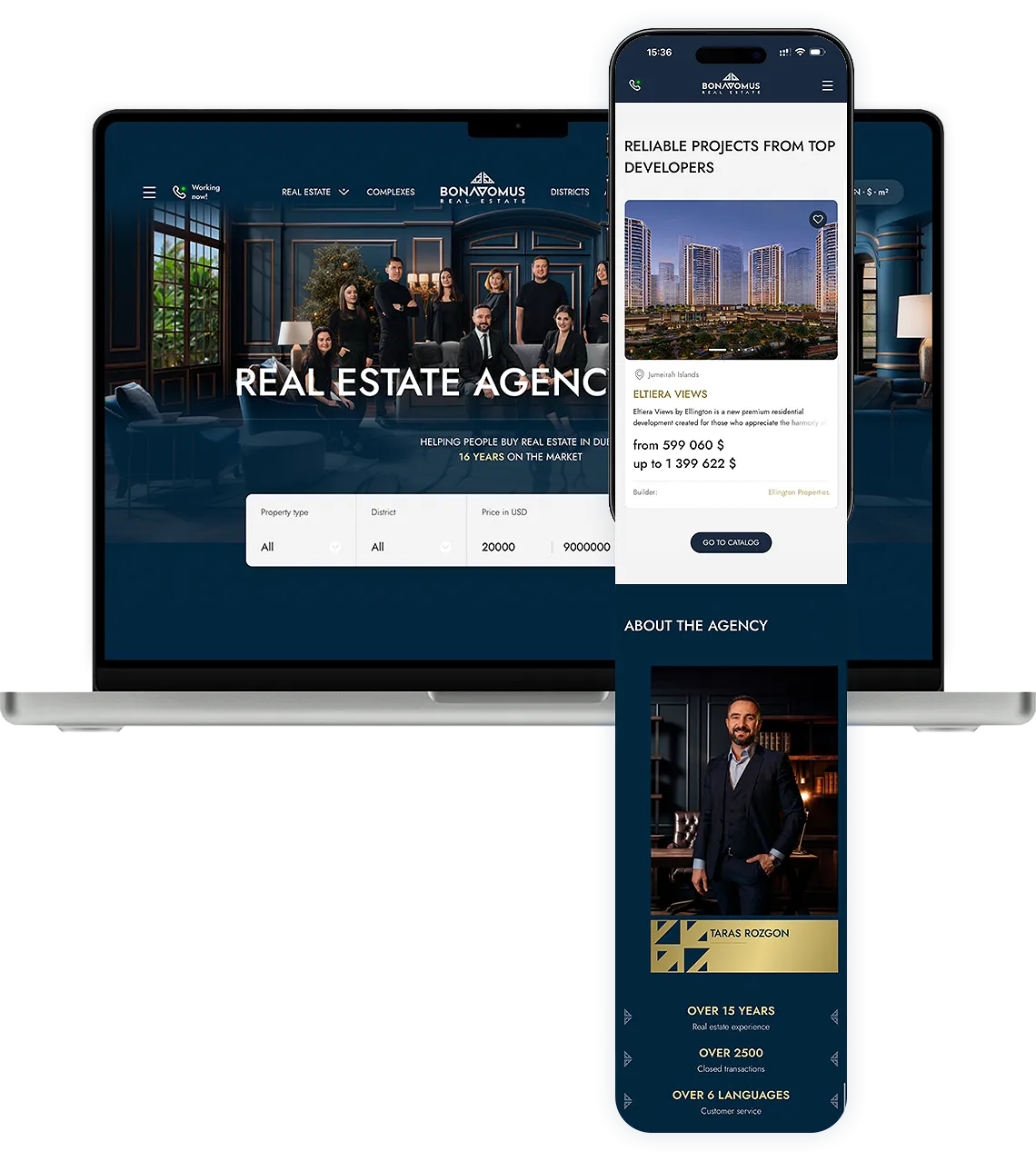
Russian Bondamus real estate agency interface on screens

Bonadomus – ERP for a real estate agency

A platform for the US and UAE markets with AI-assisted content processing and automatic property imports from external sources.

690 times

lower database load

from 4 hours to 12 minutes

to process a new property

DELIVERED:
AI-generated descriptions and metadata in multiple languages
Automatic API import with no manual entry
Architecture optimised for high loads
Multilingual structure supporting two markets simultaneously
Bonadomus case

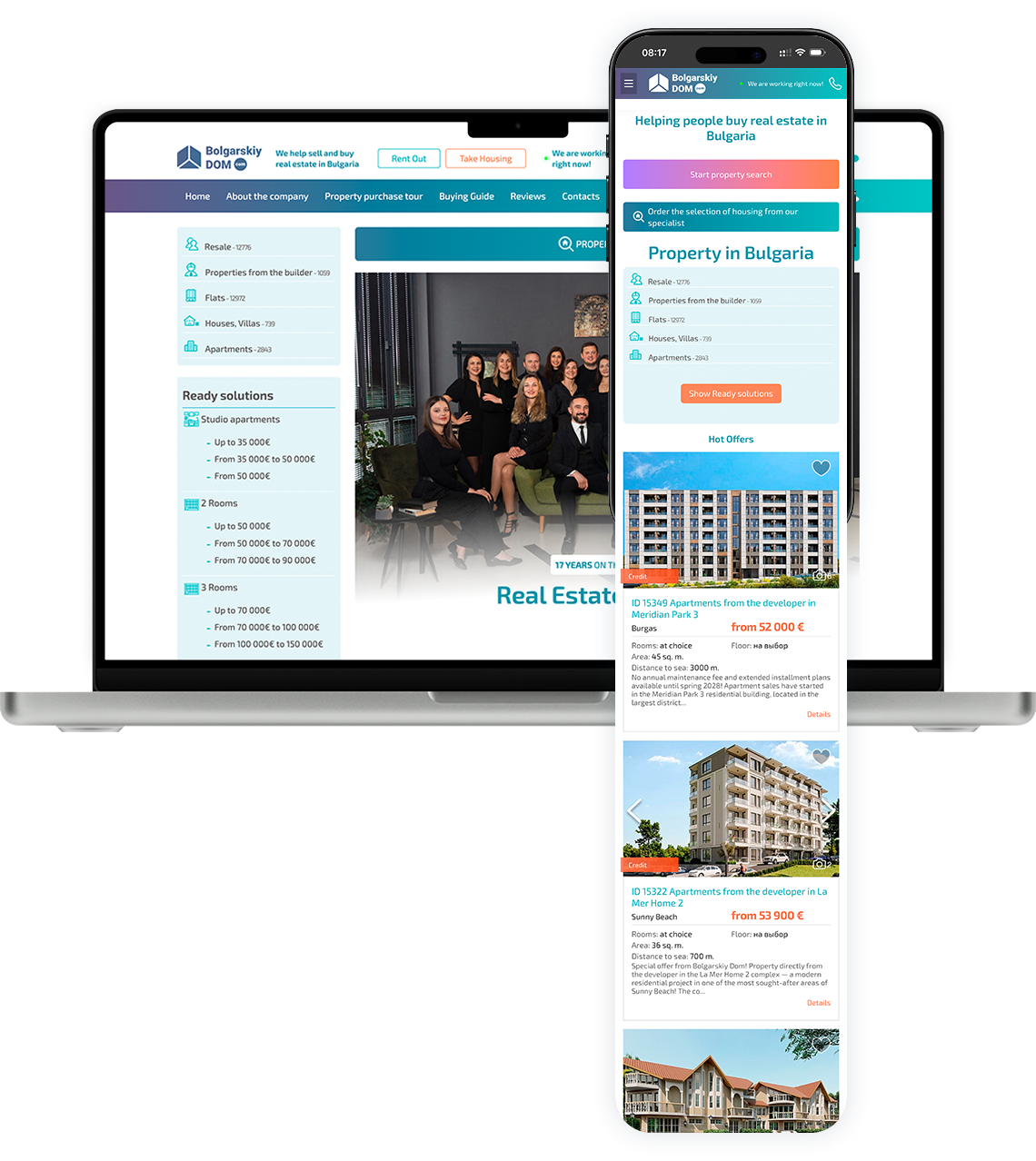
BolgarskiyDom – property sales portal

Automation of the entire sales process: from collecting enquiries from external sources to managing the property catalogue in the CRM.

3 systems

consolidated into one platform

87% of enquiries

processed without manual entry

DELIVERED:
Automatic capture of enquiries from external sources in the CRM
Property catalogue management with filters
Sales workspace with communication history
Notification system for new leads
BolgarskiyDom case
Testimonials

What they say about us

We value the trust of our clients. Below you can see real video testimonials from those who have already worked with us and are ready to share their experience.

Video Reviews

November 12, 2024
October 4, 2023
November 12, 2024
Vyacheslav G.
View Full Review
November 17, 2023
Veronika M.
View Full Review
March 14, 2025
February 15, 2025
October 15, 2023
October 9, 2023
November 23, 2023
Valentin Z.
View Full Review
October 15, 2023
January 12, 2024
March 3, 2024
April 16, 2024
Vladislav E.
View Full Review
November 16, 2023
October 15, 2023
October 10, 2023
November 12, 2024
October 9, 2023
December 21, 2023
June 15, 2023
November 6, 2024
November 18, 2024
November 15, 2024
November 14, 2024
April 21, 2024
November 13, 2024
April 21, 2024
November 12, 2024
November 11, 2024
Stanislav G.
View Full Review
October 16, 2024
October 1, 2024
October 8, 2024
September 12, 2024
August 19, 2024
March 8, 2023
Alexander R.
View Full Review
October 4, 2023
July 2, 2024
August 13, 2024
September 10, 2024
November 21, 2024
Anastasia N.
View Full Review
December 3, 2024
January 27, 2025
June 14, 2024
Svetlana A.
View Full Review
May 27, 2024
April 2, 2025
February 17, 2025
October 14, 2024
April 2, 2025
April 9, 2025
April 16, 2025
Alexandr M.
View Full Review
May 13, 2025
Alexander F.
View Full Review
May 22, 2025
Vladislav K.
View Full Review
June 12, 2025
June 18, 2025
Nikolay Ts.
View Full Review
July 3, 2025
October 21, 2025
October 20, 2025
January 21, 2026
January 27, 2026
February 10, 2026
May 22, 2026
June 5, 2026
June 17, 2026
Employees

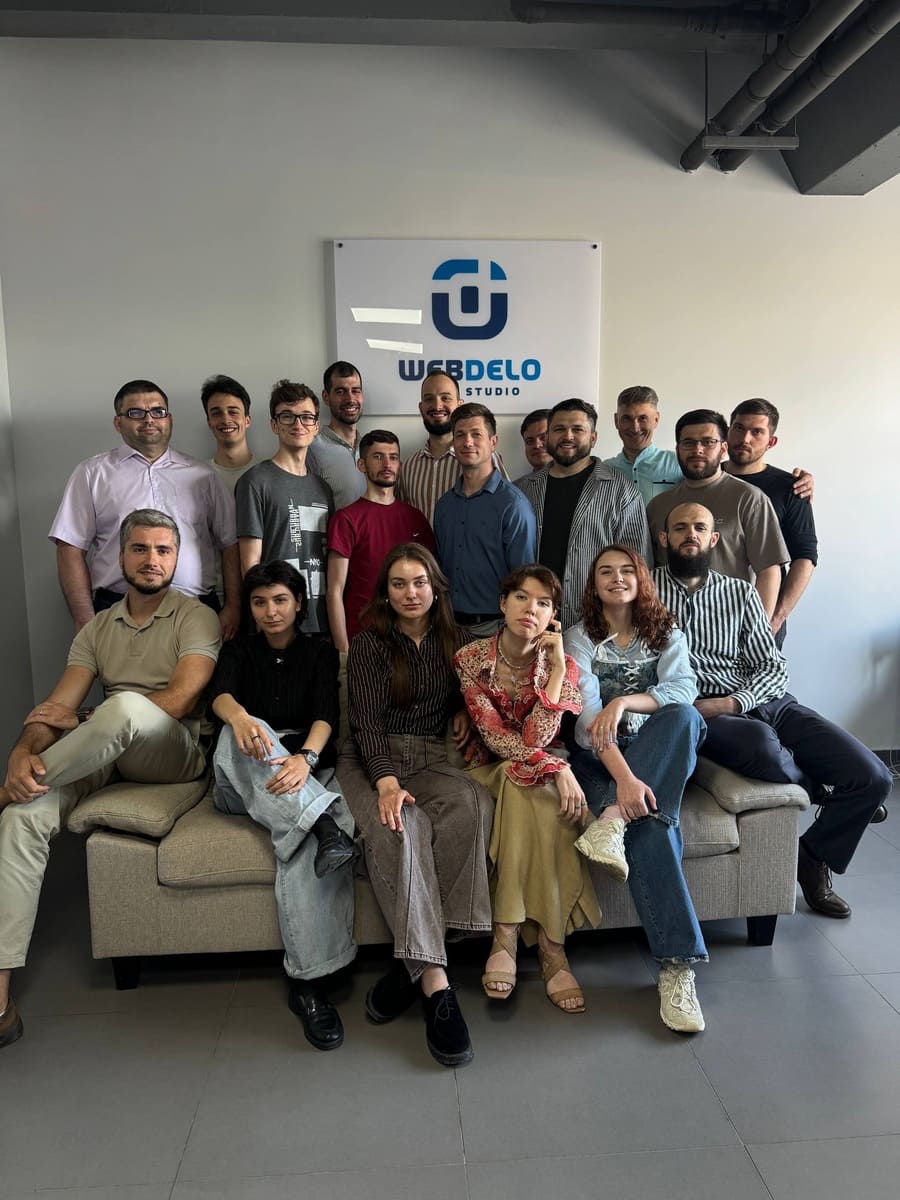
Meet Our Team

At Webdelo, we have architects, technical leads, backend and frontend engineers, DevOps, QA, and UX designers with experience in international projects.

cropped_image

Tatjana Kreuzer

Manager
cropped_image

Andrew Jumatii

Founder, Marketing Director
Portrait of Dmitri Cercel in a white shirt

Dmitri Cercel

Tech Lead, Fullstack Developer
uploadsDaniil

Daniil Shpara

SEO Lead
cropped_image

Vladimir Pustovoi

SEO
Постолаки Октавиан

Octavian Postolachi

Copywriter
uploadsПапшой Павел

Pavel Papsoi

SEO
cropped_image

Polina Finkelstein

Copywriter
cropped_image

Michael Vindalovskii

Fullstack Developer
cropped_image

Stanislav Oloinic

Typesetter
cropped_image

Said Namazov

SEO
Пинаева Лиза

Liza Pinaeva

Quality Assurance
cropped_image

Alexandr Lohani

Content Manager
cropped_image

Pavel Culaghin

SEO
cropped_image

Elena Cozearscaia

Copywriter
cropped_image

Andrei Climentiev

SEO
Timofey Kabanov smiling against an event backdrop

Timofey Kabanov

Operations Coordinator
uploadsAnna-I

Anna Isakova

Designer
cropped_image

Uliana Jumatii

SMM
cropped_image

Nicolai Jarchih

SEO
cropped_image

Dmytro Hrushko

Content Manager
cropped_image

Chirill Vindalovskii

Fullstack Developer
cropped_image

Stanislav Ticalos

Fullstack Developer

Questions and answers about CRM systems

1. How does the payment process work? Do we have to pay the full amount upfront?
No. We use a secure phased-funding model. The budget is divided into short sprints. You pay only for the current development stage and make the next payment after you have accepted and tested the features from the previous stage.
2. I am not a technical expert. How can I monitor progress if I do not understand the code?
You do not need to understand IT terminology. A business analyst leads the project and discusses metrics and processes with you. Every two weeks, you receive access to the test environment, where you can try new features, create a test case, or export a report. You approve a finished business result, not lines of code.
3. What happens if our business model or priorities change during development?
We do not lock you into a rigid specification for six months. Short iterations keep the process flexible. If the market changes, you can stop development of a module you no longer need and reallocate the remaining budget to new features without penalties or a new contract.
4. Will sales stop on the day we switch to the new system?
No. The migration is completed without downtime. Final database synchronisation, transfer of active sessions, and routing changes take place outside working hours, at night or over the weekend. In the morning, the team continues working in the new interface with all current cases already available.
5. What can we do if employees resist the new CRM because the interface is unfamiliar?
We reduce this risk through a soft launch. The entire company is not moved to the system in a single day. First, a focus group, such as one department, tests it. We collect user feedback, adjust the UX logic to their working habits where necessary, and only then roll the product out to the remaining teams.
6. Can you connect the CRM to an old internal application that does not have a modern API?
Yes. If your current software, such as a local inventory application, an older ERP, or a custom billing system, has no open API, we develop dedicated gateways for data exchange. If necessary, we set up secure synchronisation directly at database level so no information has to be transferred manually.
Contacts

Ready to discuss your project

Leave a request. We will contact you within 2 hours, ask 5-7 clarifying questions, and prepare a commercial proposal with an accurate estimate and timelines.
Terminology

Glossary

*
Custom CRM (a system for managing processes and data) — a digital system developed for the specific needs of one company. It brings together customer operations, financial transactions, and management analytics. It has no per-user fees and can be recognised as a digital asset of the company.
*
Cloud subscription (SaaS) — ready-made software sold by subscription, such as Bitrix24 or amoCRM. It enables a quick start but ties the company to the provider's pricing and standard logic, which can be difficult to adapt to unique processes.
*
Minimum viable product (MVP) — a basic version of the system with essential features such as a sales pipeline, customer database, and payment management. It can be launched within 6-8 weeks and developed further as the business grows.
*
Agile development (Agile / Sprints) — an approach that divides work into short cycles of 1-2 weeks. After each cycle, the client receives a working result and can adjust the direction of further development.
*
Total Cost of Ownership (TCO) — a calculation of all system costs over a period of 2-5 years, including development, infrastructure, support, and further development.
*
Application Programming Interface (API) — a mechanism for exchanging data between systems. It allows the CRM to integrate automatically with a website, 1C, telephony, and payment services.
*
Enterprise Resource Planning (ERP) — a business system for managing inventory, procurement, and production. It integrates with the CRM to synchronise product and shipping data.
*
1C — a system widely used in Russia for accounting, inventory, and HR management. It often serves as the core financial system that synchronises with the CRM.
*
Service Level Agreement (SLA) — an agreement that defines response and resolution times for incidents, such as a response within four hours for critical outages.
*
Federal Law No. 152-FZ — the Russian federal law On Personal Data. It governs the storage and processing of Russian citizens' personal data, including the requirement to store it within the Russian Federation.
*
GDPR (EU) and CCPA (USA) — data protection regulations governing work with customers in Europe and the United States.
*
ViDA (VAT in the Digital Age) — EU rules for electronic invoicing and digital VAT. They are relevant to companies operating in the EU market.
*
KYC / AML — procedures for screening customers and transactions to prevent fraud and money laundering. They are mandatory in the financial sector.
*
Software architecture standards (Clean Architecture, SOLID, DDD) — principles for building scalable, readable software systems that can be supported over the long term.
*
CI/CD automation — processes for automatically building, testing, and deploying updates. They reduce the risk of errors and speed up new releases.
*
Secure development (Secure SDLC) — a development process with integrated security checks such as SAST and DAST, which identify vulnerabilities before the system goes live.
*
Reliability and observability (SRE / Observability) — engineering practices for monitoring system health in real time and preventing failures before they affect users.
*
DORA software delivery metrics — metrics for release speed, system stability, and recovery time after incidents.
*
Soft launch — a phased system rollout that avoids interruptions to business processes and supports a gradual transition to the new CRM.
cookies We use Cookies

We use cookies to improve website performance, personalize content, and analyze traffic. You can choose which categories of cookies to allow. For more information, please see our Cookie Policy. You can change your preferences at any time.

Essential (Required)

Ensure the website functions properly (navigation, access to secure areas). Always enabled and can only be changed in your browser settings.

Analytics

Help us understand how you use the website so we can improve our services. Do not collect personal data. We use several analytics tools for this purpose.

Advertising

Used to deliver personalized ads and measure the effectiveness of advertising campaigns.