Website Credibility: Why B2B Buyers Don't Trust Your Claims
Phrases like "high quality" and "experienced team" give B2B buyers nothing to verify. See six types of evidence, a case study structure that works under NDA, a seven-step credibility audit, and before-and-after copy examples.

Why Generic Marketing Claims Hurt Website Credibility
B2B buyers need verifiable proof of expertise to assess the risk of choosing a provider. Phrases like "high quality," "personalized approach," and "experienced team" do not help them do that. A verifiable case study, a project-specific testimonial, or clear acceptance criteria help buyers see what backs up a promise.
At Webdelo, we develop and support complex B2B products. For these projects, "quality" needs to mean specific commitments: what the team delivers, how it checks the work, and who is responsible for fixes. The same principle applies to a service page.
What B2B Buyers Expect Before Choosing a Provider
A service is hard to evaluate before work begins. Buyers have not yet seen the result, so they review the available signs of competence and reliability. Identical claims on competing websites leave them with no basis for comparison.
Imagine a report that contains only the service name and a price. It tells you nothing about the scope of work completed or how to verify the result. The phrase "we provide quality services" leaves readers with the same gap.
The Doubts Unproven Quality Claims Leave Open
- Has this team solved a similar problem, and how did the project turn out?
- Who will work with us, and how will approvals work?
- How will we know the work has been done correctly?
- What happens if there is a delay or an error, and where are responsibilities documented?
Seven B2B Website Claims That Need Verifiable Proof
Claims about experience, quality, and results need evidence when they influence a client's choice. To understand how to prove service quality, turn each promise into a buyer's question. Then find material that lets the buyer verify the answer.
Generic Claims B2B Buyers See Everywhere
"High quality" needs acceptance criteria. For a CRM and ERP integration, for example, describe the agreed data exchange scenarios and how errors will be checked. Saying that testing takes place does not explain which requirements it verifies.
"Years of experience" becomes more specific when a company states its founding year and shows relevant work. Webdelo was founded in 2006. That date confirms how long the company has been operating, but expertise in a particular task needs separate evidence.
A "personalized approach" becomes clear through a decision the team made. A case study should explain which client constraint affected the project and what the team changed to accommodate it. A suitable example must be based on real project materials.
The Evidence Each Claim Needs
The verifiable part of a promise answers these questions: who did the work, what they delivered to the client, and what conditions the result met for acceptance. Replace "we guarantee results" with specific contractual commitments. State any limitations and dependencies on the client's actions alongside them.
| Promise | Buyer's Question | Evidence |
|---|---|---|
| High quality | What criteria will I use to accept the work? | Agreed criteria and documented acceptance results. |
| Personalized approach | What will you change to suit our circumstances? | A description of decisions made to address a specific client's constraints. |
| Experienced team | Who has solved similar problems? | Specialists' roles and their involvement in relevant projects. |
| We guarantee results | What are you responsible for under the contract? | Commitments, the process for making corrections, and limits of liability. |
| We work fast | How much work was completed within the stated time? | Verified dates and scope of work, along with the conditions under which it was completed. |
| Clients trust us | Who can confirm their experience of working with you? | Case studies, testimonials, and references approved for publication. |
| Effective solutions | What changed, and how was it measured? | Metrics with a baseline, time period, source, and methodology. |
Six Types of Evidence That Build B2B Website Credibility
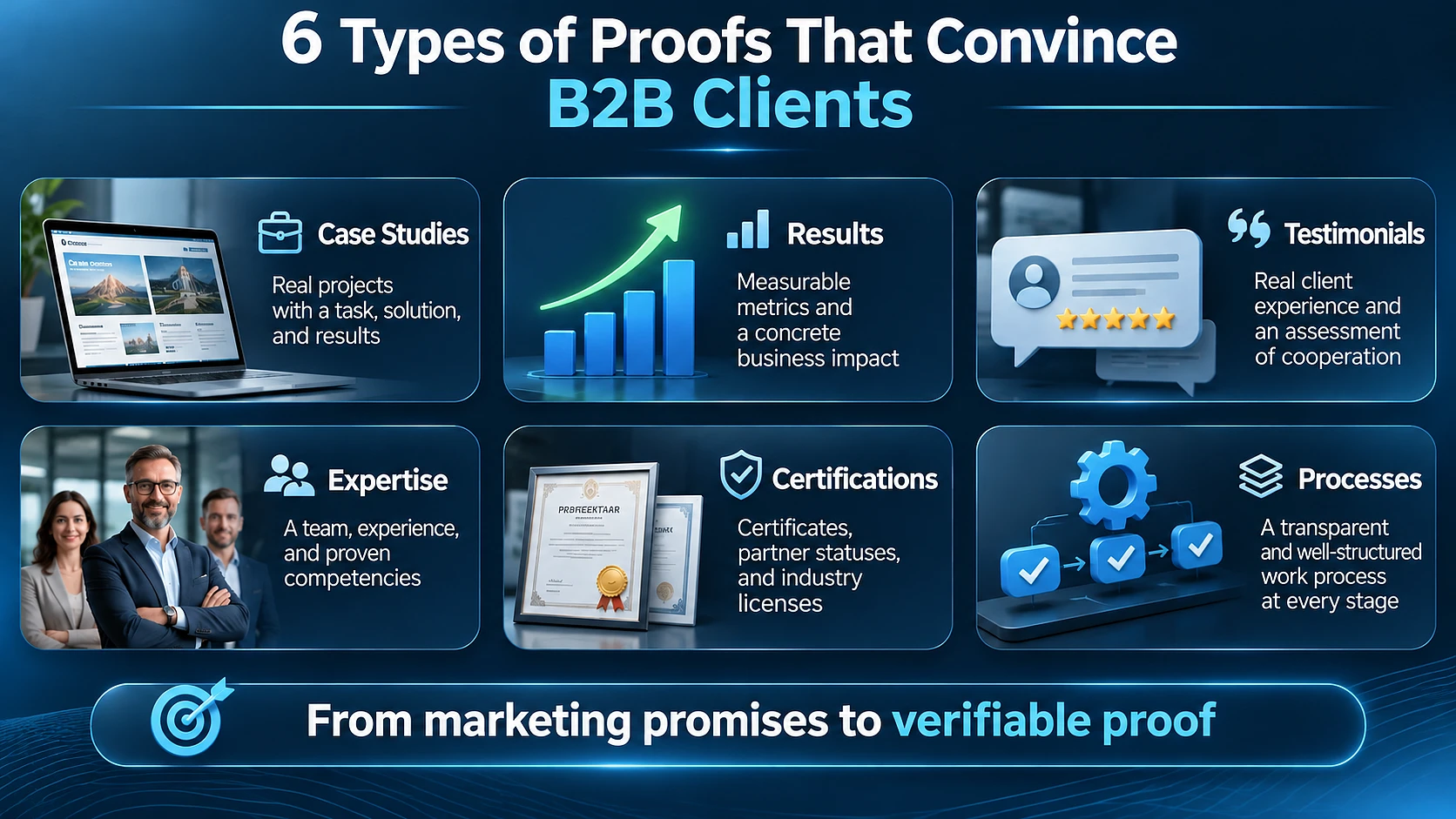
Evidence of a company's expertise falls into six categories: case studies, results, testimonials, team expertise, formal credentials, and processes. Each answers a different buyer question. It helps to combine the company's own materials with confirmation from a client or an independent organization.
B2B Social Proof: Case Studies, Results, and Testimonials
- Case studies show the original challenge, constraints, and reasoning behind the solution. Buyers can compare the situation with their own.
- Results document changes after the work. Each metric needs a time period, source, and calculation method.
- Testimonials share the client's assessment. A name, job title, company, and connection to the project make it clear whose experience is being described.
Social proof on a website should answer the questions of people involved in the buying decision. An IT leader cares about integrations and support, while a CFO needs cost control. A general star rating does not address those questions.
Proof of Expertise: Team, Qualifications, and Processes
- Team expertise is demonstrated through roles, qualifications, and completed tasks. A profile should show the specialist's contribution to the work.
- Formal credentials and commitments include current certifications, official statuses, and contractual obligations. Each should state exactly what it confirms.
- Processes show how risks are managed through code review, testing, acceptance, and delivery documentation.
At Webdelo, documented delivery and an optional SLA make support discussions concrete. Our published support and incident-response commitments provide a basis for agreeing on obligations. Final targets depend on the selected plan and are recorded in the contractual documents.
These six types of evidence provide a useful checklist for reviewing a page: which questions have been answered, and where does the reader still see only a promise?
How to Create B2B Case Studies That Prove Real Results
A convincing company case study connects the challenge, the work completed, and the verified result. It explains why the team chose a particular solution and which part of the project it was responsible for. Publish the account only when it is based on verified materials and the necessary permissions have been obtained.
Challenge, Solution, Evidence, and Outcome
We do not consider a display of logos enough to evaluate a provider. A logo reveals neither the team's scope of involvement nor the complexity of the task. Demonstrating a company's experience requires an account of the work with clear boundaries.
- Challenge. State the client's industry, starting situation, and constraints. Explain what was holding the business back.
- Work. Describe the key decisions and why they were made. Distinguish your team's contribution from those of the client and other providers.
- Result. Include approved metrics with a time period and source. If no measurements are available, describe the accepted deliverable and the verified change to the workflow.
Results-based case studies do not have to include financial metrics. A verified launch of agreed functionality is also informative. But a launch alone does not prove revenue growth or time savings.
How to Share B2B Case Studies Under an NDA
A nondisclosure agreement determines which details may be shared. Anonymization does not replace reviewing its terms: the combination of an industry and a project description can sometimes identify the client. Relative changes in metrics also require approval.
Work within the permitted scope of disclosure. You may be able to agree on an anonymized description of the solution or a reference call with a client representative. Permission to publish screenshots needs a separate check: protecting customer data when working with IT contractors also covers data accidentally included in demonstration materials.
Where to Place Trust Signals on a B2B Website
Evidence should appear next to the claim it supports. On a service page, buyers need a relevant example and a short explanation of why it matters. A separate case study section lets them explore the details, but it should not be the only place where evidence appears.
Trust Signals on the Homepage, Service, and Industry Pages
When a company develops its corporate website, it helps to place evidence according to each page's purpose. Visitors then do not have to work out the connection between a service and a portfolio project themselves.
- Homepage: verifiable company facts and brief examples of its main areas of work.
- Service page: a relevant case study, testimonial, and description of the delivery process.
- Industry page: experience solving industry-specific problems, reflecting the industry's constraints and terminology.
Placing Proof Next to the Claims It Supports
Place an example of an implemented data exchange next to a promise of easy integration. Show support terms alongside the support description. A link to a general portfolio section is less useful if readers still have to find a relevant project.
A web design agency should preserve this connection on mobile. Check whether the caption, source, and date are visible without opening additional windows. If there is no evidence, remove the evaluative claim or replace it with a precise description of the service.
Why Testimonials and Trust Badges Sometimes Fail
Evidence loses value when readers cannot identify its source, determine whether it is current, or understand its relevance to the service. An anonymous testimonial or a metric without a time period leaves questions unanswered. A certificate helps buyers evaluate a company only within the scope of what it actually certifies.
Unverifiable Testimonials and Outdated Evidence
The attribution "John, Director" does not make it clear who evaluated the work or which project they mean. If the client has only approved anonymous publication, state that limitation honestly. Do not add invented job titles or details to make it more convincing.
An old case study can demonstrate past experience. Include the project dates and do not present its result as a description of the system's current state. Separately check whether official statuses remain valid and published support terms are up to date.
How to Make Trust Signals More Credible
- Agree on the testimonial text, attribution, and publication location with the client.
- Keep the source, time period, and calculation rules for each metric.
- For a certificate, state the holder, scope, and validity period.
- For an official status, explain what it means and how to verify it.
- Assign someone to keep each item up to date.
For example, Webdelo's residency in Moldova IT Park confirms that particular company status. It is not a certification of software development quality. Similarly, describing processes informed by ISO 27001 or SOC 2 principles must not be presented as holding formal certification.
For pages targeting Russia, the USA, and Germany, check local requirements for advertising and publishing personal data. Translating the text does not replace checking permissions. Materials must be authentic in every locale.
A Seven-Step Website Credibility Audit for B2B Companies
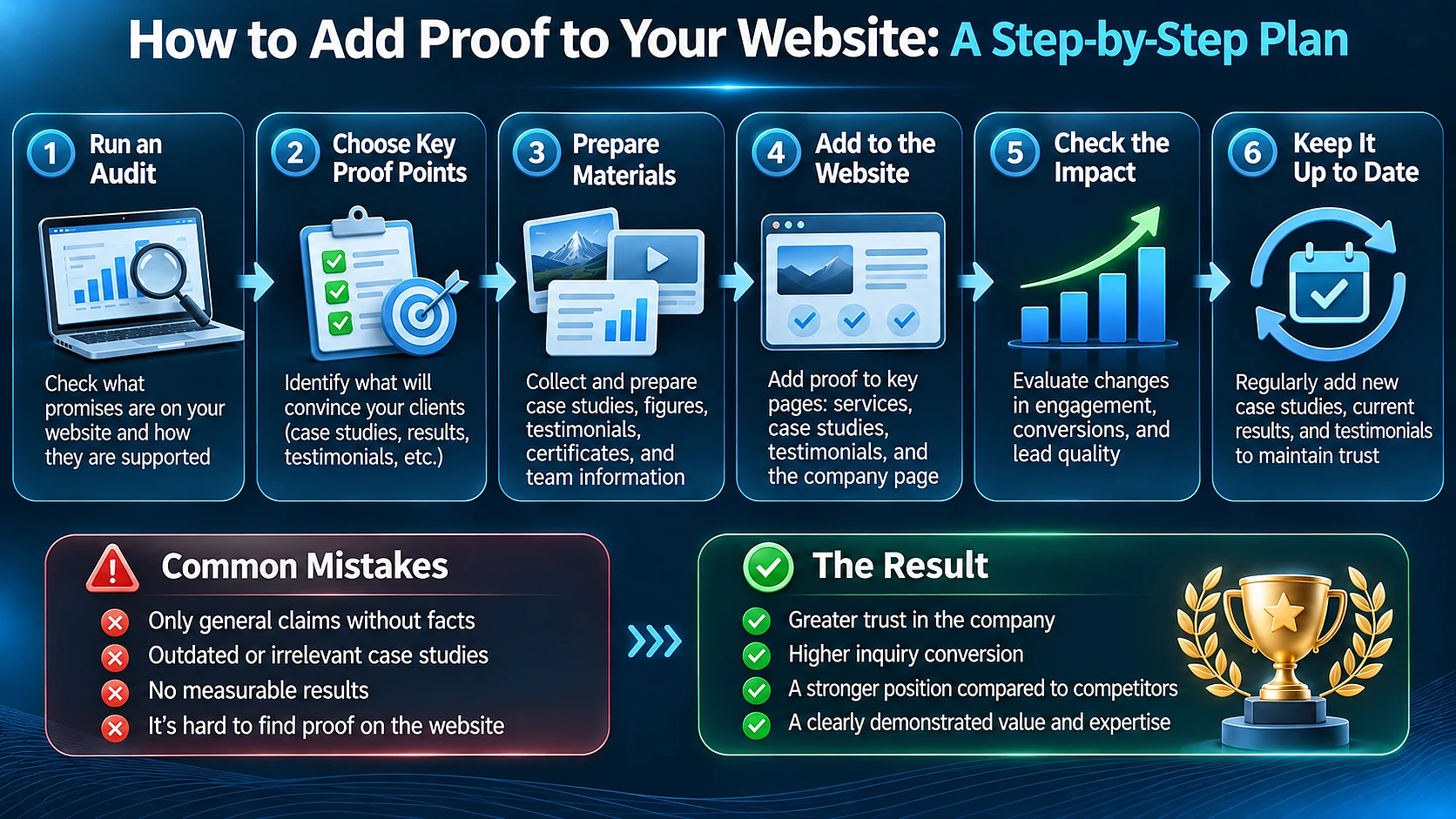
An audit shows how to substantiate service quality on each commercial page: which claims already have support, what needs updating, and what should be removed. The deliverable is an evidence register with sources, permissions, and owners. The review can be completed in seven steps.
Finding Unsupported Claims
- Collect claims. List the promises on the homepage, service pages, and industry pages. Record the exact wording and page URL.
- Find supporting evidence. Match promises with case studies, reports, acceptance records, or analytics data. Clearly flag any missing source.
- Check dates and permissions. Verify dates, data owners, and what may be published. An internal document does not automatically become public.
The register needs only these fields: page, claim, evidence, source, date, and permission to publish. Add an owner and the next action. This lets an editor distinguish ready-to-use material from an idea that still needs supporting facts.
Prioritizing and Validating Fixes
- Choose priority pages. Start with pages that help generate inquiries. Consider traffic volume and the service's importance to the business.
- Prepare materials. Create verified case studies, specialist profiles, and excerpts from documents approved for publication.
- Place the evidence. Put it next to the relevant claims. Remove or reword promises that cannot be substantiated.
- Set up measurement and updates. Record the date of the changes, the selected metrics, and a schedule for reviewing materials.
The diagram below groups the work into six broader stages. A possible increase in inquiries after the changes remains a hypothesis: it must be tested against website and sales data.
Before and After: Turning Generic Claims Into Credible B2B Copy
Replacing a promise with a fact makes the text verifiable: readers can see the work completed and the basis for evaluating it. The examples below are wording templates, not accounts of client results. Use them only when the corresponding materials exist.
| Before | After | What It Demonstrates |
|---|---|---|
| We deliver quality work | The project description includes acceptance criteria and the results of checks on the completed work. | Exactly what was checked before the deliverable was handed over to the client. |
| We take a personalized approach | The case study explains which client constraint we addressed and how it shaped the solution. | How the solution was adapted to a specific task. |
| We get websites to the top of search results | We show the work completed and changes in search visibility and traffic over a stated period. | The scope of work and observed changes based on data from identified systems. |
| We have an experienced team | Specialist profiles list roles and tasks in relevant projects. | Team members' experience in specific types of work. |
| Market leaders trust us | We publish approved case studies and testimonials that identify the companies and projects. | Experiences of working together that clients have authorized us to share. |
Examples for SEO and Marketing Services
If a company offers SEO services, evidence of service effectiveness should connect the work report with measurements. Search visibility metrics should specify the region and the set of tracked queries. Organic traffic metrics should identify the analytics platform, time period, and filters applied.
Replace ranking promises with a transparent account of the work and observed trends. If the product range or advertising activity changed at the same time, account for that when interpreting the result.
Examples for Web Development and B2B Service Providers
Instead of "quality development," show the testing and acceptance process. Useful materials may include an agreed list of scenarios and an anonymized documentation sample. Permission to publish them is required.
Explain "experienced team" through roles and completed tasks. A specialist's past involvement in a project does not mean that person will be assigned to a new engagement. The team composition needs to be agreed separately.
For Webdelo, the general description "reliable provider" can be replaced with verifiable facts: the company was founded in 2006, has been a Moldova IT Park resident since 2021, and offers an optional SLA. Each fact answers a different buyer question. None of them individually guarantees a project's success.
Instead of "we guarantee results," specify the deliverables, areas of responsibility, and process for fixing defects. This makes it possible to discuss commitments before signing the contract.
How to Measure Whether Credibility Improvements Generate Better Leads
The impact of evidence is assessed through engagement with the materials and the quality of incoming inquiries. A before-and-after comparison helps identify changes, but it does not establish their cause on its own. Any conclusion needs to account for the traffic mix, seasonality, and other website changes.
Proof-Asset Engagement and Qualified Leads
When evaluating digital marketing, it helps to connect case study views with visitors' subsequent actions. A qualified lead is an inquiry that meets agreed criteria for a target customer. Those criteria must remain the same across the periods being compared.
- Engagement with evidence: visits to case studies and views of important sections of the material.
- Actions after viewing: returning to a service page or submitting an inquiry.
- Inquiry quality: the share of inquiries that qualify and their subsequent progress through the sales process.
- Sales feedback: mentions of case studies and questions clients no longer ask at the first meeting.
How to Test the Impact of Credibility Changes
Before making changes, record baseline metrics and how they are calculated. After publication, compare equivalent periods and traffic sources. More case study views do not necessarily mean more sales.
With enough traffic, you can compare page versions in an A/B test. If inquiries are sparse, supplement analytics with a review of client conversations. Do not attribute the effects of advertising launched at the same time or changes to the offer to the evidence itself.
How Webdelo Helps B2B Companies Prove Their Expertise
Webdelo helps match commercial claims with genuine company materials and incorporate supporting evidence into service pages. We combine expertise in B2B development, marketing, and SEO for this task. The foundation is the client's data and permission to use it.
Website Credibility Audits
We check which buyer questions a page answers and what supports each key promise. We propose a specific list of actions for discussion:
- Remove claims that have no supporting evidence.
- Rephrase subjective assessments as verifiable facts.
- Gather missing materials and obtain publication approval.
- Update outdated information and assign owners.
Case Studies and Improved Service Pages
We help structure case studies around "challenge - work - result" and show the provider's role without exaggeration. On service pages, we connect claims with suitable evidence. Together with the client, we define the metrics for assessing changes after publication.
Does your website talk about service quality without proving it? Webdelo reviews commercial claims, supporting evidence, and service pages to identify the materials buyers need to make an informed choice.
Request an audit of your commercial pages.
Frequently Asked Questions
How can a B2B company improve website credibility without major case studies?
Start with facts buyers can verify today: your founding year, team roles, testing and acceptance procedures, and published support terms. A small project can still make a strong case study if it clearly describes the challenge, constraints, the work done, and the accepted result. A confirmed launch of agreed functionality is informative even without financial metrics. Remove evaluative phrases like "high quality" when nothing backs them up, or replace them with a precise description of the service. For an outside perspective, Webdelo reviews commercial pages and identifies which proof buyers are still missing.
What makes B2B social proof and other evidence credible?
Six types of evidence work in B2B: case studies, measurable results, testimonials, team expertise, formal credentials, and documented processes. What makes them credible is verifiable detail: the reviewer's name, title, and company, a link to a specific project, a date, the data source, and how a metric was calculated. Combine your own materials with confirmation from clients or independent organizations. Also address different stakeholders: an IT leader cares about integrations and support, while a CFO cares about cost control. A generic star rating answers neither.
Are anonymous customer testimonials effective?
They can be used, but they persuade less: a signature like "John, Director" does not show who evaluated the work or which project it refers to. If a client has approved only anonymous publication, state that limitation openly. With the client's consent, you can add the industry, the type of challenge, and the scope of work to tie the testimonial to a real project. Never invent job titles or details to make it more convincing. Support anonymous testimonials with other evidence, such as a description of the solution, your processes, or support terms.
How do you write a B2B case study with measurable results?
Use a challenge, solution, outcome structure. For the challenge, state the industry, the starting situation, and the client's constraints. For the solution, name the key decisions, explain why you made them, and separate your team's contribution from that of the client and other vendors. For the outcome, cite approved metrics with a time period and source; if nothing was measured, describe the accepted deliverable and the confirmed change in the workflow. A logo wall is no substitute: it shows neither your scope nor the complexity of the work.
How can you prove expertise when an NDA restricts disclosure?
Work within the scope of information the client has approved, and check the agreement's terms before publishing anything. Anonymization alone does not guarantee confidentiality: the combination of industry and project details can sometimes reveal the client, and even relative changes in metrics require approval. You can agree on an anonymized description of the solution or a reference call with a client representative. Review screenshots separately so that no client data appears in them. You can also demonstrate expertise through your processes, team roles, and support terms.
Where should trust signals appear on a B2B website, and how many do you need?
Evidence should sit right next to the claim it supports. The homepage suits verifiable company facts; a service page needs a relevant case study, testimonial, and work process; an industry page should show experience with that industry's constraints. A case study section is useful for detail but should not be the only place with proof. There is no universal number: what matters is that every key claim has its own supporting evidence. Check that captions, sources, and dates remain visible on mobile.
How do you measure whether credibility improvements generate better leads?
Before making changes, record baseline metrics and how they are calculated, then compare equivalent periods and traffic sources. Track clicks into case studies, actions after viewing, the share of qualified leads and their progress through the pipeline, and feedback from sales. Keep qualification criteria the same across compared periods. With enough traffic, run an A/B test; with little traffic, review sales conversations. More case study views do not mean more sales, and effects from a parallel ad campaign should not be credited to your evidence.