Online Reputation Management: Why Customers Find Negative Reviews and Competitors on Google
Buyers often Google your company right before contacting you. This guide explains what appears in branded search, how to audit it step by step, answer negative reviews ethically, and track CTR, reviews and leads.

Why Your Google Search Reputation Matters Before a Purchase
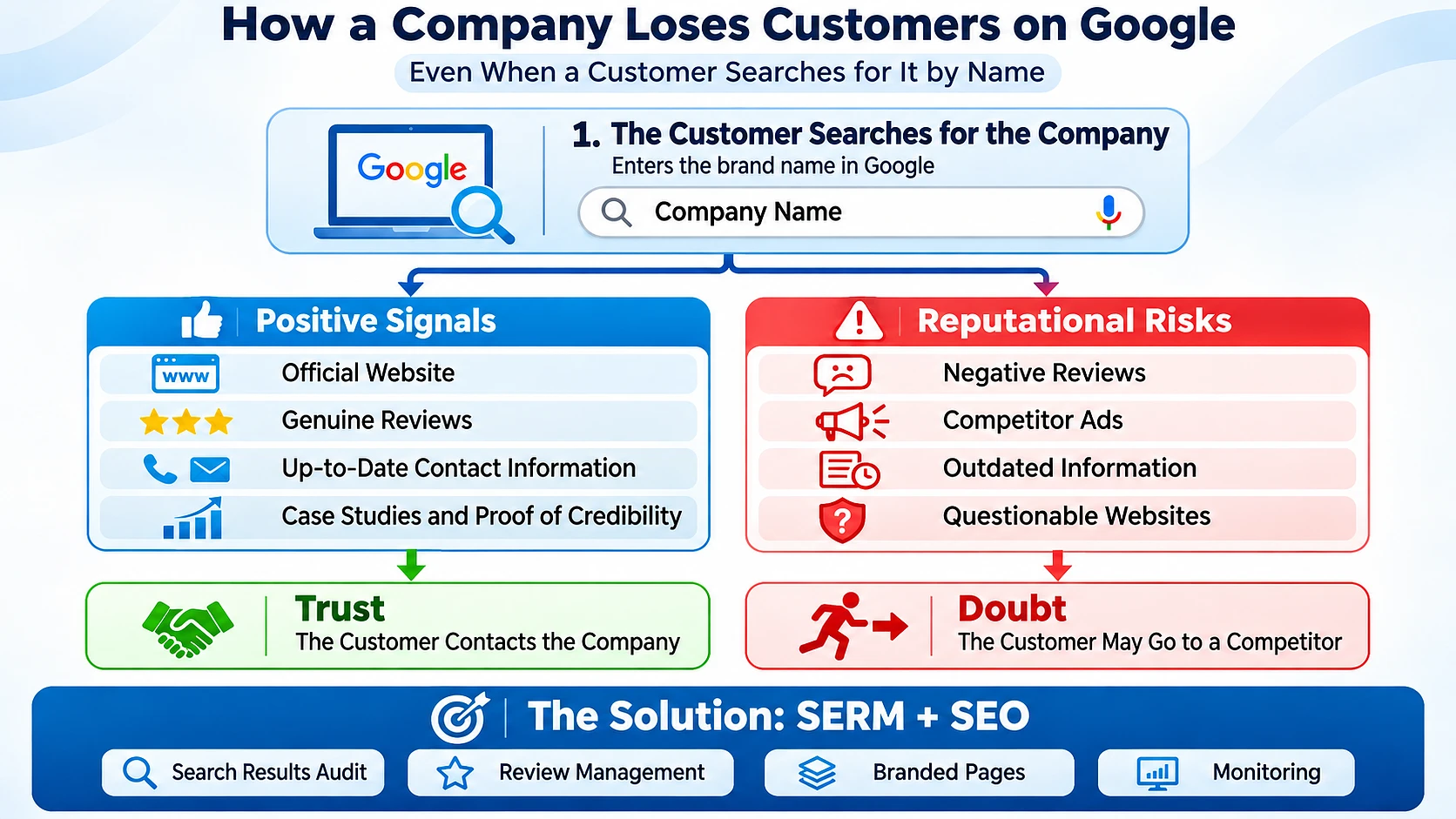
A buyer may Google your company just before sending an inquiry or signing a contract. Negative reviews, competitor ads, or outdated contact details can introduce doubt at that moment. Online reputation management is the work of monitoring and improving how your business appears online, including in these branded search results.
For a B2B company, this search can happen after a successful sales presentation. A procurement manager looks for independent evidence. A finance director checks the company behind a proposal. Someone who abandons the process before contacting you leaves no lost opportunity in your CRM.
At Webdelo, we treat branded search as part of the path from discovery to inquiry. Rankings for industry keywords tell us whether prospects can find a business. Searches for its name tell us what those prospects encounter when they check its credibility.
That distinction matters when investigating weak lead generation. Search results can reveal a trust problem, but they cannot establish how much revenue it has cost. The useful starting point is a documented audit of what buyers see and which issues your team can address.
What Customers Actually See When They Google Your Company
Your brand SERP, or search engine results page for your company name, combines information from sources you control and sources you do not. It can include your website, Google Business Profile, reviews, news coverage, and competitor ads. Buyers evaluate this collection as a whole.
Wharton's overview of online reputation includes reviews, news articles, forum discussions, social media, and blog posts. A polished homepage therefore addresses only part of what a prospect may find.
Competitors can appear through advertising that targets searches for your brand. They may also rank organically through comparison pages. Review platforms and directories can appear prominently when their pages answer the query better than your own pages do.
Negative results are not necessarily evidence of a Google penalty. A review or critical article may be relevant to the search, particularly when the buyer adds "reviews" or "complaints" to your name.
Signals that support trust
- An accurate Google Business Profile with the correct website and contact details.
- Recent, genuine reviews with useful business responses.
- Official About and case study pages that explain who you are and what you deliver.
- Credible third-party coverage that supports your company's claims.
Signals that create doubt
- Unanswered complaints that leave the customer's account as the only explanation.
- Competitor ads or comparison pages that redirect attention toward alternatives.
- Directories showing old addresses, disconnected numbers, or inconsistent company names.
- Critical publications with no accessible update or factual response.
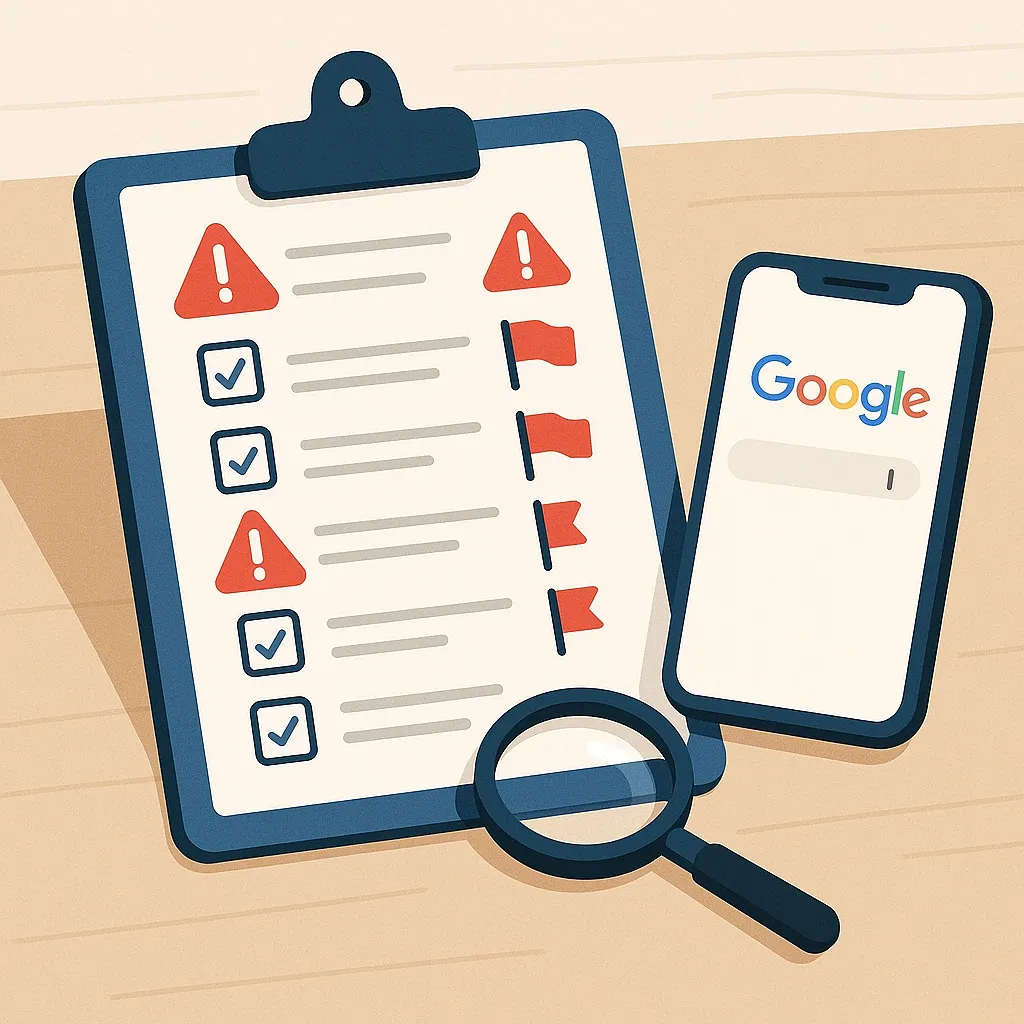
Seven Reputation Problems That Can Cost Your Business Customers
Branded search problems need different responses. A genuine complaint calls for service recovery, an outdated phone number needs correction, and a weak official page needs content or technical work. The table separates six visible problems by business risk, response, and measurement.
| Problem | Business risk | Response | KPI |
|---|---|---|---|
| Negative reviews | A prospect questions service quality or reliability. | Investigate, reply factually, and resolve the underlying issue. Report policy violations separately. | Response rate and review trend. |
| Competitors in branded results | A buyer researching your business moves to an alternative. | Identify paid versus organic appearances. Strengthen relevant brand pages and assess advertising options. | Branded CTR and conversions. |
| Outdated NAP | A prospect reaches the wrong location or cannot contact you. | Correct name, address, and phone number across official profiles and directories. | Proportion of checked records that are accurate. |
| Weak owned brand pages | Aggregators define the business before your own pages do. | Improve indexing, page clarity, internal navigation, and useful brand content. | Rank and SERP visibility. |
| Insufficient trust evidence | A purchasing team cannot substantiate your claims. | Publish verifiable case studies, company information, and relevant security practices. | Branded CTR and conversions. |
| Harmful publications | An unresolved allegation shapes the purchasing decision. | Check accuracy, seek justified corrections, and publish a documented response where appropriate. | Rank and SERP visibility. |
The seventh problem is missing ownership. Without a monitoring owner and response protocol, new complaints remain unanswered and corrected records can become outdated again. Wharton specifically warns that failing to respond to reviews can hurt a business.
Negative Google Reviews: Valid Complaints vs. Policy Violations
An honest negative review that complies with Google's policies is not eligible for removal simply because it damages your reputation. Answer the complaint publicly and address the underlying problem. Keep the reply factual and move account-specific details into a private conversation.
A useful response acknowledges the reported issue, explains what you can establish, and identifies the next step. For example, a complaint about missed project updates should prompt a check of the communication record. Avoid claiming that the issue is resolved until you have confirmed that with the customer.
Potential policy violations require a separate process:
- Fake engagement or conflicts of interest: document evidence of manipulation rather than assuming an unfamiliar reviewer is fake.
- Off-topic or prohibited content: identify the specific content and the applicable policy category.
- Reporting: flag the review through Google Business Profile and retain the decision for follow-up.
Check the current Google Maps prohibited and restricted content policy and Business Profile reporting instructions before submitting a report. Google decides whether a review violates its rules. Disagreement with a customer's account does not establish a violation, and nobody can guarantee removal.
Potentially unlawful content needs legal assessment in the relevant jurisdiction. Google's legal removal request process is separate from ordinary review reporting. A legal complaint does not automatically establish that content must be removed.
We reject promises to erase legitimate complaints. The overview of reputation management practices describes ethical concerns around fabricated grassroots support, complaint censorship, and paid temporary removals. These practices undermine the evidence buyers need to make informed decisions.
Online Reputation Management vs. SEO: What's the Difference?
ORM covers how a business is perceived across online channels. SERM, or search engine reputation management, focuses on what appears in search results. SEO improves search visibility through technical and content work, making it one of the tools used in brand SERP management.
| Dimension | ORM | SERM | SEO |
|---|---|---|---|
| Goal | Build and maintain an accurate, credible online reputation. | Improve the information buyers encounter in search. | Help relevant pages become discoverable and earn search traffic. |
| Queries covered | Not limited to search queries. | Brand, executive, product, review, and complaint searches. | Branded and nonbranded searches. |
| Channels | Reviews, social media, forums, press, and search. | Organic results, local results, and relevant paid placements. | Website content, technical infrastructure, and search listings. |
| Typical actions | Monitor mentions, respond to complaints, and coordinate communications. | Improve official pages, correct profiles, and develop credible third-party coverage. | Fix indexing, improve content, and clarify site structure. |
| Main metrics | Review trends, response coverage, and recurring issues. | Branded CTR, result composition, and relevant conversions. | Search visibility, clicks, and organic conversions. |
SERM can help useful official and independent pages compete with unfavorable results. It cannot dictate Google's ranking order or erase another publisher's content. The aim should be a more accurate and complete picture of the business.
For Webdelo, these disciplines belong in one plan. Our SEO services addresses the ranking side of branded search. Review response and profile management address information that a website optimization project alone cannot fix.
For example, improving a service page will not correct a directory's obsolete telephone number. Replying to every review will not resolve an indexing problem that keeps your case studies out of search.
How to Audit Your Company's Reputation in Google Search
A branded search audit records what buyers see, classifies each result, and assigns a practical response. Its output is a prioritized remediation plan with evidence and accountable owners. Run it separately for each important market and language.
Step 1: Record the search results
Start with a consistent set of queries:
- Your company name and common spelling variations.
- Your brand plus "reviews".
- Your brand plus "complaints" or "scam".
- Your brand plus a major product or service.
Use incognito mode to reduce account-related personalization, but remember that location and language still affect results. Check the actual target markets rather than treating one search from your office as universal. Record the date, location, device type, and search language.
Capture paid placements and local results as well as organic listings. Label each result as positive, neutral, negative, or a competitor. Keep factual accuracy separate from sentiment: a critical article can be accurate, while a positive listing can contain the wrong contact details.
Step 2: Check profiles, reviews, and contact records
Verify your Google Business Profile and the directories that appear for your brand. NAP means name, address, and phone number. Compare each listing against an agreed source of truth.
Record review themes alongside rating and response trends. Repeated complaints about onboarding, for example, point toward an operational issue. A response template will not resolve that issue without input from the delivery team.
Step 3: Inspect your own pages
Check whether important company pages appear in Google using the site: operator. Then use Search Console's URL Inspection tool for page-level indexing checks. Google's SEO Starter Guide explains these checks and recommends helpful, reliable, current content.
Look for outdated descriptions and inaccessible evidence as well as technical errors. A broader SEO website audit can investigate why an official page is missing or difficult for Google to understand. Search operator results alone are not a complete indexing diagnosis.
Step 4: Match the finding to an action
Group findings into four practical workstreams: customer complaints, inaccurate business information, weak brand visibility, and harmful publications. Assign service recovery to complaints, corrections to inaccurate records, and content or technical work to visibility gaps. Publications need a factual review before any correction request or legal escalation.
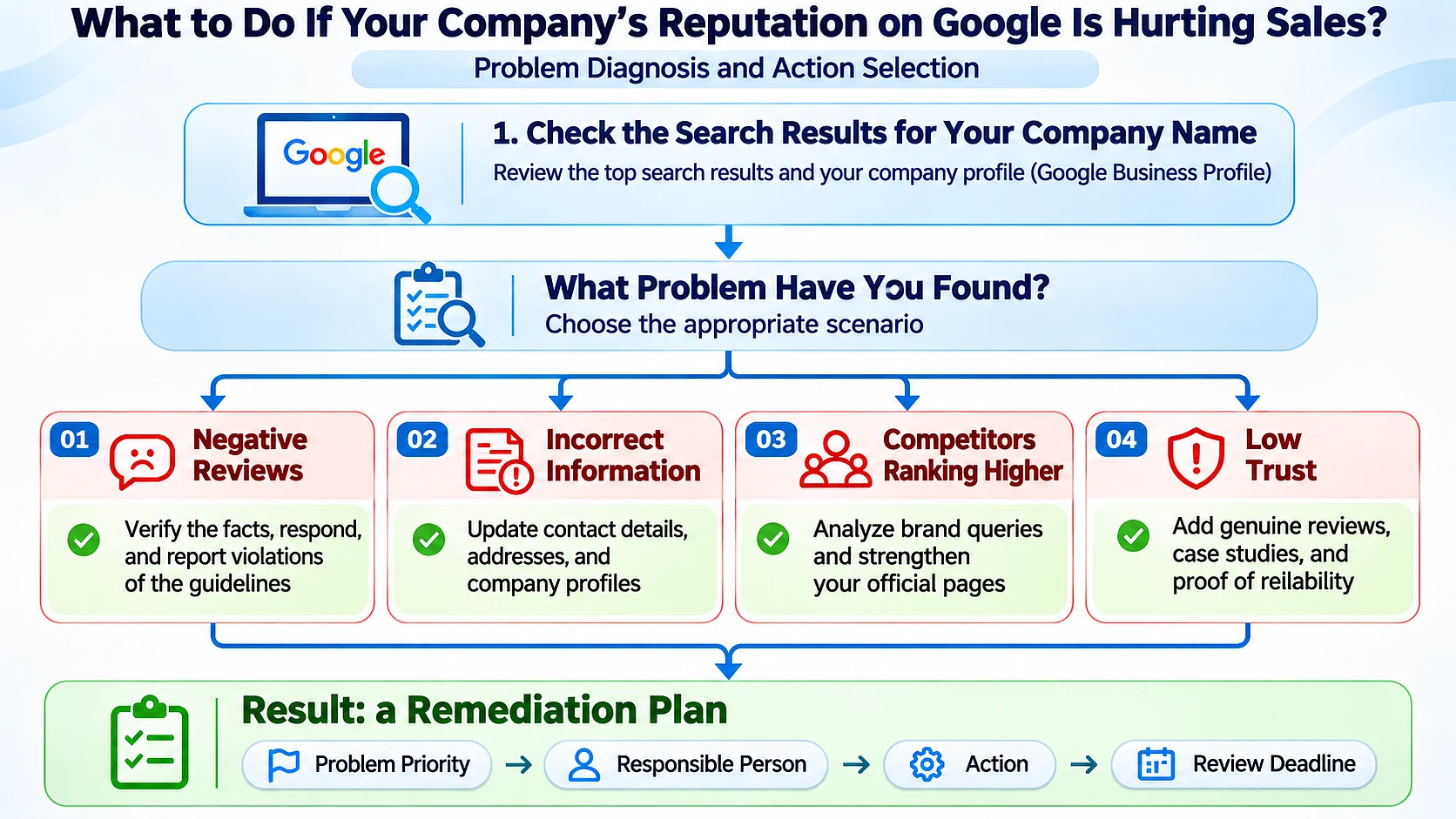
For each action, record the evidence, responsible person, dependencies, and completion check. Prioritize issues that block contact or expose customers to harm, then address the most visible trust gaps. This gives leadership a work plan rather than an undifferentiated list of negative results.
Reputation Management for Businesses: A Practical Recovery Plan
Start with assets and processes you control: official profiles, contact details, website evidence, and review responses. Then address third-party inaccuracies and build legitimate independent coverage. Each action should have an owner and a clear completion condition.
Establish monitoring and ownership
- Claim eligible business profiles and secure access through company-controlled accounts.
- Correct contact details and publish an accurate business description.
- Set up Google Alerts for your brand and manually check important review platforms.
- Name a daily monitoring owner and a backup.
- Define who can approve public responses and when legal or security teams must become involved.
Alerts are a supplementary signal, not a complete record of every mention. During a sudden increase in complaints, preserve evidence and appoint one communications lead. Publish confirmed information and a next-update commitment your team can meet.
Strengthen evidence on your website
Update the About page, case studies, and trust information with facts a buyer can verify. Explain delivery responsibilities and support arrangements. Publish certifications only when they actually exist, and obtain permission before identifying customers.
Assign owners to keep these pages up to date. Give buyers access to verifiable company information, including legal details, documents, and evidence of experience. Explain the qualifications behind your content and support claims with sources; these are practical trust signals, not a guarantee of Google rankings.
Build legitimate review processes
Invite real clients to share honest feedback after a relevant project milestone. Apply the same neutral invitation process regardless of whether you expect praise or criticism. Do not buy reviews, offer incentives, or selectively direct satisfied customers toward public review platforms.
Reply to negative reviews without exposing the customer's personal or confidential information. Move investigation details into an approved private channel. Avoid pressuring customers to change their review as a condition of resolving the problem.
When handling reviews, protect customer data and discuss account-specific details in private. Make genuine customer experiences easy to verify, as in Webdelo's client reviews section, without offering incentives for positive ratings.
Address competitors and publications
Separate paid competitor placements from organic comparisons. Brand advertising may help where platform rules and applicable trademark law permit it, but it requires a budget and conversion assessment. Competitor visibility alone does not establish a policy violation.
Coordinate this work with digital marketing so advertising and public messaging support the same factual positioning. Credible third-party contributions can add useful context when they offer genuine expertise rather than manufactured endorsements.
For inaccurate publications, send a specific correction request supported by evidence. Genuinely newsworthy reporting and court records generally cannot be removed merely because they are unfavorable. Review legal options with qualified counsel when there is a concrete basis for doing so.
How to Measure Online Reputation Management Results
Measure search reputation against your own audit baseline. Track branded search visibility alongside review handling and qualified inquiries. Star ratings alone cannot show whether buyers find accurate information or proceed to contact your business.
- Branded CTR: use Search Console to track clicks divided by impressions for a consistent set of brand queries. Separate important countries and devices.
- Conversions: use analytics and CRM data to track organic search visits that become inquiries and qualified opportunities.
- Review response rate: measure the share of reviews answered within your chosen reporting period.
- Review trend: track rating movement and recurring complaint themes together.
- Record accuracy: measure accurate business listings against all listings checked in the audit.
- SERP presence: record the visibility of official, credible third-party, negative, and competitor results for the same query set.
Search Console does not provide a complete query-to-lead attribution chain. Treat branded query performance and analytics conversions as complementary evidence. Check sales feedback before attributing a change in inquiries to reputation work.
Review the dashboard monthly and annotate major changes. Google explains that search changes can take effect within hours or take months. No vendor can guarantee a first-place ranking, and a short-term movement does not establish a lasting result.
When Should You Hire a Reputation Management Company?
Outside help becomes useful when branded search problems span several markets, require different specialist skills, or lack an internal owner. Straightforward profile corrections and routine review replies can often stay in-house. Escalate when the scope exceeds your team's capacity to investigate and act consistently.
Signals that justify a broader review include:
- Sales teams repeatedly hear questions about reviews or competitor comparisons.
- Branded CTR declines and a results-page review reveals a relevant change.
- Search results differ materially across the USA, Germany, and Russian-speaking markets.
- Critical publications or competitor pages occupy prominent positions for important brand queries.
- Marketing, support, and legal teams have no shared response process.
Ask a potential partner for a sample audit format, evidence standards, and reporting method. Establish which actions require your approval and who controls the accounts. Country-specific legal questions should go to qualified counsel.
Reject guaranteed review deletion, guaranteed rankings, fake reviews, and undisclosed link schemes. A credible engagement defines deliverables, dependencies, and review points. Its promises concern the work the provider controls.
How Webdelo Helps Businesses Protect Their Reputation on Google
Webdelo starts with a branded search audit and connects the findings to technical, content, and review-management work. We prioritize accurate information and verifiable trust evidence. We do not promise to delete genuine reviews or guarantee rankings.
The audit scope includes:
- A brand query map for agreed markets and languages.
- A review of visible business profiles and NAP consistency.
- A review-policy assessment separating customer complaints from potential violations.
- An assessment of official pages and their search visibility.
- A KPI baseline and prioritized action plan with responsibilities.
For leadership, the result is a clearer allocation of work: which issues belong to customer service, which need website changes, and which require specialist review. Progress can then be evaluated against search visibility and qualified inquiries rather than promises to make criticism disappear.
Request a branded search audit from Webdelo. Identify what buyers encounter before contacting you and which corrections deserve attention first.
Frequently Asked Questions
What is online reputation management and why does it matter for B2B companies?
Online reputation management is the work of monitoring and improving how a business appears online, including in the search results for its company name. In B2B, procurement managers and finance directors often Google a supplier just before sending an inquiry or signing a contract. Negative reviews, competitor ads, or outdated contact details at that moment can stop a deal, and no lost opportunity is ever recorded in the CRM.
Can negative Google reviews be removed?
An honest negative review that complies with Google's policies cannot be removed simply because it hurts your reputation. You can flag reviews that appear to violate Google's rules, such as fake engagement, conflicts of interest, or off-topic content, through Google Business Profile, but Google alone decides on removal. Potentially unlawful content needs a legal assessment and a separate legal removal request, and no provider can honestly guarantee deletion.
How should a business respond to a genuine negative review?
Reply publicly and factually: acknowledge the reported issue, explain what you can establish, and name the next step. Move account-specific details into a private channel and never disclose the customer's personal or confidential information. Do not claim the problem is solved before the customer confirms it, and never make resolution conditional on changing the review. Recurring complaint themes should go to the delivery or support team, because a reply template does not fix an operational issue.
What is the difference between ORM, SERM, and SEO?
ORM covers how a business is perceived across all online channels, including reviews, social media, forums, and press. SERM (search engine reputation management) focuses specifically on what appears in search results for brand, executive, product, and complaint queries. SEO improves search visibility through technical and content work and is one of the tools used in SERM. None of them can dictate Google's ranking order or erase another publisher's content.
Why do competitors appear when customers search for my company name?
Competitors can appear through ads that target searches for your brand or through organic comparison pages, while review sites and directories rank when their pages answer the query better than yours. First separate paid placements from organic results, since competitor visibility alone is not a policy violation. Then strengthen relevant official brand pages and assess whether your own brand advertising is worth the budget, within platform rules and applicable trademark law.
Which KPIs show whether online reputation management is working?
Measure against your own audit baseline using branded CTR in Search Console, organic visits that turn into inquiries and qualified opportunities, review response rate, review trend, the share of accurate business listings, and the visibility of official versus negative or competitor results. Star ratings alone are not enough. Review the dashboard monthly, check sales feedback before attributing changes to reputation work, and remember that search changes can take hours or months to show.
When should a company hire a reputation management agency, and what should it avoid?
Outside help makes sense when branded search problems span several markets or languages, need different specialist skills, or have no internal owner, for example when sales keeps hearing questions about reviews. Ask for a sample audit format, evidence standards, and a reporting method, and keep control of your accounts. Reject anyone offering guaranteed review deletion, guaranteed rankings, fake reviews, or undisclosed link schemes. Webdelo starts with a branded search audit and a prioritized action plan rather than such promises.