



Introduction
When B2B companies ask whether SEO or paid search advertising brings more qualified leads, they are asking the right question - but framing it the wrong way. According to Gartner, 61% of B2B buyers prefer a rep-free buying experience, which means your search presence is where your buyers go first - before they ever talk to your sales team. The question is not which channel wins. The question is which channel serves your business best, and at what stage.
In our work with B2B companies across CIS, Germany and the United States, we see the same pattern: companies that compare SEO vs paid search as competing options end up underinvesting in both. Companies that treat them as a connected system - supported by a quality website, proper analytics and CRM integration - consistently generate more qualified leads at a lower long-term cost per acquisition.
This article gives you a clear framework for that decision: when each channel delivers more value, how they work together, and what market-specific factors matter in the US, Germany and CIS markets.
The Direct Answer: SEO, Paid Search or Both for B2B
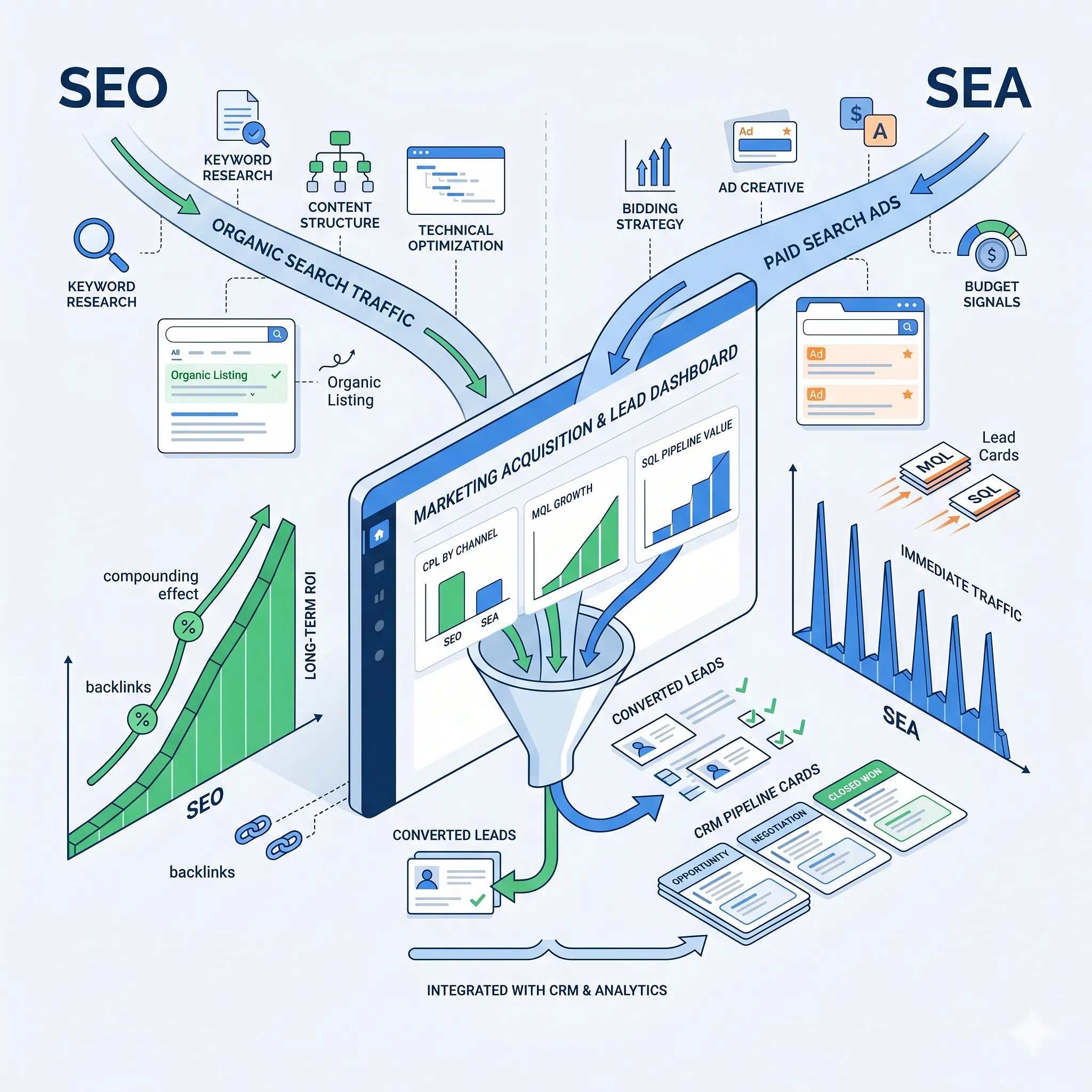
For most B2B companies, paid search brings leads faster while SEO builds more durable visibility at lower long-term cost per qualified lead. Neither channel alone is the complete answer. The combination - supported by a high-quality website and reliable analytics - typically outperforms either channel on its own.
Paid search (also called SEA or PPC) delivers results from day one. You can target specific commercial keywords, test messaging and start filling your pipeline within days of launching a campaign. That speed comes with a cost: you pay for every click, and the moment you stop the budget, the leads stop too.
SEO takes longer to build - most B2B keywords require 6 to 18 months to rank - but the returns compound over time. First Page Sage reports average conversion rates of 2.4% for SEO compared to 1.3% for PPC, based on client data from 2022 to 2024. Organic leads also tend to close at higher rates because buyers who find you through search have already done their research.
"Paid search is useful when a company needs quick feedback from the market. SEO is useful when a company wants to turn that feedback into a long-term asset." - B2B web development and search marketing team
SEO, SEA, PPC, SEM and Paid Search: What the Terms Actually Mean
Before comparing channels, it helps to establish clear definitions - especially for B2B teams working across English and German-language markets, where the same concepts carry different names.
SEO (Search Engine Optimization) is the practice of improving how search engines crawl, index and rank your website in organic (unpaid) search results. According to the Google Search Central SEO Starter Guide, SEO is fundamentally about helping search engines understand your content and helping users find it. It includes technical foundations (site speed, mobile performance, crawlability), on-page content quality, and authority signals from other sites linking to yours.
SEA (Search Engine Advertising) places paid ads at the top of search results and charges a fee each time someone clicks. SEA is the standard term in German-speaking markets, where it is described as Suchmaschinenwerbung. In US and English-language markets, the same concept is most often called paid search or PPC (pay-per-click). The broader term SEM (Search Engine Marketing) can technically cover both paid and organic search, but in practice most teams use it to mean paid search campaigns.
For B2B teams working across markets: if your German colleagues talk about SEA and your US colleagues talk about PPC, they mean the same thing. Understanding this avoids confusion when reporting channel performance across regions.
"SEO is not a secret formula for first place. It is a system that helps search engines and users understand the page, trust it and use it." - B2B web development and search marketing team
SEO vs Paid Search for B2B Lead Generation: Side-by-Side Comparison
The two channels differ fundamentally in speed, cost structure, control and the type of leads they attract. The table below shows the key differences from a B2B perspective.
| Factor | SEO (Organic Search) | Paid Search (SEA / PPC) |
|---|---|---|
| Time to first lead | 6-18 months for competitive B2B keywords | Days to weeks after campaign launch |
| Cost structure | Content, technical work, time investment upfront; no per-click cost | Pay per click; avg. CPC $5.26, avg. CPL $70.11 (WordStream 2025); costs up 12.88% YoY |
| Lead quality | Higher close rates; organic leads close at 14.6% vs 1.7% for outbound | Variable; depends heavily on landing page quality and targeting precision |
| Trust level | More than 70% of users trust organic results more than paid ads | Lower initial trust; compensated by relevance and offer clarity |
| Control and targeting | Limited control over ranking; broad audience via content strategy | Precise targeting by keyword, audience, geography, device and time |
| Risk profile | Algorithm updates can affect rankings; long build time before results | Costs rise continuously; traffic stops when budget stops |
| Long-term ROI | 500-1300% after 12+ months of consistent investment | Typically around 200%; stays relatively flat without active optimization |
| Best business situation | Established company, long sales cycle, want to reduce budget dependency | New market entry, product launch, need leads now, testing offers |
One important cost trend: WordStream / LocaliQ Google Ads Benchmarks 2025 confirm that search advertising costs have increased year over year for five consecutive years. B2B SaaS keywords now average $15.36 per click; cybersecurity runs around $10.44; HR Tech averages $14.32. This sustained cost growth makes long-term SEO investment increasingly attractive as a cost reduction strategy.
When Paid Search Advertising Brings More Value
Paid search delivers the strongest results when a company needs leads quickly, is entering a new market, or is testing a new offer before committing to long-term content investment. Speed and precision targeting are the key advantages - and they come at a price that is worth paying in the right circumstances.
Business situations where paid search is the stronger choice:
- Product launch or new market entry: need fast demand validation before investing in SEO content
- No organic rankings yet: the website is new or the commercial keywords are competitive with no organic history
- Seasonal or time-limited demand spikes: campaigns can be turned on and off with timing control
- Testing positioning and offers: paid search gives measurable feedback on messaging before scaling
- High-intent commercial keywords with short sales cycles: buyers who search "CRM software for 50-person team" are ready to evaluate options
- Startup or new brand with no organic history: no authority means no organic rankings in the short term
How Ad Rank Works - and Why Budget Alone is Not Enough
A common misunderstanding in B2B is that more budget automatically means better paid search performance. According to Google Ads Help: About Ad Rank, your ad's position and reach are determined by bid combined with quality factors: expected click-through rate, ad relevance and landing page experience. A strong landing page with a relevant offer can outperform a higher-bidding competitor.
Landing page quality has a direct financial impact: a weak or misaligned landing page raises your CPC and reduces your ad's reach and position, even with a higher bid. Improving landing page experience is often the fastest way to reduce paid search costs without reducing budget.
Key conditions for paid search to work well in B2B
- Strong landing page: clear offer, single conversion path, fast load time on mobile
- CRM tracking connected to ad platforms: attribution requires closing the loop from ad click to qualified lead
- Sufficient budget for statistical learning: typically 30-50 conversions per month per campaign for Google's algorithms to optimize
- Defined ICP (ideal customer profile): targeting without an ICP generates volume, not qualified leads
When SEO Brings More Value
SEO delivers its strongest return when a company has a longer-term view, wants to reduce dependency on ad budgets, and is in a market where buyers research extensively before engaging a vendor. The close rate advantage is significant: organic leads close at 14.6% compared to 1.7% for outbound, according to First Page Sage and Ruler Analytics data.
Business situations where SEO is the stronger choice:
- Long B2B sales cycle (3-12 months): buyers research at every stage - educational content ranks and captures intent early in the funnel
- Building long-term market presence: compounding organic visibility that does not stop when budget stops
- Strong content expertise: teams that can produce authoritative, in-depth content have a genuine SEO advantage
- Educational or research-intent keywords: top-of-funnel content that meets buyers early in their journey
- Reducing cost per qualified lead over time: as organic traffic grows, the cost per lead falls while paid search costs keep rising
- Company already running paid search: SEO makes the whole system cheaper by building organic coverage for keywords you are currently paying for
What SEO Actually Requires in B2B
- Technical website quality: page speed, mobile performance, HTTPS, clean crawlability - these are prerequisites, not optional
- Content that demonstrates real expertise: Google's E-E-A-T framework rewards genuine experience and authoritativeness, not keyword stuffing
- Patience: most competitive B2B keywords require 6 to 18 months to rank; expecting faster results leads to abandoning the investment too early
- Ongoing effort: content creation, link building and technical maintenance are continuous, not one-time activities
In our experience with B2B clients, the companies that get the most from SEO are those that treat it as a system - not a campaign. The investment builds over time, and the compounding returns are what make it genuinely cost-efficient at scale.
Why Cost Per Lead Is the Wrong Primary Metric for B2B
Cost per lead (CPL) is easy to measure and easy to optimize - which makes it one of the most misleading metrics in B2B marketing. A low CPL channel that produces leads that never convert to revenue costs more than a high CPL channel that produces buyers. In B2B, the right question is not "how much does the lead cost?" but "what is the cost of a closed deal?"
"For B2B we do not judge a channel only by lead volume. We look at lead quality, sales fit, cost of qualified lead, pipeline and the technical condition of the website." - B2B web development and search marketing team
B2B funnel metrics that actually reflect channel performance:
| Metric | What it measures | Why it matters |
|---|---|---|
| Lead (raw contact) | Someone who expressed interest | Volume indicator only; quality varies widely |
| MQL (Marketing Qualified Lead) | Meets basic criteria for your ICP | First quality filter; average MQL-to-SQL rate is 13% across industries |
| SQL (Sales Qualified Lead) | Sales-ready; meets buying criteria | Top teams with behavioral scoring reach 39-40% MQL-to-SQL conversion |
| Opportunity | Active deal in the pipeline | Indicates real purchase intent and budget |
| Closed-won | Revenue generated | The only metric that pays the bills |
| CAC (Customer Acquisition Cost) | Total cost per new customer | Includes all marketing and sales spend, not just ad spend |
| Cost per qualified lead | Cost per MQL or SQL | More meaningful comparison than raw CPL across channels |
Response speed also matters: companies that respond to SQLs within one hour convert them at 53%, compared to 17% when responding after 24 hours. This means CRM integration and lead routing are not just nice-to-have features - they directly affect the financial return of whichever channel generates the leads.
Paid search often generates more "accidental" leads when landing pages are weak and CRM integration is missing. These leads inflate CPL averages without contributing to pipeline. Before comparing SEO and paid search by cost, make sure you are measuring qualified lead cost, not raw lead volume.
How SEO and Paid Search Work as a Connected System
SEO and paid search are most effective when they reinforce each other. Paid search generates fast data about which keywords, offers and landing pages drive conversions. SEO turns those validated signals into long-term organic assets. The website, analytics stack and CRM are the connective tissue that make both channels measurable and improvable.
Forrester predicts that more than half of large B2B transactions of $1 million or greater will be processed through digital self-service channels - vendor websites and marketplaces. This means your search presence, and the quality of your website behind that presence, is not a marketing question. It is a revenue infrastructure question.
How a connected B2B search system typically develops over time:
- Early stage / new market entry: higher weight on paid search (roughly 60%) for fast pipeline fill and demand validation; SEO investment (40%) begins building foundations
- Growth stage: gradual shift toward 50/50 as organic content starts ranking and the paid search keyword list is validated
- Established organic presence: 60-70% of investment in SEO, 30-40% in paid search focused on high-intent commercial queries
Website Quality as the Shared Foundation
One of the most important - and most overlooked - factors in search lead generation is website quality. Slow sites, poor mobile experience and missing HTTPS hurt both SEO rankings and Google's Ad Rank simultaneously. Improving technical website quality is the only investment that makes both channels cheaper and more effective at the same time.
- Page speed and mobile performance affect both organic rankings and paid search Quality Score
- Landing pages with 5 or fewer form fields convert 120% better than those with more fields
- Clear value propositions, case studies and trust signals reduce friction for both organic and paid visitors
- Proper analytics and conversion tracking make it possible to measure what is actually working
Search Lead Generation in CIS and Russian-Language Markets
In CIS and Russian-language markets, Yandex is the dominant search engine with 72.69% market share in Russia as of March 2026, according to StatCounter. For B2B companies targeting these markets, search strategy means Yandex strategy - Google plays a secondary role, and the tools, platforms and ranking factors are fundamentally different from Western markets.
Key facts for CIS market search strategy:
- Yandex reaches 101.9 million users in Russia monthly - 82.9% of the population over 12 (RMAA data), making it the primary channel for any Russian-language B2B lead generation
- Paid search in CIS = Yandex Direct (контекстная реклама): the primary paid search platform; Google Ads is relevant for international companies or Google-indexed traffic
- Since 2025, Yandex Direct operates fully on automated conversion-based strategies: manual bid management is no longer available; campaigns must be structured around conversion goals
- Yandex SEO uses neural ranking models (YATI, CS YATI, YALM) that evaluate depth of expertise and logical structure, not just keyword presence - shallow content ranks poorly
- Search demand research: use Yandex Wordstat for keyword research, regional volume analysis and understanding CIS-specific search demand patterns
For B2B in CIS markets, longer decision cycles and high trust requirements mean that SEO content demonstrating genuine expertise is especially valuable. Phone and email follow-up remain important in the sales process, and CRM integration for tracking these touchpoints is critical.
Search Lead Generation in Germany
Germany uses the same primary platforms as the broader EU market - Google holds 80.05% of the search market as of March 2026 (StatCounter) - but operates under stricter data privacy requirements that directly affect how you measure and optimize both paid search and SEO. Getting the compliance layer wrong does not just create legal risk; it breaks your analytics.
Key factors for the German market:
- Terminology: SEA is the standard German term for paid search advertising (Suchmaschinenwerbung); use German terms with English equivalents in parentheses for international teams
- Consent Mode is required for EEA traffic: proper consent signals are needed for Google Ads measurement, ad personalization and remarketing; without it, conversion tracking breaks and campaign optimization suffers
- From April 1, 2025: Germany's new Consent Management Ordinance requires a recognized CMP (Consent Management Platform) service - this is a legal requirement, not a recommendation
- Trust signals matter: legal pages (Impressum, Datenschutzerklarung) are not only legal requirements - their absence damages credibility with German B2B buyers who treat data protection compliance as a vendor evaluation criterion
- Bing is relevant at 9.99%: for enterprise B2B targeting Microsoft ecosystem users, Bing Ads (Microsoft Advertising) is worth including in the media plan
In Germany, data privacy compliance (DSGVO/GDPR) is a buying criterion for B2B companies. Demonstrating that your website and tracking setup work within DSGVO principles is part of building trust with German clients - not just a legal checkbox.
Search Lead Generation in the United States
The US market operates with Google at 85% search market share (StatCounter, March 2026) and uses different terminology and metrics than German or CIS markets. US B2B teams focus on pipeline, CAC, sales cycle length and CRM-based revenue attribution as the primary measures of search channel performance.
Key factors for the US market:
- Terminology: "SEO vs PPC" or "SEO vs paid search" are standard; the term SEA is not used in the US context
- Bing Ads (Microsoft Advertising) at 9.85% share: relevant for enterprise B2B targeting decision-makers who use Microsoft 365 and LinkedIn integration
- CPC levels are above global averages: especially in SaaS, FinTech and Legal verticals, where $15+ CPCs are common for commercial keywords
- Privacy laws are expanding: as of April 2025, 20 US states have comprehensive consumer privacy laws affecting tracking and analytics setup; this impacts paid search measurement and retargeting strategies
- AI search is growing fast: approximately 60% of B2B buyers use AI tools (ChatGPT, Perplexity, Gemini) to research vendors; SEO content structured to answer questions clearly is becoming important for AI citations, AI Overviews, and GEO optimization
- B2B buying behavior: 61% of B2B buyers prefer a rep-free experience (Gartner); Forrester predicts more than half of $1M+ B2B transactions will go through digital self-service channels
Decision Matrix: Which Channel to Choose in Your Situation
The right channel depends on your business stage, budget, sales cycle and target markets. Use this matrix to map your situation to the recommended approach, then validate against your own data.
| Business Situation | Recommended Approach | Why |
|---|---|---|
| New company, no organic rankings | Paid search first, build SEO in parallel | No time to wait 12+ months; need leads to fund growth |
| Established company, long B2B sales cycle | SEO priority, paid search for high-intent queries | Compounding organic returns lower CPL over time |
| Entering a new geographic market | Paid search first | Fast feedback and market validation before content investment |
| Seasonal or event-driven demand | Paid search for peaks, SEO as baseline | Timing control; organic presence captures non-peak traffic |
| Testing a new offer or product line | Paid search | Fast iteration and measurable response before committing to content |
| Budget-constrained, long-term view | SEO with long-tail content focus | No per-click cost; compounding returns with consistent effort |
| Enterprise B2B, 6-12 month sales cycle | Both channels, full-funnel content | Buyers research at every stage; need visibility across the entire funnel |
| CIS market | Yandex Direct + Yandex SEO | Yandex holds 72.69% market share; Google Ads is secondary |
| German market | Google Ads + SEO + proper Consent setup | DSGVO compliance and Consent Mode are operational requirements |
| US market | Google Ads (+ Bing) + SEO | Full-funnel coverage with pipeline tracking and privacy compliance |
Website Readiness Checklist Before Scaling Any Search Channel
Before increasing spend on either SEO or paid search, confirm your website is ready to convert the traffic you generate. A weak website wastes both channels.
- Page speed under 3 seconds on mobile (Core Web Vitals passing)
- Mobile-responsive design with clear navigation
- HTTPS on all pages
- Contact forms with 5 or fewer fields
- Clear value proposition on every landing page
- Analytics properly configured with conversion tracking
- CRM connected to lead capture forms
- Call tracking or chat integrated with CRM
- Consent management in place (required for EU/Germany, increasingly important in the US)
- Case studies or client references visible without registration
How We Approach Search Lead Generation at Webdelo
At Webdelo, we work with B2B companies in CIS, Germany and the United States on search-based lead generation as a connected system. We measure what matters - MQL, SQL, cost per qualified lead and pipeline influence - not just traffic and lead volume. Our team has handled both the technical and marketing sides of this work since 2006, which means we understand how website architecture, tracking setup and content quality affect real business outcomes.
Our starting point is always an audit, not a plan. Before recommending budget allocation, channel mix or content strategy, we look at the current state of your website, tracking setup, analytics, existing rankings and paid search performance. This gives us a grounded picture of what is actually limiting your lead generation - and where the fastest improvements are.
What our search lead generation work typically covers:
- SEO site audit: speed, mobile performance, crawlability, conversion paths, form optimization
- Analytics and tracking setup: making sure every lead source is properly attributed and CRM-connected
- Paid search campaigns: Google Ads for US and European markets; Yandex Direct for CIS markets
- SEO content: keyword research, content planning, on-page optimization, E-E-A-T signals
- Landing page development: pages built for conversion, not just traffic
- Market localization: adapting search strategy for US, German and CIS markets - including compliance requirements in each region
- Consent Mode and privacy compliance: properly configured for EEA requirements; aligned with US state privacy law requirements
We built processes aligned with ISO 27001 and SOC 2 principles for how we handle client data and analytics configurations. Our team operates across USA, Germany and Eastern Europe, which allows us to work with B2B companies that need a technical partner understanding local market realities - not just a vendor applying a global template.
Conclusion
SEO and paid search solve different problems, and B2B companies that treat them as competitors end up with a weaker lead generation system than companies that connect them. The practical framework is straightforward: use paid search for speed, market validation and high-intent commercial queries; use SEO for compounding visibility, lower long-term cost per qualified lead and building authority with buyers who research before they engage.
- Paid search and SEO are complementary - they feed each other when connected through quality website, analytics and CRM
- Lead quality metrics (MQL, SQL, cost per qualified lead) reveal the real channel performance; raw CPL is a misleading comparison point
- Market matters: CIS needs Yandex expertise; Germany needs DSGVO compliance and Consent Mode; the US needs pipeline tracking and privacy-compliant analytics
- Technical website quality is the shared foundation - improving it makes both channels cheaper and more effective
- Search advertising costs have risen every year for five consecutive years; this trend makes long-term SEO investment more valuable, not less
If you want a clear picture of where your search lead generation stands today - website quality, paid search performance, SEO coverage, analytics accuracy, and market-specific gaps - we can run a structured audit. We cover website technical quality, SEO status, paid advertising setup, analytics and tracking, landing page conversion, and local market adaptation for the US, Germany and CIS markets. Request a search lead generation audit from the Webdelo team and we will come back with a grounded assessment and a practical next step.
Frequently Asked Questions
What is the main difference between SEO and paid search advertising?
SEO (organic search) builds long-term visibility without per-click costs, but takes 6-18 months to show results. Paid search (PPC/SEA) delivers leads within days but requires continuous budget - the moment you stop paying, the leads stop. SEO converts at higher rates (2.4% vs 1.3%) because buyers who find you organically have already researched you.
Should B2B companies choose either SEO or paid search, or do both channels together?
Most successful B2B companies use both channels as a connected system. Paid search provides fast data about which keywords and offers convert - then you invest that validated learning into long-term SEO content. Over time, as organic traffic grows, your cost per qualified lead falls while paid search costs continue rising. The combination, supported by website quality and CRM integration, outperforms either channel alone.
When should a B2B company prioritize paid search over SEO?
Use paid search first when you need immediate results: launching a new product, entering a new market, testing positioning or messaging, or when your website has no organic rankings yet. Paid search also works when you have a short sales cycle and high-intent commercial keywords where buyers are ready to evaluate options immediately. Once you have validated what converts through paid data, invest those insights into SEO content.
Why is cost per lead (CPL) a misleading metric for comparing SEO and paid search?
CPL is easy to measure but reveals nothing about quality or revenue. A low CPL from a channel that produces leads that never convert costs you more than a high CPL from a channel producing actual customers. In B2B, measure instead: MQL-to-SQL conversion, cost per qualified lead, pipeline influence, and closed-won revenue. SEO leads close at 14.6% while outbound-generated leads close at 1.7% - a massive quality difference that CPL alone hides.
How do SEO and paid search work together as a connected system?
Paid search gives you fast, measurable data about which keywords, offers and landing pages convert - this becomes your SEO content roadmap. As SEO content ranks and organic traffic grows, you shift budget from paid to organic because your cost per lead drops. Website quality (page speed, mobile experience, conversion rate) is the shared foundation that makes both channels cheaper and more effective. Analytics and CRM integration tie everything together so you can actually measure what works.
What is the difference between SEO, SEM, PPC and SEA? Are they the same thing?
SEO is organic (unpaid) search optimization. PPC and SEA both mean paid search advertising - PPC is the English term, SEA is the German term (Suchmaschinenwerbung). SEM technically covers both paid and organic, but in practice most teams use it to mean paid search. In Cyrillic markets, the primary paid platform is Yandex Direct. Bottom line: if people are talking about paid search with different terms across regions, they mean the same thing. Understanding terminology avoids confusion in international B2B teams.
How long does it take to see results from SEO compared to paid search?
Paid search delivers leads within days to weeks of campaign launch - you can see results immediately. SEO takes much longer: most competitive B2B keywords require 6 to 18 months to rank at all. This is why new companies or products often start with paid search for fast market validation, then parallel-build SEO content while the campaign runs. After 12+ months of consistent SEO investment, the long-term ROI (500-1300%) exceeds paid search (typically 200%), and your cost per lead gradually falls as organic traffic compounds.
