

What Is a Customer Acquisition Strategy?
A customer acquisition strategy defines which customers a business wants to win, how it will reach them, what it is prepared to invest and how it will judge success. Channels are only one part of it. The strategy also covers the offer, the website journey, the sales process and the metrics that connect spending to new revenue.
At Webdelo, we assess channel selection alongside website performance and the sales process. If you cannot connect a lead source to a closed deal, increasing your advertising budget will not tell you what actually brings in customers.
Customer acquisition vs. lead generation vs. demand generation
Demand generation builds awareness of a problem and of your way of solving it, often among people who are not yet looking. Lead generation turns that interest into identifiable contacts. Customer acquisition covers the whole path and ends only when a lead becomes a paying customer.
The distinction matters for measurement. An inquiry from a potential buyer is a lead, and checking whether that prospect fits your target audience is qualification. A campaign can look strong on lead volume and still fail as acquisition if few of those leads qualify or close.
Why choosing channels without a strategy leads to wasted spend
When a team picks channels first, each one tends to be judged by its own platform metrics: clicks, impressions or form fills. Without agreed goals, nobody can say whether a channel brought the right customers at an acceptable cost, and budgets follow whichever dashboard looks busiest.
It also helps to separate channels from tools. A social network is a channel, while expert posts and targeted ads are customer acquisition tactics used within it. You can change ads and formats without changing the channel, so a weak campaign does not always mean a weak channel.
Build Your Acquisition Strategy Around the Right Customers
The question of how to acquire customers starts with deciding which customers are worth acquiring. A clear customer definition narrows the list of channels, shapes the offer and sets the economic limits for spending.
Define your ideal customer profile and target segments
An ideal customer profile (ICP) describes the buyers who get the most value from your offer and are most valuable to your business. In B2B it usually includes industry, company size, region, buying roles and the problem you solve. Segments within the ICP group buyers who share a need and respond to the same message.
Start by talking to current customers. Find out what need led them to buy, where they looked for a solution, and why they chose your company. Compare their answers with the lead sources in your analytics.
Map the buyer journey and purchase triggers
The buyer journey runs from first contact through interest, inquiry, qualification and deal to repeat purchase. For each stage, note what the buyer needs to know and where they look for it. Purchase triggers, such as a new regulation or a failed system, show when a segment is most likely to act.
A single customer may interact with several channels. An executive might hear about a service on a podcast, later find the website through search, and request a demo after exchanging messages. If you track only the final inquiry, that first encounter goes unnoticed.
Align acquisition goals with business economics
"Acquire new customers at an acceptable acquisition cost by an agreed date" is a more useful goal than "increase traffic." Set targets based on contribution margin, cash position and team capacity. You can estimate an acceptable cost per lead from your target customer acquisition cost and the expected share of leads that become customers; without sales history, treat that share as a hypothesis.
Customer Acquisition Channels: Which Options Should You Consider?
Customer acquisition methods differ in audience intent and how contact happens. Search reaches someone with an existing need, while content and advertising can build interest in an unfamiliar solution. Your website brings online customer acquisition channels together, and a CRM, a system for managing contacts and deals, shows what happens after someone submits a form or calls.
Organic search, SEO and content marketing
SEO helps users find your website in organic search results. It is useful when people already search for your product or for ways to solve a related problem. Results build gradually and require technical maintenance and useful content.
Content explains a complex offer before a buyer speaks with sales: a demo answers questions about using the product, while a case study shows how the team works. Choose formats based on buyers' questions and the resources available to publish regularly.
Paid search, paid social and display advertising
Paid search lets you test an offer against existing demand once a campaign goes live. Paid social and display advertising reach audiences by characteristics and interests, which makes them useful for demand creation. Remarketing brings back visitors who have not yet completed a purchase.
A useful test depends on precise targeting and a match between the ad and the landing page. A quick launch alone does not guarantee leads or an acceptable acquisition cost.
Social media, communities and thought leadership
Professional communities and expert profiles reach buyers who are learning about a problem rather than searching for a vendor. Thought leadership works when your specialists share concrete experience that helps buyers decide. It builds trust slowly, so judge it by its influence on later inquiries and plan it only if someone can contribute regularly.
Email, outbound sales and account-based marketing
Email and messaging apps are useful for engaging an existing contact database, with each message matched to the recipient's interests and buying stage. Marketing messages require a lawful basis, any necessary consent, and a way to opt out.
Outbound sales and account-based marketing (ABM) focus effort on a defined list of target accounts through personalized outreach, events and direct conversations. These methods require employee time, so their cost is not zero even without advertising spend.
Referrals, partnerships and affiliate channels
A referral transfers some of the trust in a partner to your company. Technology partners, agencies and complementary vendors can introduce you to buyers who already trust them, while affiliate programs need clear rules on what counts as a referred customer. Directories, marketplaces and maps also belong here; include their commissions and contact restrictions in your calculations.
Audio advertising, podcasts and emerging channels
Audio is usually an additional channel rather than a starting point. Radio supports broad awareness, while niche podcasts and internet radio let you select audiences by interest. Connecting a listening session to a sale is harder than tracking a click, so decide in advance how you will measure reach and inquiries.
Our guide to digital audio advertising explains the placement formats. If you want to engage your own audience regularly, assess what it takes to start an internet radio station and maintain it. A dedicated page, a promo code and the question "where did you first hear about us?" help track responses.
How to Choose Marketing Channels for Your Business
Effective customer acquisition channels match your audience, demand and available resources. First understand how buyers choose a solution and how long a deal takes, then compare candidates by intent, cost, speed and the effort needed to run them well.
Evaluate customer intent, reach and competitive pressure
If buyers already search for a specific solution, you can test a search channel. If the product is unfamiliar, you first need to explain the need it addresses. Reach matters too: a channel is only useful if a meaningful share of your ICP actually uses it.
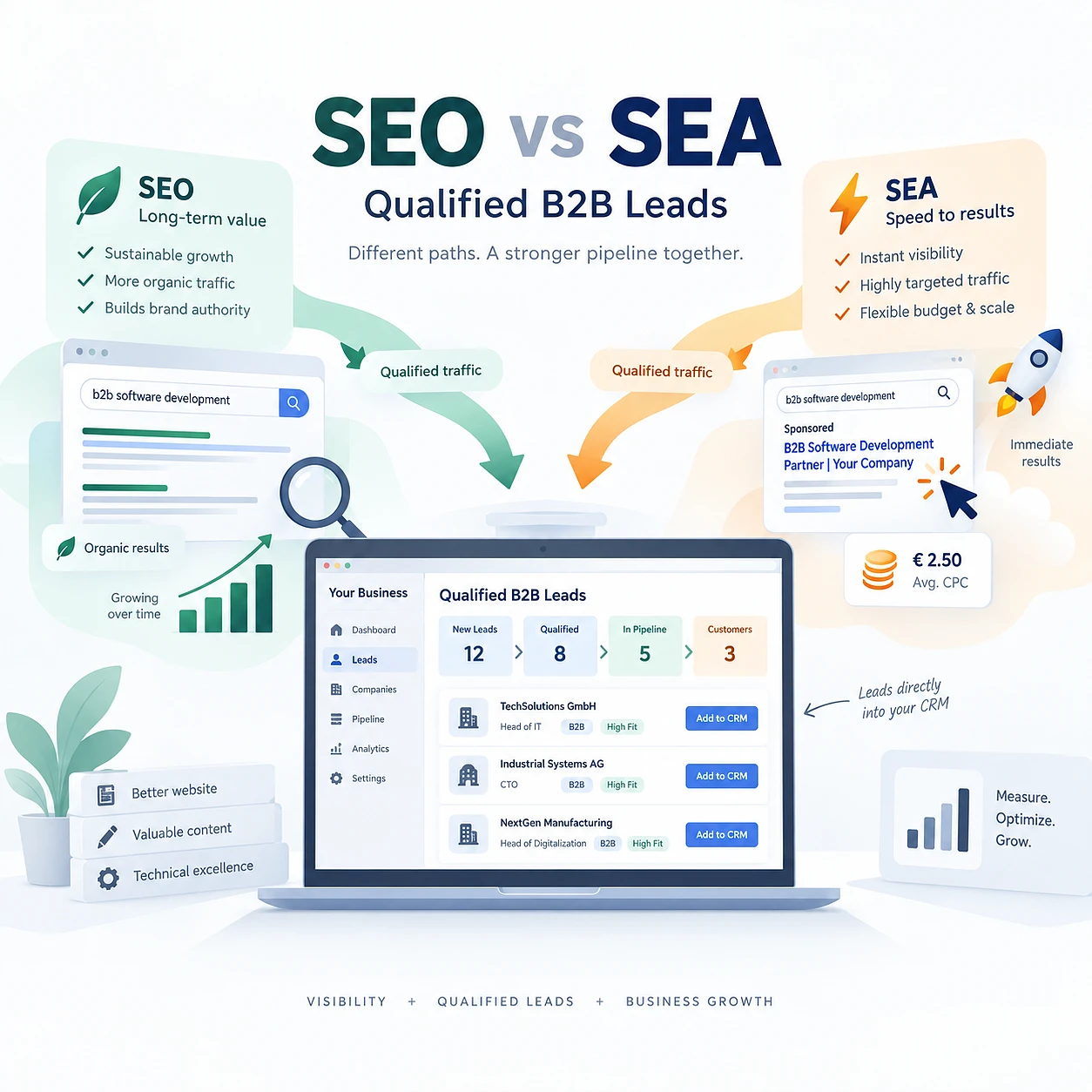
Competitive pressure changes the cost of entry, as crowded auctions and saturated search results raise the price of each contact. The choice of SEO vs SEA for B2B leads depends partly on how soon you need data: an advertising test gauges the response to your offer quickly, while organic visibility takes longer.
Compare time to results, channel costs and scalability
Some channels produce measurable signals within weeks, others only after months. Paid media is a variable cost per contact, while content, SEO and partnerships need upfront investment that may pay off later. Scalability asks whether volume can grow without the cost of each new customer rising sharply.
We recommend combining a channel that tests current demand with one you can develop over time. An advertising test can inform future organic landing pages, but do not assume its results will carry over to SEO without testing.
Select channels based on your stage of business growth
Early-stage companies need fast learning about which segment and message work, so channels with quick feedback come first. Growing companies can add channels that take longer to build but reduce dependence on paid traffic. Mature businesses often focus on efficiency, retention and new segments or regions.
With a small budget, choose two or three channels your team can maintain. Competitors can provide ideas to test, but their visible activity does not reveal their actual returns.
B2B Customer Acquisition vs. B2C Acquisition
Choose customer acquisition channels based on how your customers buy. In a complex enterprise deal, you need to help several people assess risk. In a transactional business, you need to make selection and payment easy and bring customers back.
Acquisition channels for long B2B sales cycles
B2B customer acquisition often involves several stakeholders. Executives care about business outcomes, technical specialists about compatibility, and procurement teams about commercial terms. Expert content and direct contact help answer these questions before a contract is signed.
Our overview of B2B marketing channels helps you shortlist options for testing. Evaluate them by tracking how target accounts move into sales discussions and closed deals in your CRM, and only once enough leads have had time to pass through approvals.
Channels for transactional and repeat-purchase businesses
Paid search and marketplaces suit products with established demand. Social media helps demonstrate product use, while follow-up communication reminds customers about their next purchase. Before increasing traffic, check that ordering is easy on mobile.
Here the value of a customer comes from the second and third orders as much as the first. Your own website and a compliant contact database reduce dependence on a single platform, though they still carry acquisition and service costs.
Build a Customer Acquisition Channel Scorecard
A scorecard turns channel selection into an explicit, repeatable decision. The team rates each candidate against the same factors and sees where the trade-offs are. Use it to shortlist channels for testing, not as an effectiveness ranking.
| Evaluation factor | What to assess | Why it matters |
|---|---|---|
| ICP fit | Does the channel reach your ideal customers? | Prevents investment in irrelevant audiences |
| Buyer intent | Are customers actively looking for a solution? | Helps distinguish demand capture from demand creation |
| Time to impact | How quickly can results be measured? | Aligns channel selection with business priorities |
| Testing cost | What investment is required for a meaningful experiment? | Protects limited acquisition budgets |
| Measurement quality | Can leads and customers be linked to the channel? | Supports evidence-based decisions |
| Scalability | Can the channel grow without disproportionate cost increases? | Helps identify long-term opportunities |
| Operational capacity | Can the team maintain and optimize the channel? | Avoids execution bottlenecks |
Rate each channel from 1 to 5 on every factor, then multiply each score by a weight agreed before scoring. The weights are specific to your business, so there is no universal ranking: the same channel can score high for one company and low for another.
A company that needs data within a quarter might weight time to impact and testing cost highest. A business with a long sales cycle and a narrow ICP might favor ICP fit and measurement quality. A small team should never ignore operational capacity.
Illustrative example with fictional values: a team weights ICP fit at 3 and measurement quality at 2. Channel A scores 4 and 3 on these factors, channel B scores 3 and 5. Before the other factors are added, A has 4 × 3 + 3 × 2 = 18 points and B has 3 × 3 + 5 × 2 = 19. The scores do not decide for you, but they show which assumptions the test should verify.
How to Test Customer Acquisition Strategies Before Scaling
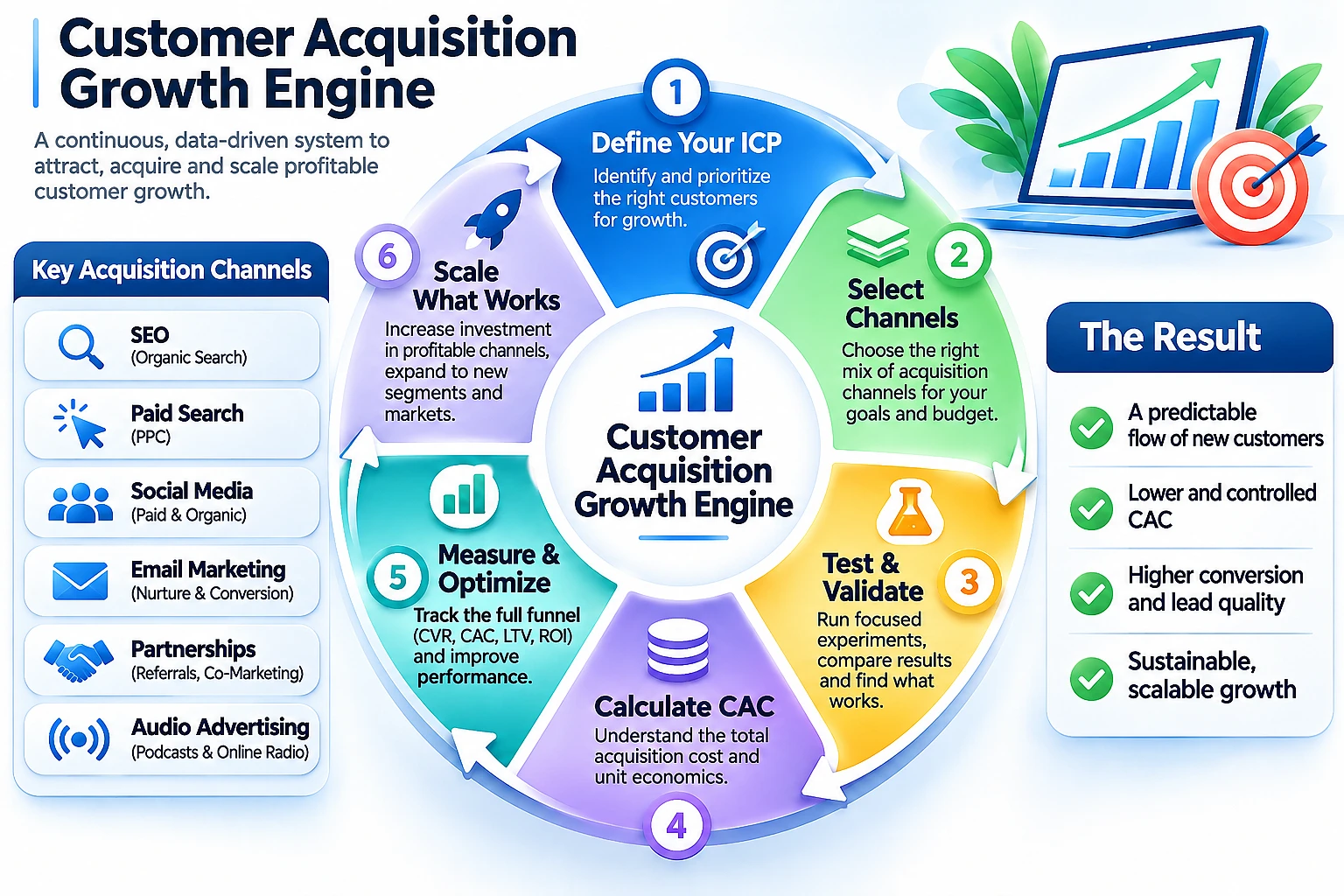
A test connects a customer acquisition strategy with specific actions and a budget. For each test, define the audience segment, channel and offer on the corresponding landing page, so you can tell which hypothesis the results support. Testing is one step in a repeating cycle from ICP to scaling.
Develop a clear acquisition hypothesis
Write a separate, testable hypothesis for each channel. For example: "Paid search for a service aimed at a specific industry will generate inquiries from companies that fit our offer." Define what qualifies as a suitable lead in advance so the assessment does not depend on a sales representative's impression.
Change one significant variable at a time. If you change the audience and offer simultaneously, it will be hard to identify what caused the result.
Define experiments, budgets and success criteria
Include preparation and lead handling in the test budget, not just ad placements. Before launching, agree on:
- A spending limit and test period that account for the sales cycle.
- The conversion events you will count, from inquiry to closed deal.
- Who owns the channel, data quality and lead handover to sales.
- Criteria for continuing, changing or stopping the test.
If the budget cannot support a meaningful test across several channels, reduce their number. Token amounts spread across many platforms rarely produce enough data to decide.
Use test results to prioritize future investment
Make decisions after completing the test agreed on in advance, comparing channels by qualified leads, customers and acquisition cost rather than clicks. Update the scorecard with what you learned. A promising result from a small sample justifies a larger test, not the whole budget, and a weak result may point to the offer or landing page rather than the channel.
Customer Acquisition Cost: CAC, LTV and Payback
Customer acquisition cost (CAC) measures the cost of acquiring a new customer, while cost per lead (CPL) measures the cost of generating a lead. Evaluating a channel requires both, plus an estimate of what customers are worth. Cheap leads do not mean profitable acquisition if they never turn into purchases.
Calculate CAC and understand what belongs in the formula
CAC = total acquisition costs / number of new customers. A complete calculation includes all attributable costs:
- Paid placements and advertising traffic.
- Contractor services and content production.
- Software and services used.
- Marketing and sales staff time attributable to acquisition.
Illustrative example, not a client result: $60,000 in acquisition spending generated 100 leads and 12 new customers.
This CAC is complete only if the $60,000 includes all attributable expenses, not just ad spend. If there are no new customers yet, report spending and deal stages rather than a CAC.
| Metric | Calculation | Strategic use |
|---|---|---|
| Lead Conversion Rate | Leads / Relevant Visitors × 100% | Measure how efficiently traffic converts into inquiries |
| Lead-to-Customer Rate | New Customers / Leads × 100% | Evaluate conversion from leads to paying customers |
| CPL | Lead Acquisition Costs / Leads | Compare the cost of generating leads |
| CAC | Total Acquisition Costs / New Customers | Assess customer acquisition efficiency |
| LTV | Expected contribution margin from a customer over the relationship | Estimate the economic value of acquired customers |
| LTV-to-CAC Ratio | LTV / CAC | Assess whether customer value justifies acquisition cost |
| CAC Payback Period | CAC / Average Monthly Contribution Margin per New Customer | Estimate how long it takes to recover acquisition costs |
These metrics are comparable only with consistent definitions of acquisition costs, customer cohorts and gross margin. There are no universal benchmarks for them, so compare channels and periods within your own business using one set of rules.
Compare CAC with customer lifetime value
Customer lifetime value (LTV) estimates the contribution margin a customer is expected to generate over the relationship. Use contribution margin rather than revenue, because revenue ignores the cost of delivery. A low CAC is not automatically good if it brings customers who buy little or leave early.
Continuing the illustrative example: if each customer brings an average monthly contribution margin of $500 for an expected 24 months, LTV is $12,000 and the LTV-to-CAC ratio is 2.4. Whether that is acceptable depends on your margins, retention and growth plans, not on a ratio borrowed from another company.
For long sales cycles, group leads by acquisition period and track their later deals. Dividing this month's costs by sales from older leads distorts CAC, and estimating LTV from your best customers inflates it.
Use CAC payback to make better budget decisions
CAC payback shows how long it takes to recover acquisition costs from customer contribution. In the example, $5,000 / $500 per month gives 10 months, during which each new customer ties up cash. A channel with a healthy LTV but a long payback may still strain a business that cannot fund months of upfront spending, so compare payback across channels and cohorts before reallocating budget.
Are your customer acquisition costs supporting sustainable growth?
If your marketing reports show traffic and leads but cannot explain which channels generate profitable customers, Webdelo can help review your acquisition funnel, analytics and CRM attribution.
Build and Measure Your Customer Acquisition Funnel
The customer acquisition funnel shows the progression from first contact to sale. Measuring it requires tagged links, web analytics and a CRM. Tracking drop-offs at each stage pinpoints where things go wrong, whether in the ad, the inquiry form or lead handling.
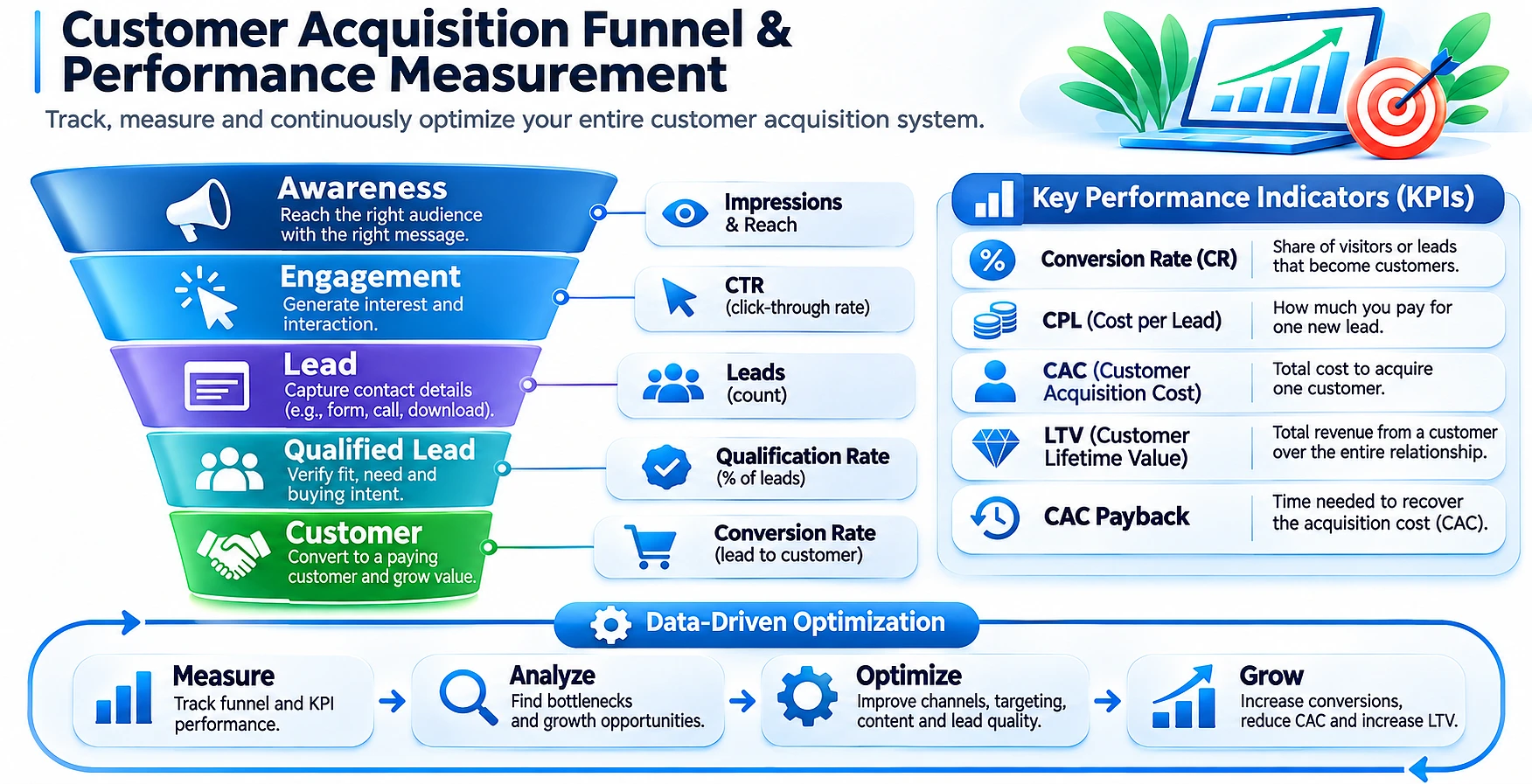
Track the journey from first touch to closed customer
Define each stage in terms both teams accept: awareness, engagement, lead, qualified lead and customer. Then measure conversion between stages and the cost at each step. A drop between lead and qualified lead points to targeting or the offer, while a drop after qualification points to the sales process. Keep definitions stable, or conversion rates and CAC stop being comparable over time.
Connect attribution, analytics and CRM data
UTM parameters are link parameters that carry information about the traffic source and campaign. Use consistent tagging rules and verify that the data passes through when a form is submitted. Calls and messaging app inquiries also need a way to track their source.
In the CRM, save the source alongside the deal status and reason for loss. When there are several interactions, distinguish the first known source from the latest inquiry so the entire result is not attributed to one touchpoint.
Improve conversion quality, not just lead volume
Increase lead volume only after checking lead quality and your team's capacity. An inquiry from outside your service area raises the lead count but will not generate a sale, so lead-counting criteria must be consistent across channels.
Our article on B2B lead quality helps align lead assessment between marketing and sales. Sales feedback should give specific reasons for rejection, not just an "unqualified" label.
Scale Customer Acquisition Without Losing Efficiency
A sustainable acquisition system combines several proven lead sources with consistent sales tracking. Each channel has a purpose, an owner and a criterion for economic performance. Add new channels as resources become available and hypotheses are validated.
Know when to double down or diversify channels
The right action depends on what caused the result:
- Scale: acquisition cost is acceptable, lead quality holds, and the team can handle the volume.
- Improve: you have identified a specific issue, such as qualified visitors abandoning a complicated form.
- Stop or redesign: a sufficient test has shown unacceptable economics, with no credible path to improvement.
Increase the budget gradually and track the cost of each additional customer, because last period's average CAC does not guarantee the same economics with a wider audience. When marginal cost keeps rising, diversify: test the next channel on your scorecard instead of forcing more volume from the current one.
Avoid common customer acquisition mistakes
- Copying competitors without adapting. Their audience and economics may differ from yours.
- Spreading a small budget across many channels. Each test produces too little data to support a decision.
- Launching without analytics. Missing source data cannot always be recovered after a campaign.
- Judging results by clicks and CPL. User activity alone does not reveal the cost of acquiring a customer.
- Stopping a channel before the sales cycle is complete. Promising leads may still be going through approvals.
- Sending different segments to one generic page. Buyers may not find answers to their specific needs.
- Depending on one platform. A change in its rules can disrupt your entire flow of new inquiries.
Build a Customer Acquisition Strategy You Can Measure and Scale
Webdelo helps businesses evaluate acquisition channels, improve website conversion paths, connect marketing data with CRM outcomes and identify opportunities for more efficient growth. Start with a focused assessment of your current acquisition strategy.
Frequently Asked Questions
What is the difference between a customer acquisition strategy and a marketing channel?

A customer acquisition strategy defines whom a business wants to acquire, how it will reach those customers, what resources it will invest, and how success will be measured. Marketing channels, such as SEO, paid search, email and partnerships, are the individual routes used to execute that strategy. Choosing channels without clear acquisition goals makes performance harder to evaluate.
How should a business choose customer acquisition channels for its ideal customer profile?
Start by identifying your ideal customer profile, buying triggers, purchase process and preferred sources of information. Evaluate potential channels according to audience fit, buyer intent, cost, measurement quality and operational capacity. Prioritize channels that can reach relevant buyers and support your business model rather than those that are popular in your industry.
How many customer acquisition channels should a company test at once?
There is no universal number. Many smaller teams benefit from starting with two or three channels so they can maintain execution quality and gather useful data. Larger businesses may run more experiments in parallel. The right number depends on available budget, team capacity, expected conversion volume and the time needed to measure results.
How can you validate a customer acquisition strategy before scaling it?
Form a specific hypothesis about the audience, offer and channel. Define a test budget, conversion events, evaluation period and success criteria before launching. Measure lead quality and customer outcomes alongside traffic and inquiries. Scale only when the results provide sufficient evidence that additional investment is likely to remain economically viable.
What is a good customer acquisition cost (CAC)?
A good CAC depends on customer lifetime value, contribution margins, retention, cash flow and the time needed to recover acquisition spending. A low CAC is not automatically desirable if it produces customers with low revenue or poor retention. Compare acquisition costs with the expected economic value of customers from the same segment or cohort.
How do LTV and CAC payback influence acquisition decisions?
Customer lifetime value estimates the economic contribution expected from a customer over the relationship. CAC payback measures how long it takes to recover acquisition costs through customer contribution. Together, these metrics help businesses evaluate sustainability, cash requirements and the risks of scaling acquisition too quickly.
When should a business scale, optimize or stop a customer acquisition channel?
Consider scaling when the channel consistently delivers customers with acceptable economics and there is evidence that additional spending can reach more suitable buyers. Optimize when conversion rates, targeting or lead quality reveal addressable weaknesses. Stop or redesign a channel when adequately tested results remain economically unsustainable and there is no credible improvement path.