Digital Audio Advertising: How to Plan and Measure Campaigns
A practical look at online radio, podcast and streaming audio ads: how to choose a format, script a spot, budget a pilot and measure results when attribution is imperfect. Plus why the website and CRM decide whether leads are lost.

What Is Audio Advertising and How Does Audio Marketing Work?
Digital audio advertising delivers promotional messages through internet radio, podcasts, and streaming audio. Audio marketing is broader: it uses sound to help people recognize a brand and remember its offer. Audio can introduce someone to a company. Search, the website, and a CRM system for managing customers and inquiries help turn that interest into a sale.
This article is for business owners and marketing leaders, including companies that sell to other businesses. We will cover format selection, budgeting, ad production, and measurement. This is the second article in the series. It focuses on paid placements, while launching your own radio station is covered separately.
At Webdelo, we see audio as a source of demand that other marketing channels need to capture. For example, an executive hears about a sales automation solution on the way to work. Later, they search for the company, explore its website, and share a link with a colleague. Time may pass between hearing the ad and making an inquiry.
Audio advertising vs. traditional radio commercials
With broadcast radio, advertisers choose the station, region, and airtime. Some digital audio platforms also let advertisers target audiences by location, device, and other characteristics. Check which settings each service offers.
Reporting differs too. Online platforms may report ad impressions, frequency, and completed listens. A link is sometimes available beside the player. The audio message may be similar, but the ways placements are bought and measured differ.
How sound supports brand recognition
Audio advertising reaches people when they are not looking at a screen, such as while traveling or doing household chores. A consistent voice and a short musical signature help connect different messages to one brand. For this to work, the company name must be easy to distinguish by ear.
Awareness does not mean someone is ready to buy. Listeners need a clear reason to remember the company, such as a problem with lost inquiries that its product helps solve.
What Are the Main Audio Advertising Formats?
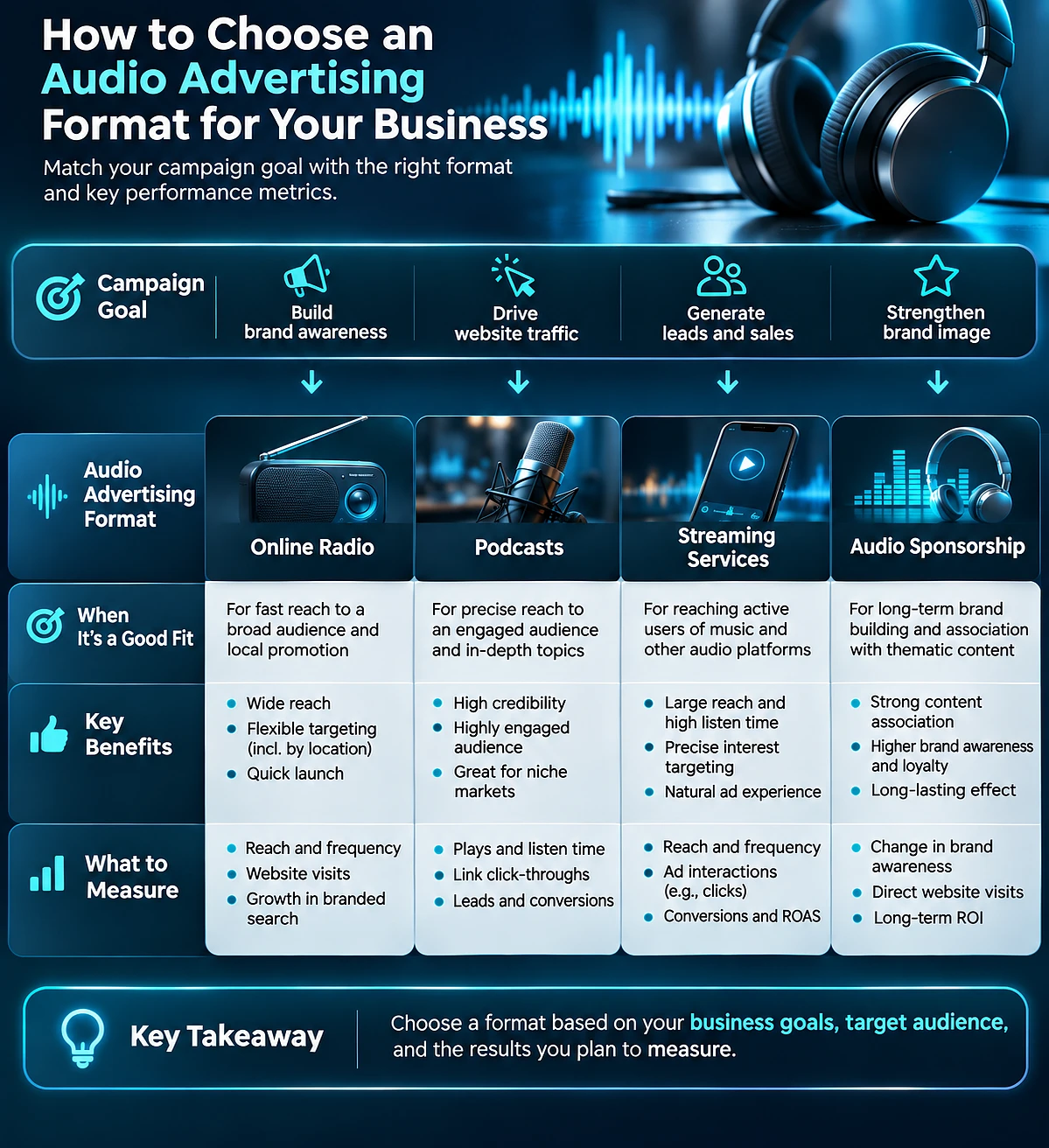
The main types of audio advertising include online radio ads, podcast placements, ads on music services, and sponsored segments. They differ in listening context, targeting options, and reporting. Audio branding connects these formats through a recognizable brand sound.
Running your own station requires separate work on programming and attracting listeners. We covered how to start an internet radio station in the first article in this series. Here, the company pays to reach an existing audience.
Online radio and internet radio advertising
Internet radio ads may play between tracks, before listening begins, or during a show. Choose a station based on its subject matter and audience location. However, a station being available in a region does not mean a significant share of its listeners lives there.
Online radio advertising often accompanies another activity. A complex offer with several conditions is therefore easy to miss. One customer problem and a clearly spoken company name work better in this setting.
Podcast advertising and host-read ads
A podcast can feature a prerecorded ad or a host-read placement. Ads appear before an episode, during it, or after the main content. Compare these positions using platform data, not price alone.
A host-read placement can draw on the audience's trust in the host. However, the script should fit the episode's topic and be identified as advertising under applicable rules. For business audiences, the connection between the offer and listeners' needs is especially important.
Streaming audio ads
Streaming audio ads are placed through services' advertising accounts, partners, or programmatic buying platforms. Available settings depend on the market and platform. Before planning a campaign, check whether placements are available to the advertiser and in the target region.
In a music stream, an ad competes for attention with familiar background listening. It needs to explain the benefit quickly, without a long introduction. If the service offers a companion banner, the main message should still make sense without the image.
Sponsorships and audio branding
Sponsoring a recurring segment or podcast season creates repeated audience exposure. The contract should specify what the package includes: mentions, integrated ads, and additional materials. The word "sponsorship" alone says nothing about the extent of the placement.
Audio branding consists of a company's consistent sound elements: a voice, melody, or sonic logo. These can be used across advertising channels. Their impact is measured through recognition and audience behavior, not just immediate inquiries.
| Format | Goal | Advantages | Limitations |
|---|---|---|---|
| Online radio | Introduce a brand to a regional or station audience | Choice of content context and airtime | Background listening, limited audience detail from some stations |
| Podcasts | Explain an offer to interested listeners | Episode context and the option of a host-read placement | Dependence on the editorial schedule and audience composition |
| Music streaming | Reach a selected audience repeatedly | Targeting settings and reports, where the service provides them | Brief exposure, differences in platform availability |
| Sponsorships | Strengthen the brand's association with a topic or project | Consistent presence within content | Harder to separate the impact from other channels |
| B2B podcasts | Reach industry professionals and executives | Specialized professional topics | Listener profiles need verification, and long sales cycles must be considered |
What Are the Benefits of Audio Advertising for Business?
Audio advertising for businesses makes sense when the goal is to build awareness and the offer is clear. The company must be ready to handle the resulting interest: the website form works, inquiries reach the CRM, and sales representatives respond to customers. Campaign results determine whether it pays off.
Benefits and limitations of digital audio advertising
The advantages of audio advertising stem from the listening context and the possibilities of sound:
- Reaching audiences when they are not using a screen.
- Expressing the brand's personality through voice, tone, and music.
- Choosing relevant content and available audience targeting options.
- Repeating a recognizable message across audio formats.
Planning also needs to account for limitations:
- Without visuals, showing an interface or explaining how a product works is harder.
- Listeners cannot always visit the website immediately.
- An ad playing does not prove that someone listened carefully.
- A later inquiry can be difficult to connect to a specific audio exposure.
B2B audio marketing for long sales cycles
B2B audio advertising makes sense when you can reach listeners with relevant professional needs. For example, an episode about managing a dental practice is a suitable context for a patient management system provider. This illustrates context selection, not a verified campaign result.
A similar approach can apply to financial technology, real estate, or e-commerce. In a long sales cycle, audio helps a company make the shortlist of potential suppliers. Evaluation requires data on lead quality and subsequent deal progress.
When audio advertising is not the right channel
If the priority is inquiries from people with an existing need, consider testing paid search first. SEO also helps capture this demand, but generally takes longer. Neither channel can compensate for a broken inquiry form.
We do not recommend using audio advertising simply to establish a presence in a new channel. First, determine whether the website can explain the offer and pass inquiries to sales. Otherwise, expanding reach will only increase losses.
How to Choose the Right Audio Advertising Platform
Choose a platform based on its audience, listening context, and the campaign's goal. Online radio may reach a regional audience, an industry podcast may offer topical relevance, and a music service may provide targeting options. The format alone does not prove that it fits your needs.
Audience targeting, location and listening context
Ask for listener data and how it was collected. A service's total audience, a podcast's subscriber count, and an ad's expected reach are different metrics. For B2B, ask specifically how listeners' professions and job titles are verified.
Context affects the action you can ask someone to take. While traveling, a person is more likely to remember a name than fill out a form. Someone listening at a computer may find it easier to open a link in the episode description.
Comparing audio advertising formats
Ask each candidate to provide the same information:
- Audience composition and the share of listeners in your target regions.
- Ad position within the content and available frequency caps.
- Pricing model and the exact definition of the billable event.
- Report contents: impressions, reach, completed listens, and other available metrics.
- Terms for replacing the ad, rescheduling the placement, and stopping the campaign.
For an initial test, it is easier to work with a limited number of platforms. This makes differences in results easier to explain. The diagram below helps match formats to goals, but the final choice requires checking the terms of each placement.
How to Produce an Effective Audio Ad
Creating an audio ad starts with one idea: which listener problem the company solves. Next come voice selection, recording, and editing. The ad should leave listeners with the brand name and one clear action.
Scriptwriting, voice, length and sonic identity
A practical script structure is problem, solution, brand, and action. For example, a CRM provider might discuss inquiries that get lost between email and the sales team. Listing every system module would overload the message.
Before recording, prepare a short brief:
- Who the listener is and which problem they will recognize in the message.
- The one benefit they should remember.
- How to pronounce the company name.
- The platform's requirements for length and audio.
- Where and for how long the recording and music may be used.
The voice should match the brand's personality, and the music should keep speech clear. Read the script aloud at a natural pace. If the voice actor has to rush, shorten the script rather than speed up the recording.
Before delivery, listen to the ad through headphones and a regular speaker. Check whether the name and call to action are clear without reading the script. Agree on the file's technical specifications with the platform before the final edit.
How to build a clear call to action
A searchable name or short web address is easier to remember by ear. A long URL with several sections adds unnecessary effort. A promo code is useful if listeners can hear it clearly and easily provide it when making an inquiry.
The ad's offer must match the landing page. If the ad promises a review of sales processes, visitors should see a description of that review and a way to book it. Sending them to a general page of unrelated services interrupts the path to an inquiry.
How Much Does Audio Advertising Cost?
The cost of audio advertising includes production, placement, and campaign management. The total depends on the audience, platform, and recording usage rights. A detailed estimate is based on a media plan that lists the selected placements, dates, volume, and costs.
Production, media placement and management costs
The production budget covers the script, voice actor, and editing. Music and voice recording rights need a separate check. The original ad's price may not include additional versions or an extended usage period.
Placement often accounts for a large share of the budget, but preparation costs can also be significant for a small test. Campaign management includes analytics setup, report reviews, and adjustments. Factor these tasks in before approving the overall spending limit.
| Cost Item | Pricing Model | Price Factors |
|---|---|---|
| Script | Per script or set of versions | Offer complexity, number of versions and approval rounds |
| Voice recording | Per recording and agreed usage rights | Voice actor, territory, duration, placement channels |
| Editing | Per ad or scope of work | Sound design, music, platform-specific adaptations |
| Placement | CPM, fixed fee, or package | Audience, season, position, frequency, and volume |
| Analytics | Per setup or agreed scope of ongoing support | Website condition, integrations, reporting structure |
| Optimization | Per period or scope of work | Number of platforms, ad versions, and changes |
CPM pricing, flat fees and sponsorship packages
CPM means cost per thousand ad impressions. Ask the platform which event counts as a billable impression. An impression, a playback start, and a completed listen should not be treated as interchangeable events.
A fixed fee may apply to an integrated ad in an episode, for example. A sponsorship package may combine several types of exposure. To compare offers, estimate the expected cost of reaching your target audience while accounting for differences in the quality and duration of that exposure.
Planning a pilot campaign budget
The test needs enough volume to assess the chosen hypothesis. An awareness campaign requires sufficient reach and repetition. To evaluate inquiries, also consider the sales cycle and the company's usual inquiry volume.
Illustrative calculation: with an assumed 100,000 impressions and a CPM of RUB 400, placement costs 100,000 / 1,000 × 400 = RUB 40,000. These are hypothetical figures used to explain the formula, not market rates. Production, analytics, and landing page improvements are not included.
Before launch, set a spending limit and conditions for continuing the test. Insufficient data is also a possible outcome. It means no conclusion can be drawn yet, not that the channel definitely works or does not work.
How to Launch a Digital Audio Advertising Campaign
A launch involves setting a goal, choosing an audience, preparing the ad, and checking tracking. A test follows, along with placement adjustments. In our marketing approach, we check the website and inquiry tracking before any advertising budget is spent.
Campaign goals, audience and success metrics
Choose a primary goal: awareness, branded search, or qualified leads. Qualified leads are inquiries that meet agreed business criteria. For example, a request for a relevant service from a company in the target region.
Describe the listener by role, industry, and work-related need. Record baseline search and inquiry metrics for a comparable period. Also note other campaigns and seasonal events that could affect the results.
Channel selection, creative production and tracking
Before launch, check the entire inquiry journey:
- Agree on the platform, placement schedule, and ad requirements.
- Prepare a page featuring the advertised offer.
- Add source-tracking parameters, such as UTM tags, to available links.
- Set up the transfer of inquiries and their sources to the CRM.
- Submit a test inquiry and check that the assigned sales representative receives a notification.
- Agree on reporting and personal data handling rules.
UTM tags are URL parameters used for analytics. They work when someone follows that link. They cannot identify the source of someone who remembers the brand and later finds the website independently. For these inquiries, it helps to record the customer's answer to how they heard about the company.
Testing and optimization
Change one significant variable at a time. For example, test a different offer in the ad under the same placement conditions. Changing the platform, voice, and landing page at once makes it impossible to identify what caused the results to change.
Check ad delivery and form functionality from the start of the campaign. Decide whether to continue after the agreed observation period. For long sales cycles, track early signs of interest separately from the quality of later deals.
How to Measure Audio Advertising Effectiveness
Audio advertising effectiveness is assessed at three levels: message delivery, audience actions, and business results. Platform reports show ad delivery, website data shows visits and inquiries, and the CRM shows deal progress. Reconstructing every listener's full journey is usually impossible.
Reach, impressions, frequency and audio engagement
Reach reflects the number of unique users or devices according to the platform's methodology. Impressions count advertising events, while frequency describes repeated exposure. If someone listens on multiple devices, the accuracy of unique audience counts depends on the service's capabilities.
The completion rate helps show how often an ad plays to the end. It does not prove attention or recall. Similarly, a podcast episode download does not equal a verified listen to its ad segment.
Brand search lift, traffic and leads
An increase in searches for the company name is one sign of interest after an audio campaign. Compare it with visits to a dedicated page, promo code use, and inquiries. Direct visits are useful too, but may include visits from unidentified sources.
A before-and-after comparison shows a change, but does not prove its cause. Where conditions allow, also compare similar regions with and without advertising. Account for concurrent promotions and changes in search demand.
CPL, CAC, ROI and attribution limitations
For financial evaluation, agree on definitions and included costs in advance:
- CPL, cost per lead: campaign spending divided by the number of inquiries attributed to it. It is useful to calculate qualified leads separately.
- CAC, customer acquisition cost: agreed marketing and sales costs divided by the number of new customers.
- ROI, return on investment: subtract campaign costs from incremental profit before campaign costs. Divide the difference by campaign costs and multiply by 100%.
Revenue without costs does not show profitability. A long sales cycle also requires enough observation time: some inquiries may still be in progress.
Attribution is the rule used to assign a result to an advertising channel. If a listener later arrives through search, the system may credit search with the inquiry. Audio ROI therefore cannot be guaranteed, and calculations must clearly state their assumptions.
Common Audio Advertising Mistakes
The main audio marketing risks are an unsuitable audience, an overloaded ad, a mismatch between the ad and website, and a lack of measurement. A review of the media plan and inquiry journey can reveal these issues. Another mistake is expecting immediate sales from a campaign designed to build awareness.
Poor targeting and unclear messaging
High reach cannot compensate for a lack of potential buyers. An entrepreneurship podcast may attract listeners who do not yet run a business. For an enterprise software offer, that is an important distinction.
An overloaded ad asks listeners to remember several services and conditions at once. Before recording, share the script with someone who was not involved in creating it. If they cannot name the company and its main benefit after one listen, simplify the message.
Missing measurement and excessive ad frequency
Without baseline metrics and inquiry tracking, separating advertising impact from normal fluctuations is difficult. We also do not consider it sound practice to stop audio after one week solely because there are no direct inquiries. The evaluation period should match the goal and buying cycle.
Excessive repetition can irritate listeners, while infrequent exposure may not build recall. There is no universal frequency for every business. Check how impressions are distributed and whether exposure can be capped for each listener.
How to Combine Audio Advertising with Other Digital Marketing Channels
Audio advertising in digital marketing helps generate interest, while search and the website turn that interest into an inquiry. Analytics and CRM show what happens next. We consider the entire journey because a lost inquiry after an ad exposure may stem from the website or the way the inquiry is handled.
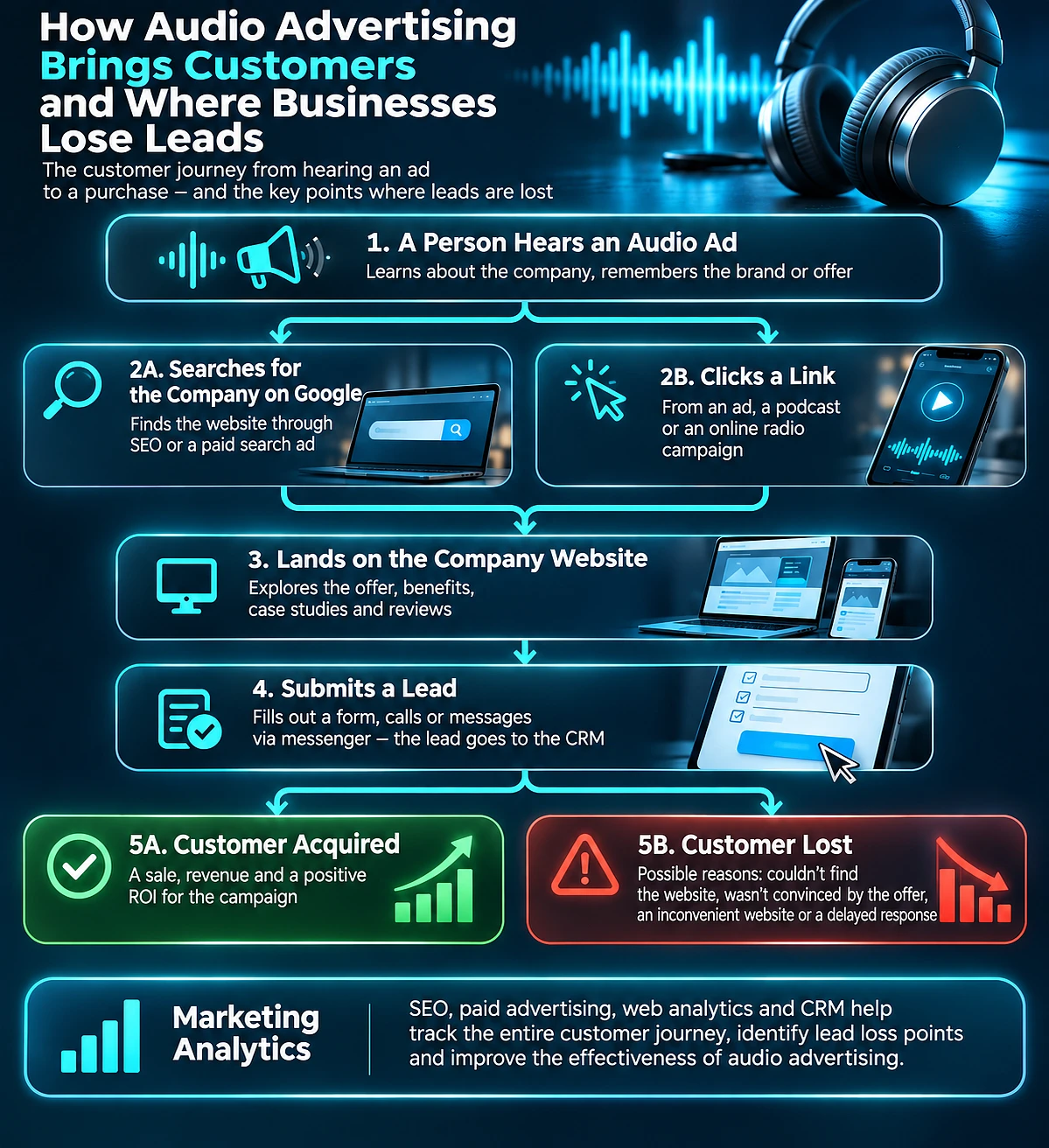
Audio Advertising and SEO: Building Brand Awareness and Branded Search Demand
After hearing an ad, someone may search for the company name or a phonetic spelling of it. Check which page they will see and how clearly its search listing describes it. The advertised offer should be easy to find on the website.
In this combination, seo helps make the right pages discoverable in search and clear to visitors. An increase in branded searches does not, by itself, guarantee better rankings for generic queries. Website quality and meeting search demand remain separate tasks.
Audio Advertising and Paid Search: Reaching Customers Across the Buying Journey
Paid search reaches people when they are already expressing a need. In markets where Google Ads is available, it can complement audio at this stage. Elsewhere, choose an available advertising platform with the right audience.
A branded search campaign can increase a company's presence in search results, but whether that spending is necessary depends on the situation. Retargeting website visitors helps remind them of the offer where it is permitted and consent requirements are met. Hearing an audio ad alone does not always make someone eligible for that audience.
Audio Advertising and Brand Marketing: Strengthening Recognition and Trust
The ad, website, and sales materials should make the same promise. If the audio ad offers greater control over processes, the page should explain how the company delivers it. A description of the approach and verified examples of work can help.
For B2B, sales representatives should know about current advertising offers. They can then understand the context of an inquiry and continue the conversation from the right point. This reduces the risk of customers having to explain again what caught their interest.
Webdelo's Experience in Digital Advertising, Marketing Strategy and Performance Analytics
Founded in 2006, Webdelo works on complex digital products for businesses. Our expertise includes websites, SEO, advertising campaign setup, and analytics. We also develop CRM systems and integrations for managing inquiries.
In our projects, we connect digital marketing with the readiness of the product and website to capture demand. For an audio campaign, our role is to help define the channel's purpose, prepare landing pages, and set up measurement. We do not claim audio media buying as an established service here.
When inquiries come from several channels, a crm helps preserve their sources, assign owners, and track outcomes. For audio, it is useful to distinguish the technically identified visit source from the customer's account of first hearing about the company. That way, search does not completely obscure the contribution of an earlier exposure.
We begin a marketing review by identifying where inquiries are lost. The findings help determine what needs attention first: the offer, the page, or the handoff to a sales representative. This provides a basis for deciding whether to add online audio advertising now.
Assess the effectiveness of your advertising strategy. Webdelo can help analyze your advertising channels, landing pages, and marketing analytics to identify growth opportunities and improve inquiry handling.
Request a Marketing Audit
Frequently Asked Questions
What is audio advertising, and how is it different from traditional radio advertising?
Digital audio advertising places promotional messages in internet radio, podcasts, and streaming audio, while audio marketing is broader and covers all use of sound to build brand recognition. With traditional broadcast radio, advertisers mainly choose a station, region, and airtime, whereas some digital platforms also let you target audiences by location, device, and other criteria. Reporting differs too: online platforms may show impressions, frequency, and completed listens, and a clickable link is sometimes available next to the player. The exact targeting options and reports should always be confirmed with each specific service.
What are the main types of digital audio advertising?
The main formats are spots on internet and online radio, podcast placements, ads in music and streaming services, and sponsorships or integrated mentions. In podcasts, you can run a pre-produced spot or a host-read integration before, during, or after the episode. Streaming audio ads are bought through the services' ad accounts, partners, or programmatic buying platforms, and availability depends on the market. Audio branding, meaning a consistent voice, jingle, or sonic logo, ties all these formats to one recognizable brand.
How much does audio advertising cost for businesses?
There is no universal price: the budget combines production (script, voice talent, editing, music and voice rights), media placement, and campaign management, including analytics setup and optimization. Placement is typically priced by CPM (cost per thousand impressions), as a flat fee, for example for a podcast integration, or as a sponsorship package. Before comparing offers, check exactly which event counts as a billable impression and whether the production price includes extra versions or extended usage rights. An accurate estimate comes from a media plan, and a pilot budget should be large enough to test one specific hypothesis.
Does audio advertising work for B2B companies?
B2B audio marketing makes sense when you can reach listeners with relevant professional responsibilities, for example through industry podcasts. Ask the platform how listeners' professions and job titles are verified, because subscriber numbers alone say nothing about who is actually listening. With long sales cycles, the role of audio is to help your company get onto the buyer's shortlist rather than to generate instant deals. Evaluate lead quality and deal progress in your CRM over a sufficient period, and if your priority is existing demand, test paid search first.
How do you create an effective audio ad?
Build the script around one idea using a simple structure: the listener's problem, your solution, the brand, and a single action, rather than listing every service. Choose a voice that fits the brand, keep music from masking the speech, and shorten the text if the voice actor has to rush. For the call to action, use a brand name that is easy to search, a short web address, or a promo code that is clearly audible. Before final delivery, listen on headphones and a regular speaker, and make sure the landing page matches the offer in the ad.
How can businesses measure audio advertising effectiveness?
Effectiveness is assessed on three levels: message delivery (reach, impressions, frequency, completed listens), audience actions (branded searches, visits to a dedicated page, promo codes, inquiries), and business results in the CRM (CPL, CAC, ROI). Record baseline metrics before launch so you can compare the periods before and after the campaign. UTM parameters only work when someone clicks a link, so it also helps to ask customers where they first heard about you. Because every listener's path cannot be fully reconstructed, ROI cannot be guaranteed, and calculations should state their attribution assumptions openly.
Which is better for advertising: online radio, podcasts or music streaming?
There is no universally best format: the choice depends on your audience, the listening context, and the campaign goal. Online radio suits introducing a brand to a regional audience, but it is often heard in the background, so the message must be simple. Podcasts help explain an offer to engaged listeners, including through host-read ads, while music streaming provides repeated short contacts and targeting options where the service offers them. For a first test, limit the number of platforms and compare them on the same checklist: audience profile, ad position, pricing model, reporting, and cancellation terms.