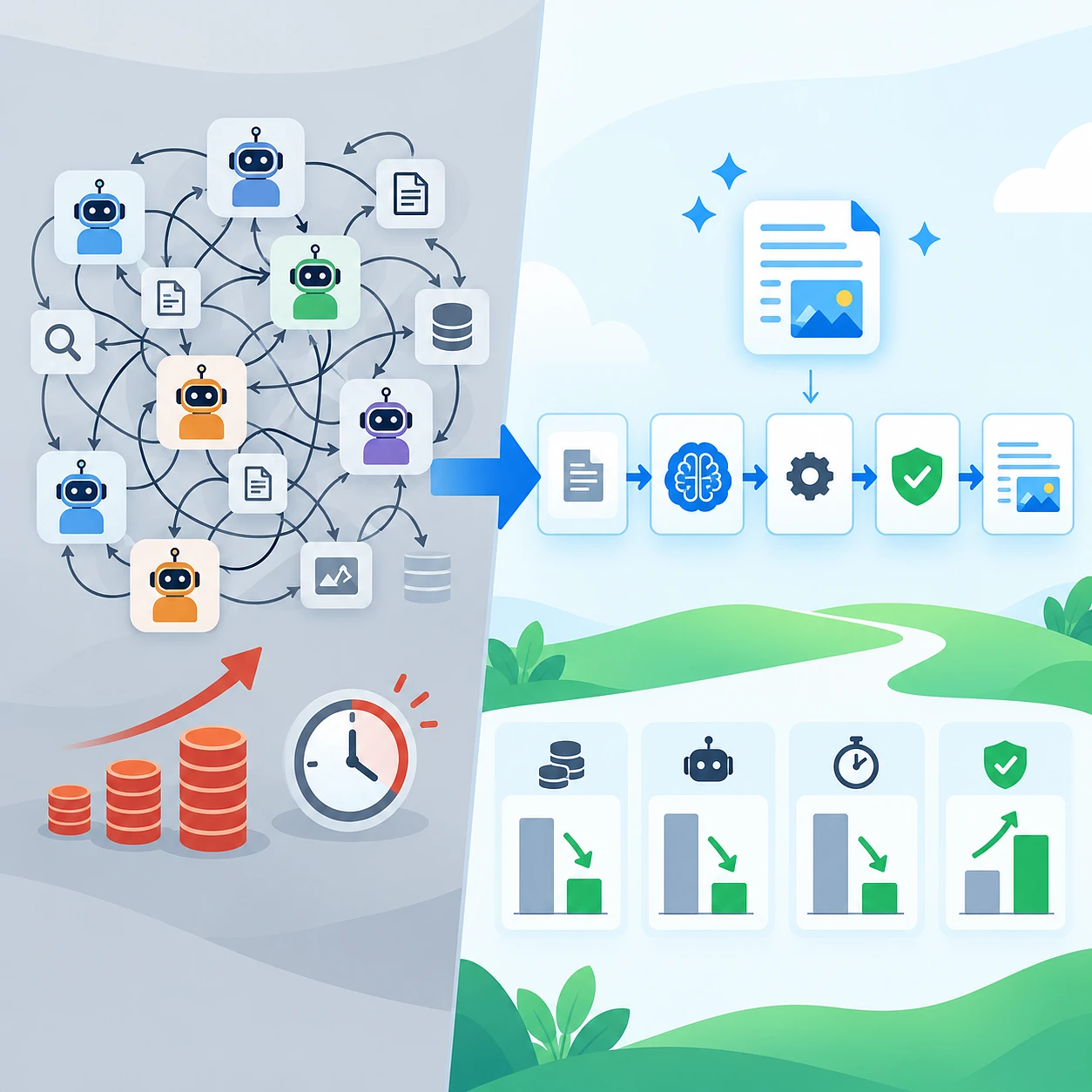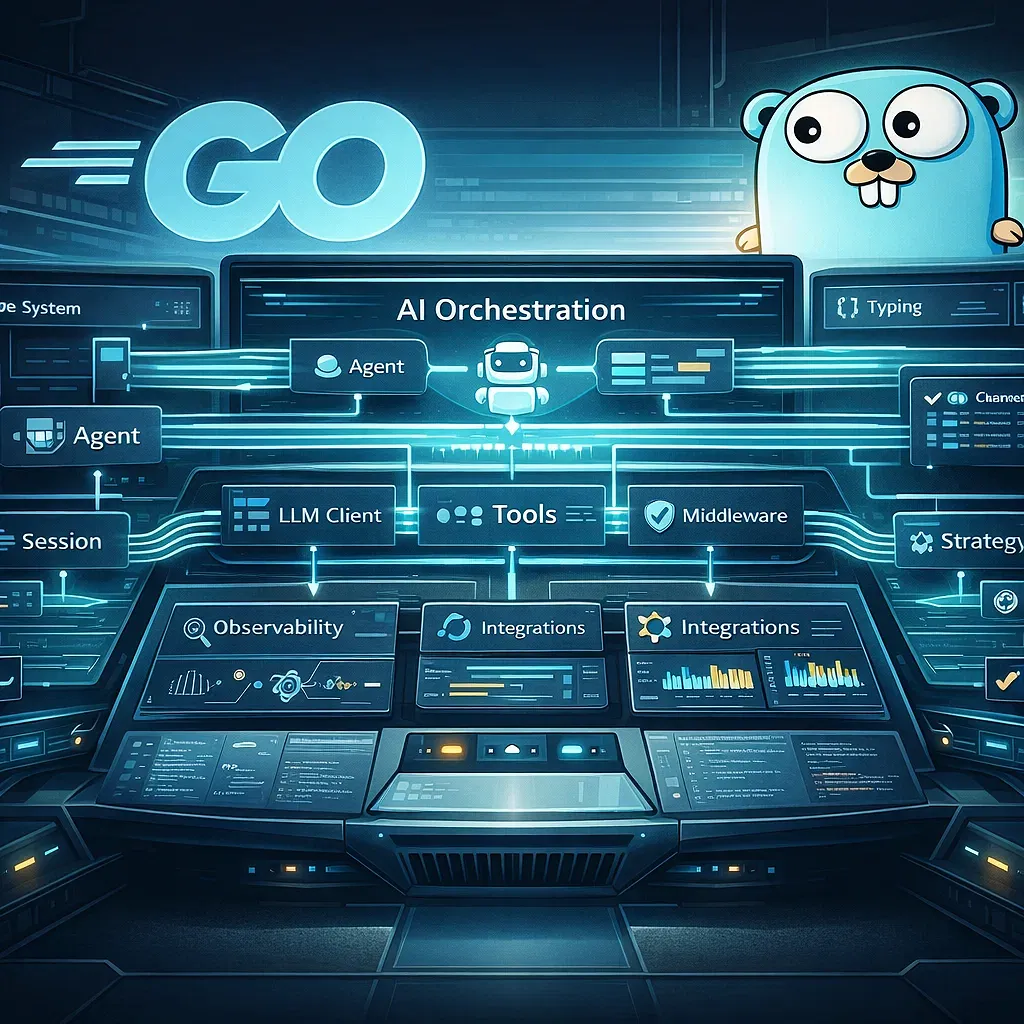

Why Your Backend Stack Is a Business Decision
For teams evaluating golang for high load systems, the appeal is practical: compiled execution, lightweight concurrency, and straightforward deployment. Go fits many high-traffic APIs and background services. At Webdelo, we choose technologies from system requirements and measured results because a backend stack affects infrastructure costs, incident recovery, and long-term maintenance.
We build B2B platforms, ERP/CRM systems, FinTech and trading tools, and high-load services. Those products connect architecture decisions to DevOps, QA, and operations. A language choice must support the team maintaining the system as well as the workload running on it.
The useful question is where Go improves a specific system. Answering it requires a workload definition, an understanding of concurrency, and a realistic comparison with the existing stack.
What Makes a Backend System High-Load?
A backend becomes high-load when traffic, concurrency, or latency requirements approach its resource limits. Request rate alone cannot describe that pressure. Reliability during peaks and recovery after failures also belong in the definition.
- Requests per second (RPS): incoming demand and completed throughput, measured separately when requests queue or fail.
- Concurrent connections and requests: open connections consume resources even when they carry little traffic.
- p95 and p99 latency: the response times below which 95% and 99% of requests finish. These reveal slow requests hidden by averages.
- Error rate: failed operations, including rejected requests and downstream timeouts.
- Availability: whether users can complete the operations the service promises to support.
CPU-bound work spends its time computing, such as encrypting data or calculating prices. I/O-bound work waits for databases or remote services. Many business backends are I/O-heavy, but profiling must establish which resource limits a particular endpoint.
Consider an order API waiting on an inventory service. Adding concurrent requests may increase the queue without increasing completed orders. Backpressure limits intake when downstream capacity is exhausted, while graceful degradation preserves essential functions when optional dependencies fail.
High load is a property of the whole system, not of a single language. We cover the broader design principles in our guide to scalable high-load system architecture; this article focuses on the role Go plays within that picture.
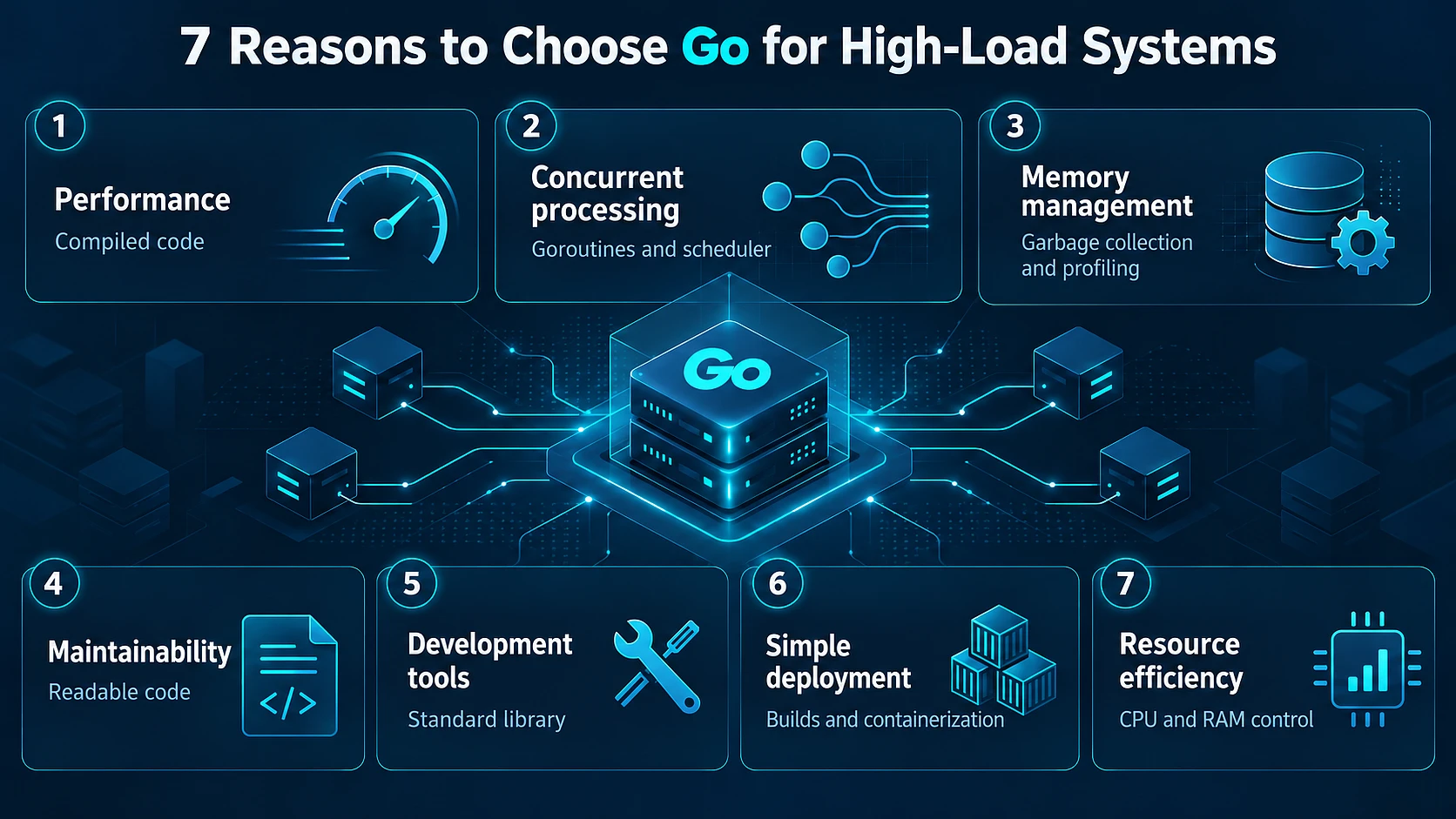
Seven Reasons Engineering Teams Choose Go
Go combines compiled execution, inexpensive concurrency, and integrated operational tools. Together, these properties make it a practical option for network services. Their business value depends on whether they reduce resource pressure or maintenance effort in the actual application.
Published Go adoption accounts provide context: Google created the language, Cloudflare describes using it in network infrastructure, and Dropbox reports moving performance-critical backends from Python. ByteDance also reports extensive microservice adoption. These are examples of workload fit, not evidence of a universal industry standard.
- Performance - compiled code. Go compiles to native machine code. This supports efficient request handling, but database waits and algorithmic complexity still determine much of an endpoint's latency.
- Concurrent processing - goroutines and scheduler. Goroutines let services overlap independent operations without assigning a dedicated operating-system thread to each task. Teams still need explicit limits on in-flight work.
- Memory management - garbage collection and profiling. Automatic reclamation simplifies memory ownership. The Go Garbage Collector Guide explains the CPU and memory trade-off: collecting more frequently can reduce heap growth while increasing collection work. Allocation profiles make this trade-off measurable.
- Maintainability - readable code. Consistent formatting and explicit control flow help engineers review unfamiliar services. Capital One's published testimonial says its team was writing Go endpoints within a month. That is one team's experience, not an onboarding promise.
- Development tools - standard library. Go includes HTTP support and a consistent toolchain for testing, benchmarking, and profiling. American Express highlights this integrated tooling in its published Go testimonial. Shared tools reduce variation between repositories.
- Simple deployment - builds and containerization. Many pure-Go services can ship as a single statically linked executable. Builds using cgo, which connects Go to C code, may introduce native dependencies. Container images still need the certificates and runtime files the application uses.
- Resource efficiency - CPU and RAM control. Profiling and runtime controls help teams manage consumption. PayPal reports in its published case study approximately 10% lower CPU use in its own tightly managed Go environments. That company-reported result is specific to those environments and is not a cross-language benchmark.
“In high-load systems, raw execution speed is only part of the equation. What matters more is how the system behaves during traffic spikes, how predictably it uses resources, and how quickly the team can identify and resolve problems. Go is a strong fit for many of these workloads, but we always choose the technology based on system requirements and measured results.”
How Go Concurrency Handles Overlapping Work
Go concurrency uses goroutines, functions scheduled by the runtime onto operating-system threads. Channels and synchronization primitives coordinate their work. This makes overlapping I/O practical, but developers must design cancellation and capacity limits explicitly.
Goroutines and the G-M-P Scheduler
The scheduler uses three concepts: G represents a goroutine, M an operating-system thread, and P the execution resources needed to run Go code. GOMAXPROCS controls the number of Ps and therefore how many threads can execute Go code simultaneously.
For supported network I/O, the runtime can park a waiting goroutine and reuse execution capacity for other work. Blocking system calls and cgo calls can occupy threads, so goroutine count does not translate into a fixed thread count. Concurrency overlaps tasks, while parallelism executes tasks simultaneously.
Channels, Mutexes, and Cancellation
Channels suit transferring work or ownership between stages. The official Go concurrency patterns article explains pipelines and cancellation, including why producers must be able to stop when consumers exit.
- Channels: coordinate work distribution and fan-out/fan-in pipelines.
- Mutexes: protect shared state, with
RWMutexallowing concurrent readers when that access pattern helps. - WaitGroup: waits for a group of goroutines to finish.
- Context: carries deadlines and cancellation through operations that support them.
A data race occurs when goroutines access the same memory without proper synchronization and at least one access writes. A race condition is a correctness bug caused by an uncontrolled ordering of events. Run go test -race to detect data races on exercised paths, while testing business-level ordering separately.
Passing a context does not automatically stop work. Database drivers and request handlers must observe cancellation. Canceling a payment request also cannot undo a payment already accepted by an external provider.
A Bounded Worker Pool
This skeleton bounds both active workers and queued jobs. Its worker and buffer counts are illustrative configuration values, not capacity recommendations. The handler owns job outcomes and must honor cancellation.
package workers

import (
    "context"
    "sync"
)

type Job struct {
    ID string
}

func Run(
    ctx context.Context,
    input []Job,
    handle func(context.Context, Job),
) error {
    const workers = 8
    jobs := make(chan Job, 16)
    var wg sync.WaitGroup

    for i := 0; i < workers; i++ {
        wg.Add(1)
        go func() {
            defer wg.Done()
            for {
                select {
                case <-ctx.Done():
                    return
                case job, ok := <-jobs:
                    if !ok || ctx.Err() != nil {
                        return
                    }
                    handle(ctx, job)
                }
            }
        }()
    }

enqueue:
    for _, job := range input {
        select {
        case <-ctx.Done():
            break enqueue
        case jobs <- job:
        }
    }

    close(jobs)
    wg.Wait()
    return ctx.Err()
}
A full channel blocks the producer, providing backpressure within this function. An HTTP service also needs admission control so blocked request handlers do not become an unbounded upstream queue. This example takes an existing input slice and therefore does not bound the memory occupied by that input.
- Goroutine leaks: blocked sends or abandoned connections keep work alive after callers leave.
- Deadlocks: workers wait indefinitely on incompatible lock or channel operations.
- Starvation: long-running jobs prevent other work from progressing.
- Unbounded fan-out: each request starts additional work until downstream capacity is exhausted.
Where Go Fits a Scalable Backend
A golang scalable backend works best for services that coordinate many independent operations, especially when requests spend substantial time waiting on I/O. That is why teams building Go high traffic applications usually start with APIs and workers. Suitability still depends on dependency behavior and operational requirements.
- High-throughput HTTP APIs: serve concurrent requests with explicit deadlines and bounded database access.
- gRPC services: exchange typed messages between internal services, with deadlines propagated across calls.
- Event-driven workers: process Kafka events at a rate matched to downstream capacity.
- Multi-tenant SaaS backends: apply tenant-level limits so one customer's workload does not consume shared capacity.
- Integration and gateway services: coordinate external APIs with timeouts and controlled retries.
- FinTech and trading services: support network-facing workflows where latency consistency matters. American Express reports Go adoption in payments and rewards networks.
These workload categories overlap with Webdelo's B2B platforms, ERP/CRM integrations, and FinTech tools. Our architecture discussion starts with the critical business operation and its dependencies. For hard real-time requirements, Go's garbage collector and general-purpose runtime need separate scrutiny.
Go vs Java, Node.js, Python, and PHP
No backend language wins every workload comparison. Go offers a compact concurrency model and straightforward service deployment. Other stacks may offer a stronger ecosystem or a better fit for the team already responsible for the product.
| Stack | Strengths | Limitations | Typical use cases | When to choose |
|---|---|---|---|---|
| Go | Lightweight concurrency, native compilation, integrated diagnostics. | GC trade-offs and explicit application plumbing. Fewer specialized libraries in some domains. | Network APIs, gateways, background workers, infrastructure services. | Concurrent service workloads benefit from bounded resource use and simple deployment. |
| Java | Mature enterprise frameworks, JVM diagnostics, broad integration support. | Runtime and framework configuration can add operational complexity. | Enterprise platforms, transactional systems, established JVM services. | The team and architecture already benefit from the JVM ecosystem. |
| Node.js | Productive JavaScript/TypeScript development and asynchronous I/O. | CPU-heavy work can block the event loop unless isolated. | Web APIs, backend-for-frontend services, real-time integrations. | An experienced JavaScript team owns an I/O-heavy product. |
| Python | Extensive data and ML libraries, expressive application development. | CPU-intensive Python paths often require native libraries or process-level parallelism. | ML services, analytics, automation, web applications. | Specialized libraries and data workflows drive the product's value. |
| PHP | Mature web frameworks and established request-oriented development. | Long-lived workers and concurrent services require deliberate runtime choices. | Business web applications, commerce, content platforms. | The existing application and team are productive within the PHP ecosystem. |
This comparison is contextual: implementations, frameworks, and dependency behavior matter more than a language-level ranking. A mature service with sound database access can outperform a poorly designed replacement regardless of its language.
Example High-Load Go Architecture
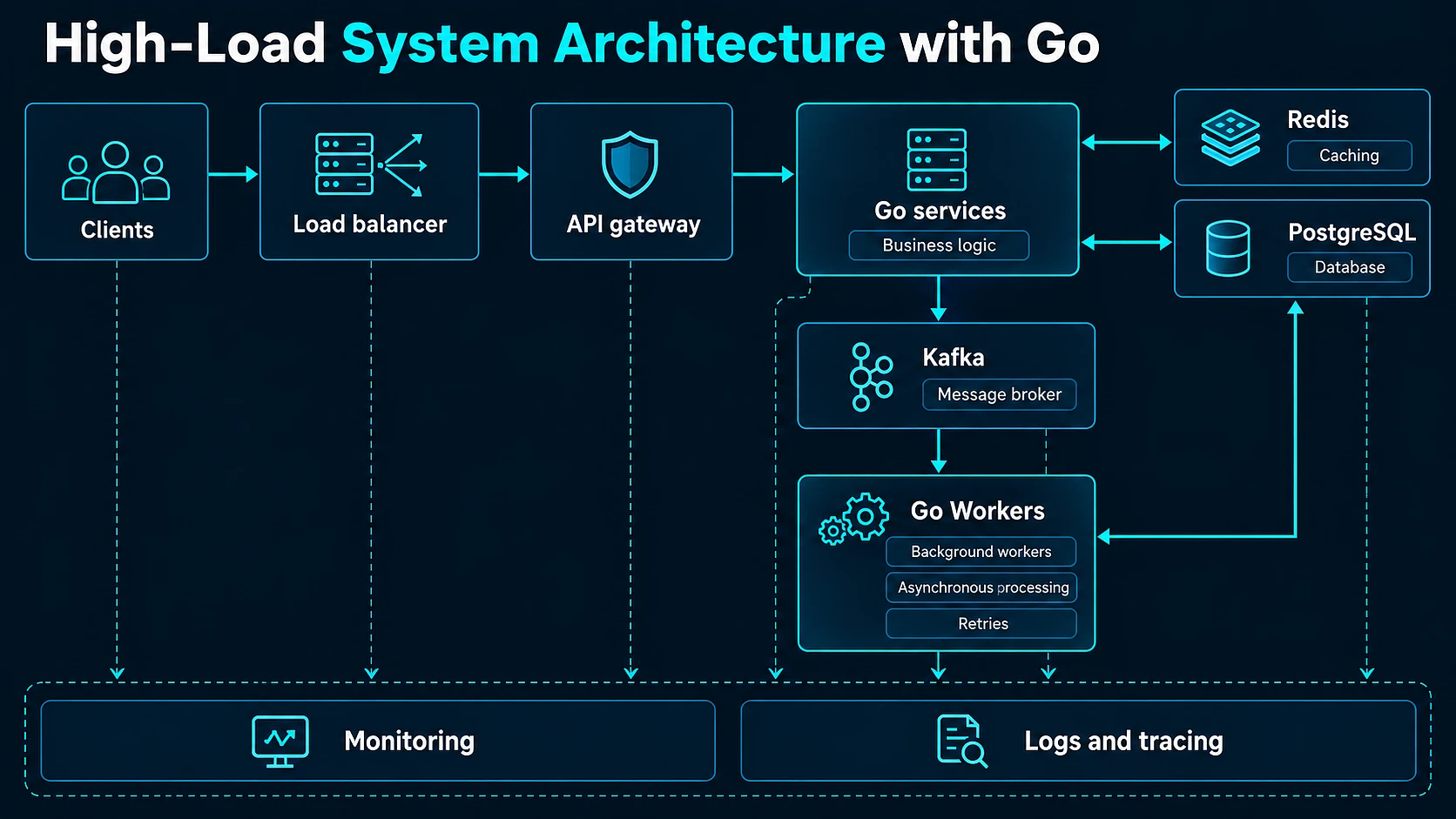
A conceptual order-processing system routes clients through a load balancer and API gateway to Go services. Those services access Redis and PostgreSQL directly, while Kafka carries events to Go workers. The diagram illustrates a design option, not a measured client architecture.
The example also shows where golang microservices pay off: small services with clear ownership, fast instance startup, and one toolchain for diagnostics. Every new service boundary adds network calls, though, so split the system only where load or independent team ownership justifies it.
Request Path and Storage
Stateless Go API instances handle requests behind the gateway. Internal services can communicate through gRPC with propagated deadlines. Horizontal scaling adds API capacity only while shared dependencies have room for more work.
Redis serves cached hot reads, while PostgreSQL remains the source of truth. Each client pool needs an explicit connection limit. The database connection budget must include every service replica, including temporary overlap during deployments.
Cache behavior also needs a failure plan. Simultaneous expiry of popular entries can send a surge of reads to PostgreSQL. Request coalescing or serving acceptable stale data can reduce that pressure.
Events and Reliable Processing
The API logically publishes order events to Kafka. To avoid losing an event between a database commit and publication, the outbox pattern writes the order and an event record in one PostgreSQL transaction. A relay publishes that record to Kafka afterward.
Workers handle payments, notifications, and integrations. Delivery retries can produce duplicates, so consumers need idempotency: processing the same event again must not repeat its business effect. For payments, that protection must extend to the provider request.
Retries need bounded attempts and backoff. Failed events also need a recoverable destination and an operational owner. A queue can absorb a temporary burst, but it cannot resolve a permanent capacity deficit.
Observability and Shutdown
Prometheus metrics track service saturation and queue lag. Structured logs explain individual failures, while OpenTelemetry traces follow requests across service boundaries. Together, these signals show whether delays originate in application code or dependencies.
In Kubernetes, readiness checks remove unavailable instances from routing. Graceful shutdown stops new intake and gives active work a bounded completion window. Liveness checks should avoid restarting healthy processes merely because a shared dependency is temporarily unavailable.
Why Go Alone Does Not Guarantee Performance
Golang backend performance depends on database access, allocation behavior, and overload handling. Changing the language leaves architectural bottlenecks intact. Our recommendation is to identify where time and resources go before proposing a rewrite.
An N+1 query pattern fetches a list and then issues another query for every item. That multiplies database round trips in Go just as it does elsewhere. Query batching and appropriate indexes often address the problem directly. The same batching principle applies to large writes; we describe the production patterns we use in our article on bulk inserts into PostgreSQL with Go.
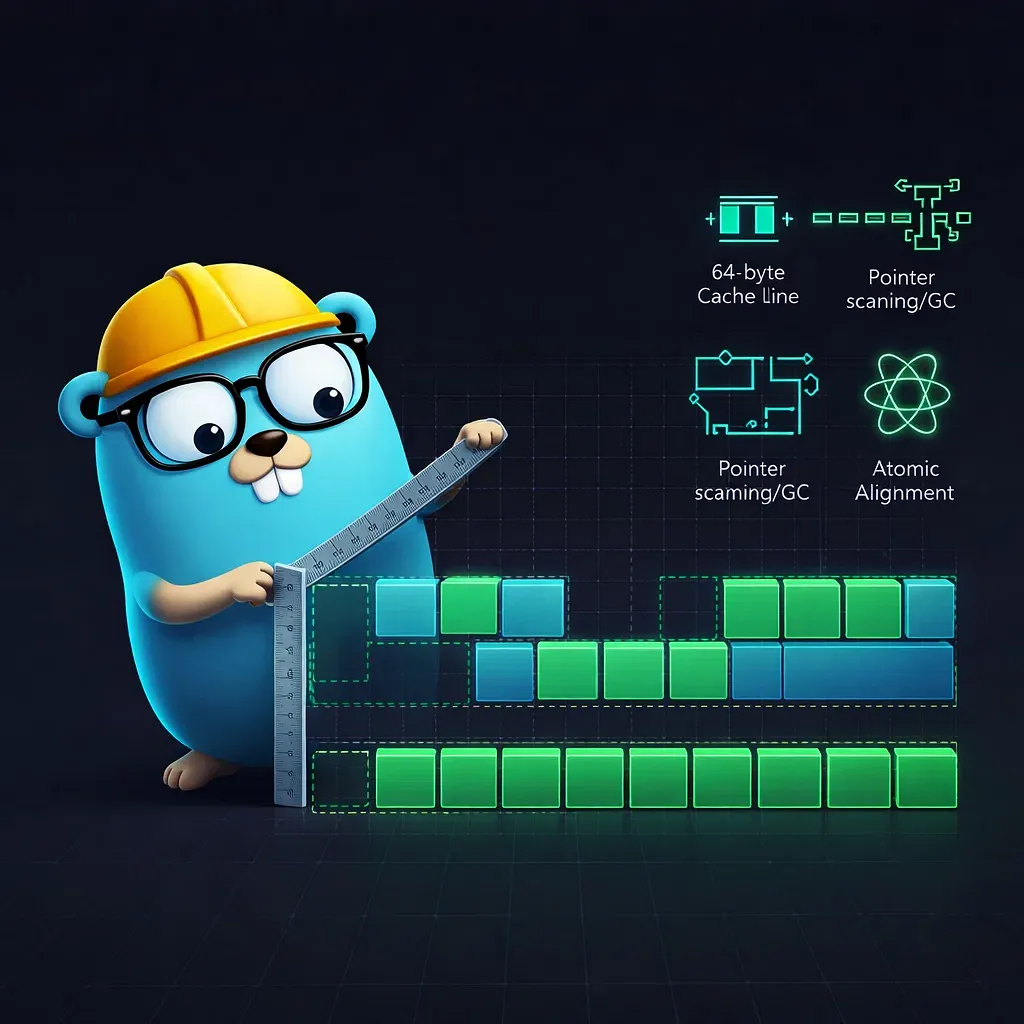
Allocation-heavy paths increase garbage collection work and can affect tail latency. The Go Diagnostics documentation describes profiling and tracing tools for locating these costs. Use CPU and allocation profiles before introducing buffer reuse or sync.Pool. Data layout matters too: our breakdown of Go memory alignment shows how field order changes struct size.
GOMEMLIMIT provides a soft limit for runtime-managed memory, not a hard cap on total process memory. Native allocations and other memory outside the runtime need separate headroom. A limit that is too tight can force excessive collection work.
Overload also requires explicit behavior. Bound queues and reject excess work before timeouts spread across dependencies. Realistic load tests should include slow downstream responses and recovery after a peak, because steady traffic alone will not expose those failure modes.
When Go Is Not the Right Choice
Go is a weaker choice when migration cost exceeds the operational benefit or the core workload depends on another ecosystem. An effective existing platform deserves a measured improvement plan. Language preference is insufficient justification for replacement.
- Mature JVM architecture: established Spring integrations and experienced operators may offer more value than a new runtime.
- Python ML and data workflows: specialized libraries often determine the architecture. Go can handle surrounding network services without replacing model development.
- A modest MVP: the existing team's framework may deliver validated product behavior with less implementation risk.
- An unsupported rewrite: migration introduces feature-parity work, operational retraining, and rollout risk before any benefit appears.
When one component has a measured bottleneck, we favor evaluating a narrow extraction before a full rewrite. The boundary must be stable enough to test independently. Otherwise, another service may add network failure modes without removing the original constraint.
How We Decide Whether to Adopt Go
At Webdelo, Go adoption starts with requirements and measured results. We structure the decision around a baseline, a focused experiment, and an incremental rollout. This keeps architecture discussions tied to business outcomes.
- Establish the baseline. Record throughput, p95/p99 latency, errors, CPU, and memory for critical operations. Separate normal demand from peak behavior.
- Locate the bottleneck. Use profiling and traces to distinguish computation from database waits or queueing.
- Compare alternatives. Include improving the existing stack. A query change or concurrency limit may solve the problem without migration.
- Build a focused proof of concept. Implement one representative path with realistic authentication, serialization, and dependency calls.
- Run realistic load tests. Reproduce traffic bursts, data sizes, and downstream failures. Compare implementations under equivalent resource constraints and acceptance criteria.
- Roll out incrementally. Monitor business outcomes alongside technical metrics. Keep rollback practical, including data-format and schema compatibility.
A proof of concept is useful when it can disprove the proposed choice. If Go improves a local benchmark but leaves the customer-facing bottleneck unchanged, the experiment has identified where engineering effort belongs.
Discuss your high-load requirements and a possible Go architecture with Webdelo's engineering team to define a focused evaluation. Our Go development services page describes how we run such projects.
Choose Go Where Its Strengths Match the Workload
Go is a pragmatic option for concurrent APIs and event-driven workers. Its value comes from combining language capabilities with sound architecture and operational discipline. The decision should follow evidence about the system your team needs to run.
Define success through latency and reliability under realistic demand. Validate dependency capacity and recovery behavior before expanding the rollout. Keep the existing stack wherever it continues to serve the product well.
Frequently Asked Questions
Is Go a good choice for high-traffic applications?
Go is a strong fit for many high-traffic workloads, especially HTTP and gRPC APIs, gateways, and event-driven workers whose requests spend much of their time waiting on I/O. Compiled execution, lightweight goroutines, and simple deployment help these services handle many concurrent operations. Suitability still depends on database capacity, downstream dependencies, and operational requirements. For hard real-time systems, the garbage collector and the general-purpose runtime need separate evaluation.
How does Go compare with Java and Node.js for backend services?
The comparison is contextual, not a ranking. Go offers a compact concurrency model, native compilation, and easy service deployment. Java brings mature enterprise frameworks and JVM diagnostics, which matter when the team and architecture already rely on the JVM. Node.js offers productive JavaScript/TypeScript development and asynchronous I/O, but CPU-heavy work can block its event loop unless it is isolated.
How do you limit concurrency in a Go service under heavy load?
Goroutines are cheap, but downstream databases and APIs are not, so in-flight work needs explicit limits. A bounded worker pool caps both active workers and queued jobs, and a full channel blocks the producer to create backpressure. HTTP services also need admission control so blocked handlers do not become an unbounded queue. Propagate context deadlines and cancellation, and make sure drivers and handlers actually observe them.
How does Go manage memory in high-load services?
Go uses automatic garbage collection, which trades CPU time for lower heap growth: collecting more often uses less memory but more CPU. Allocation-heavy code paths increase GC work and can raise p99 latency, so use CPU and allocation profiles before adding buffer reuse or sync.Pool. GOMEMLIMIT sets a soft limit for runtime-managed memory, not a hard cap on total process memory. Native allocations, for example through cgo, need separate headroom.
Should we migrate an existing backend to Go?
Only when measurements show that the benefit outweighs migration cost. Start with a baseline of throughput, p95/p99 latency, errors, CPU, and memory, then locate the actual bottleneck and compare alternatives, including fixes in the current stack. If one component has a measured bottleneck, a narrow extraction tested with a proof of concept and realistic load tests is usually safer than a full rewrite. Roll out incrementally and keep rollback practical, including schema and data-format compatibility.
Why doesn't switching to Go automatically improve backend performance?
Changing the language leaves architectural bottlenecks intact. N+1 query patterns multiply database round trips in Go just as in any other stack, allocation-heavy code increases GC pressure, and unbounded queues spread timeouts across dependencies under overload. Only profiling and load tests that include traffic bursts, slow downstream responses, and recovery after a peak show whether the new implementation actually removes the constraint.