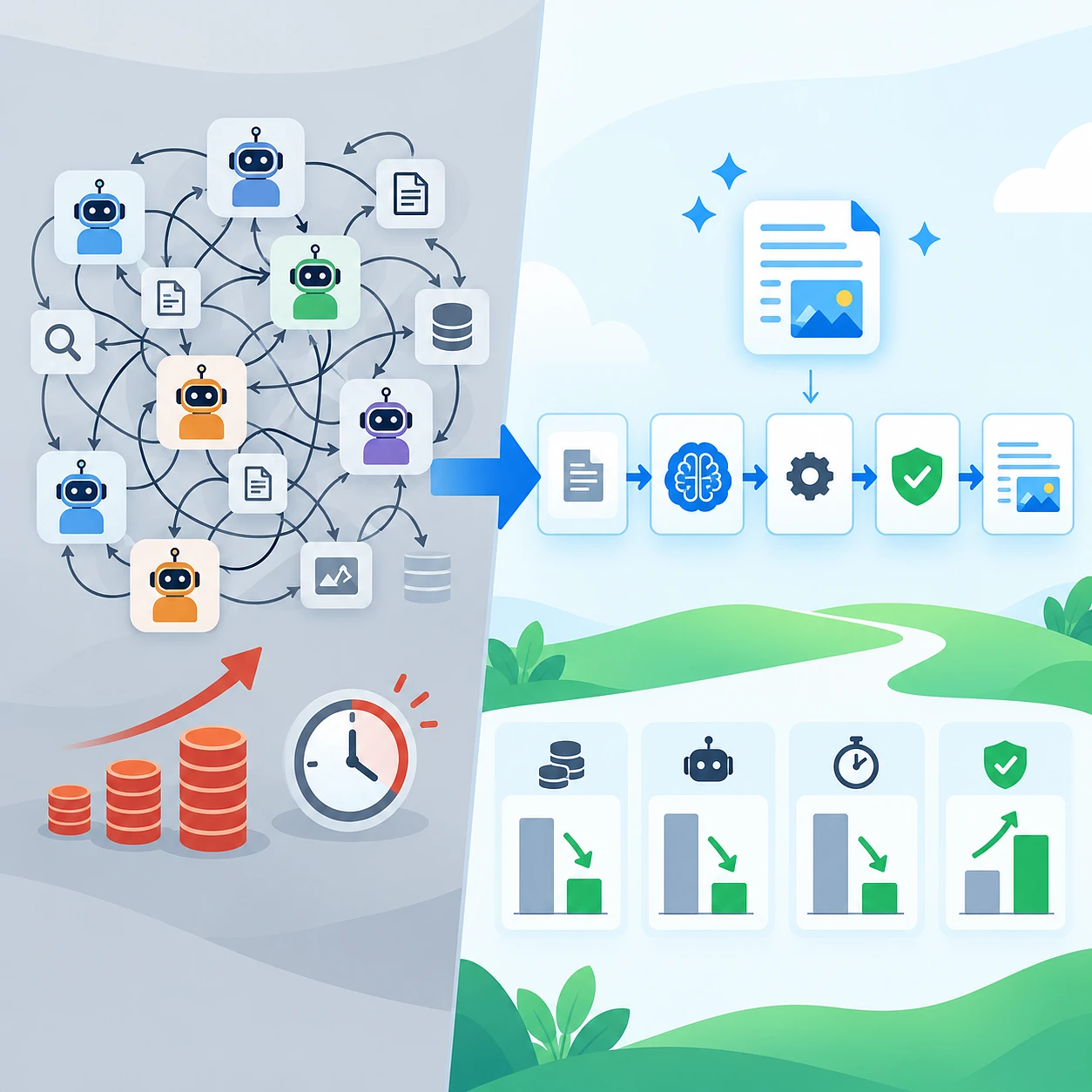

Start With Demand, Business Risk, and Measurable Limits
High-load systems require engineering decisions based on real demand and business impact. Building scalable systems means knowing which resources will run out, how failures affect users, and what additional capacity costs. The right architecture meets those needs without adding complexity the team cannot operate.
A slow database query can delay order processing. An overloaded integration can stop account onboarding. These problems deserve different solutions, even when their dashboards show similar request rates.
At Webdelo, our engineering perspective spans architecture through long-term support. Founded in 2006, we build B2B platforms and complex software, including ERP/CRM and high-load services. Our Web Development work connects product requirements with implementation and operations.
This guide explains how we frame high-load system development decisions. It covers bottleneck diagnosis, architecture choices, and the evidence needed before a scaling investment. Examples are illustrative, while references to our expertise are limited to documented company facts and published engineering materials.
When Does Demand Become an Architecture Problem?
A system faces high load when demand approaches its practical limits and threatens required performance or correctness. There is no universal requests-per-second threshold. The relevant limit depends on the work each request performs and the service level the business needs.
Why Fixed RPS Thresholds Mislead
Requests per second, or RPS, measures traffic volume. It does not describe transaction complexity. An illustrative checkout API handling 200 RPS can face harder consistency and latency requirements than a static site serving 20,000 RPS through a content delivery network.
Concurrent connections measure something different again. Thousands of mostly idle connections may consume little CPU while still exhausting connection limits or memory. Capacity planning needs both arrival rates and the resources occupied by ongoing work.
Data-intensive platforms spend much of their effort storing, retrieving, or coordinating data. Compute-intensive platforms spend more on calculations. A crm platform can become data-intensive through reporting and synchronization long before its user count looks exceptional.
Metrics That Reveal Real Pressure
We recommend defining a workload profile before choosing infrastructure. It should describe normal demand, expected peaks, and the mix of operations behind those numbers.
- Throughput: incoming RPS and successfully completed operations, separated by user journey.
- Concurrency: active requests, sessions, connections, and background jobs.
- Latency: p95 and p99 response times for important operations.
- Errors: timeouts, rejected requests, and failed business transactions.
- Saturation: pressure on CPU, memory, disk, connection pools, and worker capacity.
- Data growth: stored volume, working-set size, and changes in query cost.
- Queue lag: processing backlog and the age of unfinished work.
Business impact determines which limits matter most. A delayed analytical report may be acceptable. A delayed inventory reservation may cause overselling. Both need explicit requirements rather than a shared, platform-wide response-time average.
What Breaks First as Traffic Increases?
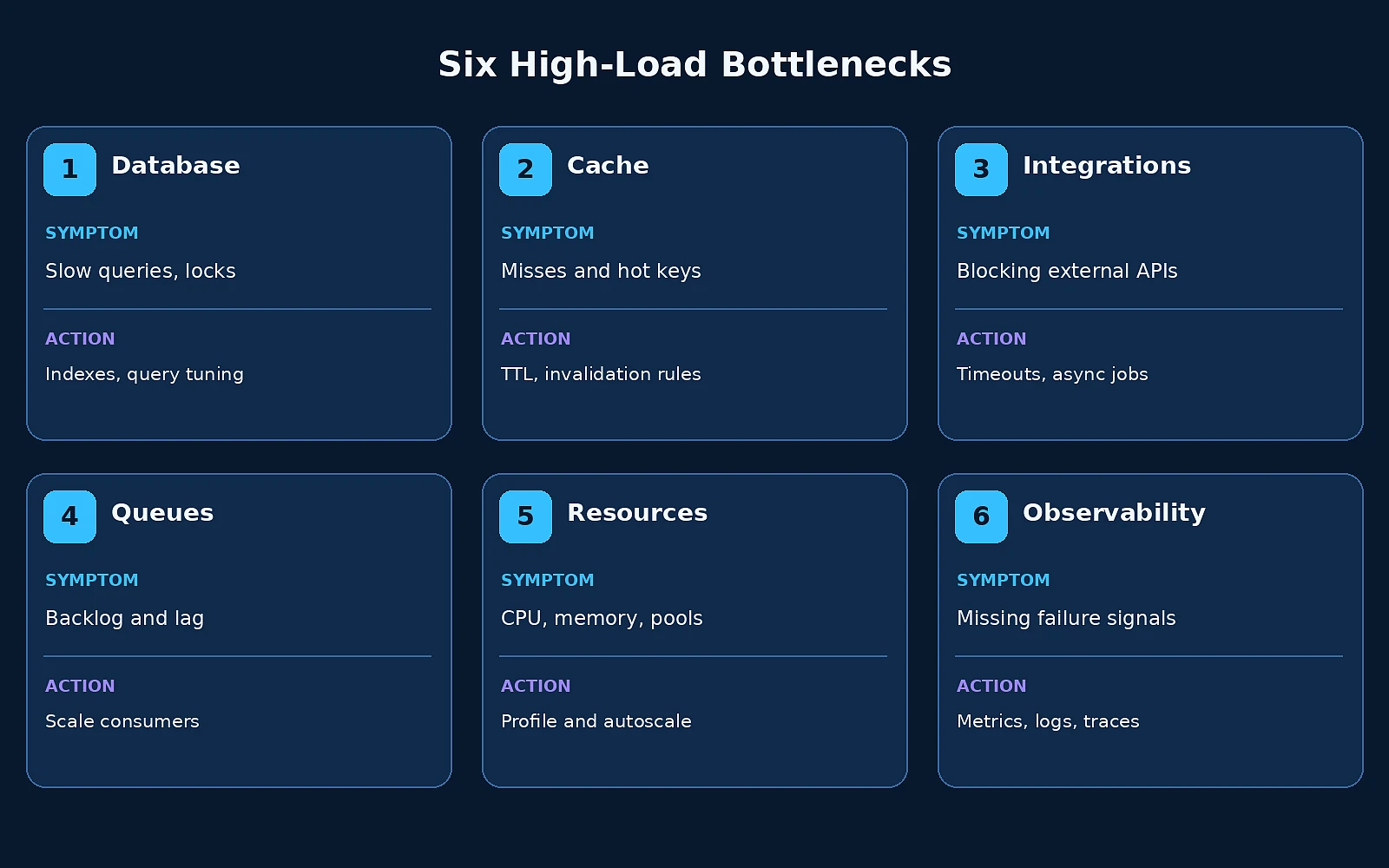
The database is a common first bottleneck in transaction-heavy systems. Cache failures, synchronous integrations, and growing queues can also exhaust capacity before application CPU appears busy. Diagnosis starts by locating where requests wait, not by assuming every slowdown needs more servers.
Database Waiting and Connection Pressure
A missing index increases the work required for each query. Lock contention makes transactions wait for each other. An N+1 query pattern turns one application request into many database round trips.
Connection pools introduce another limit. When every connection is occupied, new requests wait for a slot. Adding application instances can worsen the problem because each instance may open another pool against the same database.
Cache Misses and Slow Dependencies
A cache stampede occurs when many requests try to rebuild the same expired value. The resulting database traffic can overwhelm a system that appeared healthy while the cache was warm.
Synchronous integrations hold up the request until another service responds. On an ecommerce website, a slow shipping-rate provider can occupy checkout workers even when the store's own database is healthy. The remedy starts with a bounded timeout and an agreed fallback or failure path.
Backlogs, Resource Limits, and Blind Spots
A queue absorbs temporary bursts, but it cannot compensate indefinitely for insufficient processing capacity. A growing backlog delays business outcomes and eventually threatens retention or storage limits.
Memory pressure and full disks can also develop outside the main request path. Without correlated telemetry, teams may scale application servers while the real constraint remains a shared database or external API.
Core Components of a Scalable Software Architecture
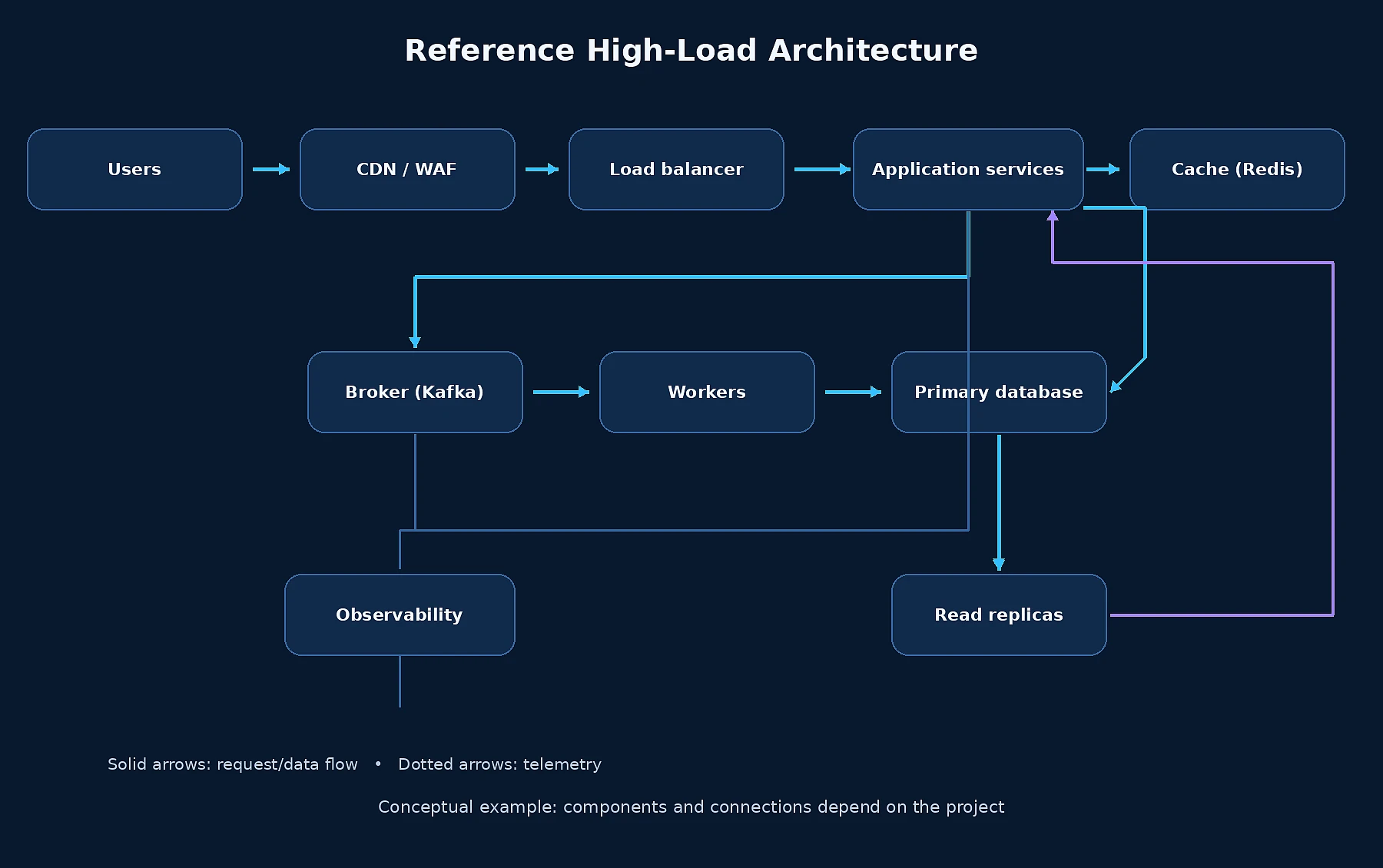
A scalable software architecture usually combines traffic control, application processing, data storage, and telemetry. CDN/WAF, load balancers, stateless services, caches, and message brokers are reusable building blocks. Each should solve a specific capacity or reliability problem.
Northwestern University's scalable architecture course describes a similar collection of components behind large Internet services. The familiar frontend, backend, and database model remains a useful starting point. Additional layers should have clear responsibilities.
Edge, Load Balancing, and Stateless Services
A content delivery network, or CDN, serves cacheable content close to users. A web application firewall, or WAF, filters requests using security rules. Neither removes the need for application-level authorization and abuse controls.
A load balancer distributes incoming requests across healthy instances. Stateless application instances keep durable session state outside local process memory. This lets another instance handle the next request without depending on the original server.
For a corporate website, public content may be heavily cacheable. Authenticated account pages need different cache rules. An incorrect cache key can expose personalized content, so caching policy belongs in the security review.
Data, Processing, and Telemetry
PostgreSQL can serve transactional writes through a primary database. Read replicas can handle suitable read traffic. Redis can store frequently reused results, while Kafka or RabbitMQ can deliver work to background consumers.
Metrics, logs, and traces connect these layers operationally. The component map should also identify ownership and failure behavior. For each dependency, document what happens when it becomes slow, unavailable, or inconsistent.
Every additional component creates operating work. Before adding one, identify who will patch it, monitor it, and recover its data. A diagram that omits those responsibilities understates the cost of the architecture.
Monolith, Modular Monolith, or Microservices Architecture?
The strongest reason to choose microservices architecture is a need for independent ownership, deployment, or scaling. A modular monolith preserves one deployment while establishing clear domain boundaries. We favor choosing between them based on measured constraints and team capacity.
| Criterion | Monolith | Modular monolith | Microservices |
|---|---|---|---|
| Deployment | One application release | One release with explicit internal boundaries | Separate service releases |
| Independent scaling | Usually scales as a whole | Usually scales as a whole until extraction | Services can scale separately |
| Data ownership | Often shared across the application | Defined by module, even within one database | Defined by service with controlled access |
| Operational overhead | Relatively limited | Limited infrastructure with boundary governance | Greater networking, deployment, and telemetry demands |
| Team fit | One coordinated team | One team or several closely aligned teams | Teams able to own services through production |
| Debugging | Mostly within one process | Within one process across explicit interfaces | Across network and asynchronous boundaries |
| Cost of change | Rises with internal coupling | Contained when module boundaries hold | Low for isolated changes, higher for cross-service changes |
Why We Favor Clear Modules First
Our recommendation is to establish domain boundaries before distributing them. An order module should expose deliberate operations rather than allow unrelated code to update its tables directly. This reduces coupling and creates a clearer path to later extraction.
A modular monolith still requires discipline. Shared tables, circular dependencies, and unrestricted internal calls can erase its benefits. Boundary checks and code review matter as much as folder structure.
Service extraction becomes more attractive when one module has a different load profile or release cadence. The decision should include the cost of on-call ownership and cross-service consistency. Splitting code alone does not create operational independence.
Event-Driven Design Across Deployment Models
Event-driven design is a communication pattern, not a competing deployment model. A monolith can publish events to background workers. Microservices can use synchronous APIs, asynchronous events, or both.
Notifications and report generation often tolerate delayed completion. Inventory confirmation may require an immediate result. Choose the interaction pattern for each business operation and define what users see while asynchronous work remains unfinished.
Databases, Redis Caching, and Reliable Messaging
The data layer sets practical limits on throughput and correctness. PostgreSQL replication can offload reads, Redis caching can avoid repeated work, and messaging can separate processing stages. These mechanisms also introduce stale data, delayed completion, and duplicate-delivery risks.
We recommend inspecting query plans and transaction scope before adding infrastructure. Webdelo's published technical guide on bulk insert in PostgreSQL with Go provides a concrete example of write-path engineering. Its existence supports a technical discussion, without implying an unpublished client outcome or benchmark.
PostgreSQL Primary and Read Replicas
Read replicas may lag behind the primary. A user who updates an account and immediately reloads it could see old data if the read goes to a lagging replica. Route consistency-sensitive reads to the primary or use an explicit consistency mechanism.
Replicas do not remove the primary's write bottleneck. Connection pooling, efficient indexes, and shorter transactions may provide more useful headroom. Partitioning can help selected workloads, but only when query and maintenance patterns benefit from the partition key.
Batch writes reduce repeated overhead. Oversized batches can also hold locks longer and increase recovery work after failure. Choose batch size through testing with representative records and transaction boundaries.
Redis Caching With Controlled Failure
A cache needs a freshness contract. Define which data can be stale, for how long, and what invalidates it. Financial balances and descriptive product content rarely deserve the same policy.
Randomized expiration times reduce synchronized refreshes. Request coalescing lets one worker rebuild a missing value while others share its result. Both techniques reduce pressure during cache turnover.
A cache outage must have a bounded failure path. Unrestricted fallback to the database can turn a cache problem into a platform outage. Rate limits, stale responses where permitted, and controlled rejection can protect essential transactions.
Kafka, RabbitMQ, and Idempotency
Kafka is often useful for retained event streams and replay. RabbitMQ is often useful for routed tasks and work queues. Evaluate ordering, retention, and consumer behavior before choosing a Kafka message queue simply because traffic is growing.
Many practical delivery configurations can redeliver messages. Idempotency means processing the same operation again without creating another business effect. A consumer might record a unique operation identifier in the same database transaction as the update it protects.
The AWS Builders' Library discusses retries and resilient distributed systems. The practical lesson is to design retry safety around business effects. A message acknowledgment alone cannot prove that a payment or order was applied only once.
When a database update must also publish an event, consider a transactional outbox. The application stores the change and an outgoing event record in one transaction. A separate publisher delivers the event, while consumers remain prepared for duplicates.
Horizontal Scaling and DevOps Need Shared Capacity Limits
Horizontal scaling adds processing instances, while vertical scaling gives an existing instance more resources. Both are valid tools. Scaling works only when shared dependencies and deployment practices can support the added capacity.
Application instances may scale independently, but they still compete for database connections and external API quotas. Set a total connection budget before increasing replica counts. Reserve capacity for maintenance and recovery as well as ordinary traffic.
The Kubernetes documentation describes mechanisms for autoscaling workloads. Kubernetes does not eliminate startup delays or downstream limits. Choose scaling signals that reflect the workload, such as queue age for background processing.
Our Webdelo DevOps and Infrastructure capability sits within full-cycle delivery. Architecture decisions need deployment automation and production visibility to remain manageable as the product grows.
- Automate releases: build and test repeatable artifacts rather than changing servers manually.
- Limit rollout exposure: introduce a release gradually and compare operational signals.
- Protect rollback: keep database changes compatible with the previous application version where required.
- Drain work safely: stop accepting new requests before terminating an instance.
- Test reduced capacity: verify behavior when an instance or failure domain becomes unavailable.
Public traffic also includes legitimate crawlers. Coordinate caching and crawl access with seo work so important pages remain accessible without repeatedly triggering expensive backend operations.
For geo, meaning optimization for generative search visibility, useful public content must also remain retrievable. Apply intentional crawler policies and resource limits rather than assuming every automated request has the same value or risk.
Load Testing and Observability Reveal the Capacity Boundary
Load testing measures system behavior under controlled demand. Observability helps explain that behavior through telemetry. Read RPS, tail latency, errors, and saturation together to identify the operating range that still meets user requirements.
The Grafana k6 documentation covers scripted workloads and pass/fail thresholds. A useful scenario follows real operations, including authentication and realistic data access. Repeatedly requesting one cached endpoint reveals little about transactional capacity.
Traffic forecasts should include product launches and digital marketing campaigns. A campaign that concentrates users on one expensive workflow can create a different bottleneck from the same traffic spread across the platform.
Reading p95 and p99 Latency
p95 latency is the response time at or below which 95% of measured requests finish. p99 describes the corresponding boundary for 99%. These percentiles describe requests, not necessarily unique users, and expose delays that averages can hide.
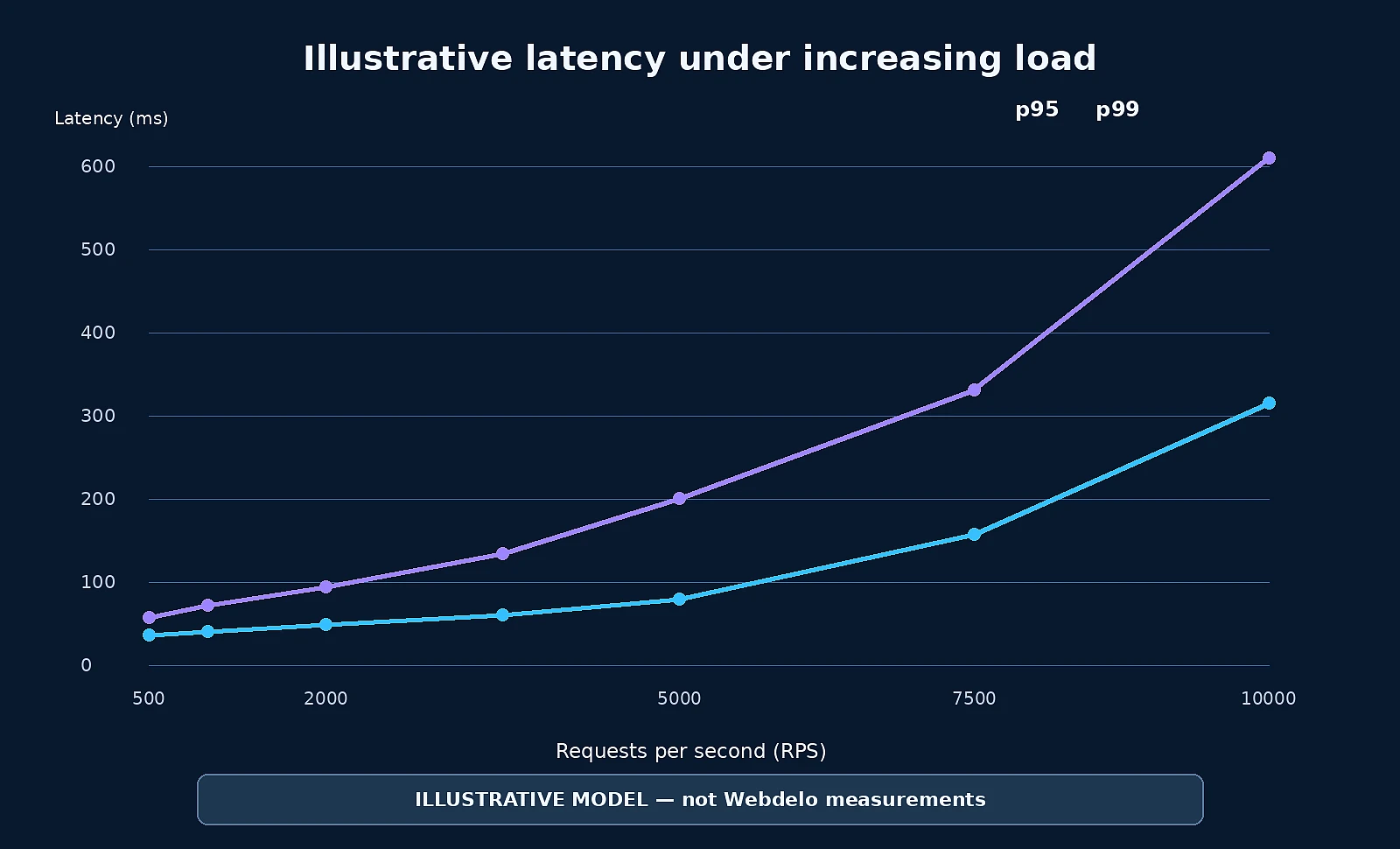
A sharp rise in p99 can indicate growing queues or resource contention. It is a warning rather than a universal capacity formula. The usable limit is the highest tested workload that meets the agreed criteria with enough headroom for expected variation and failure.
Separate successful and failed requests when interpreting latency. Fast error responses can make aggregate latency look better while useful throughput collapses. Also verify that the load generator actually delivered the intended arrival rate.
Building a Representative Test Program
- Baseline tests: establish behavior under expected ordinary demand.
- Stress tests: increase demand to identify limits and overload behavior.
- Spike tests: check abrupt traffic changes and scaling response.
- Soak tests: sustain demand to reveal leaks, backlog accumulation, and storage growth.
Use representative data volumes and access patterns. A database containing a small test dataset may produce misleading query plans and cache hit rates. Include expensive journeys rather than modeling only the most common endpoint.
Backend throughput also differs from perceived page speed. A web design agency should account for asset weight and loading behavior alongside the engineering team's server-side tests. A responsive API cannot compensate for excessive browser work.
Connecting Metrics, Logs, and Traces
OpenTelemetry provides vendor-neutral instrumentation for metrics, logs, and traces. Metrics reveal trends, logs record events, and traces follow work across component boundaries.
Instrument important business journeys and carry correlation context through asynchronous processing. Record deployment versions so regressions can be associated with changes. Keep sensitive customer data out of telemetry, and control high-cardinality attributes that can make monitoring expensive.
Fault-Tolerant Systems and High Availability Require Tested Recovery
Fault-tolerant systems preserve specified behavior despite defined faults. Resilience includes absorbing disruption and recovering, sometimes through graceful degradation. High availability depends on redundancy, failure isolation, and recovery practices matched to explicit service objectives.
Define Which Failures Must Be Tolerated
Fault tolerance always needs a failure model. Surviving one application instance failure does not prove survival of a regional outage. Identify the failures the architecture must handle and the behavior users should see during each one.
A recommendation panel can show cached content when its dependency fails. An account balance must preserve its correctness requirements. Graceful degradation therefore needs a product decision, not only an infrastructure mechanism.
SLO, SLA, and Error Budgets
A service level objective, or SLO, defines a measurable performance or reliability target. A service level agreement, or SLA, is a contractual commitment with defined consequences. Neither should be selected independently of measurement and recovery capability.
The Google SRE Workbook explains SLOs and error budgets. An error budget represents the allowed amount of failure within the objective's measurement window. It gives teams a basis for deciding when reliability work should take priority over additional change.
Define objectives around completed user journeys. A server returning a successful HTTP status does not prove an order was accepted correctly. Measurement should distinguish infrastructure health from business success.
Timeouts, Retries, and Circuit Breakers
Outbound calls need bounded timeouts within an end-to-end request budget. Retries need limits and backoff, which increases the delay between attempts. Jitter adds randomness so many clients do not retry simultaneously.
A circuit breaker temporarily stops calls to a dependency that is failing. Concurrency limits provide another boundary by restricting how much work that dependency can occupy. Together, these controls help contain cascading failures.
Rehearse restoration from backups and measure the result. Define acceptable data loss and recovery time before an incident. A successful backup job does not establish that the application can be restored with consistent data and usable credentials.
How Webdelo Frames High-Load Engineering Decisions
Our approach begins with business-critical journeys and measured constraints. We recommend the simplest architecture that meets the required operating targets. Public engineering materials support our technical credibility without requiring invented client stories or unavailable performance figures.
Webdelo was founded in 2006 and has an engineering presence in Eastern Europe. We develop B2B platforms, ERP/CRM systems, and FinTech and trading tools. Our scope also includes IoT and high-load services, from discovery and architecture through DevOps and support.
Our engineering leadership includes founder and Webdelo CTO Andrew Popov. His public profile provides a reference for technical leadership. Webdelo has also been a Moldova IT Park resident since 2021, a company fact rather than a performance certification.
What Our Public Engineering Materials Show
The PostgreSQL and Go bulk-insert guide documents work at the data-access layer. Published materials on JSON handling in Go and e-commerce load testing address code behavior and test design. These are concrete technical subjects that influence platform capacity.
Publication alone does not establish a capacity figure for another application. Hardware, datasets, and transaction semantics change the result. We therefore treat these materials as evidence of engineering subject matter, not as transferable benchmark claims.
Our Architecture Review Framework
An architecture review should produce decisions that an engineering team can execute. Our proposed framework connects business requirements to evidence and then to a prioritized plan.
- Map critical journeys. Identify operations that create revenue or protect customer trust. Record latency, correctness, and recovery requirements.
- Establish the workload. Document current demand, anticipated growth, and data characteristics. Separate observed facts from planning assumptions.
- Find the limiting resource. Use telemetry and controlled tests to locate waiting, contention, and failed work. Include dependency quotas and operational limits.
- Compare intervention options. Evaluate local improvements before service extraction or a rewrite. Describe implementation effort, operating cost, and migration risk.
- Define acceptance evidence. Specify how the team will prove improvement and detect regression. Assign ownership for testing and production follow-through.
The resulting artifacts should include a dependency map and a ranked bottleneck list. Architecture options need explicit assumptions and trade-offs. A capacity statement should identify the tested workload and environment rather than present one context-free RPS number.
Where We Challenge Default Advice
We challenge microservices proposals when an inefficient query remains the limiting factor. Moving that query behind a network boundary leaves the underlying work unchanged. It also introduces another deployment and failure surface.
We also recommend regular load testing rather than a single launch gate. Changes in data shape can create regressions without a major code release. Reliability commitments should follow measured capability and agreed scope, with no unconditional availability promise.
Architecture Mistakes That Raise Cost Without Capacity
The most expensive mistakes separate infrastructure decisions from workload evidence. Premature distribution and unlimited concurrency can increase both cost and failure risk. Review the mechanism behind each proposed improvement before approving it.
- Scaling the wrong layer: additional application instances cannot resolve a saturated database write path.
- Sharing mutable data across services: direct access to each other's tables couples releases and weakens ownership.
- Keeping sessions on one instance: local state makes balancing and instance replacement harder.
- Building synchronous dependency chains: each required call adds another source of delay and failure.
- Retrying without limits: repeated attempts can amplify overload and duplicate business effects.
- Using queues without backlog policies: delayed work accumulates until deadlines or storage limits are breached.
- Watching averages alone: aggregate latency can hide slow critical journeys and a growing tail.
- Ignoring operating cost: components need upgrades, recovery procedures, and accountable owners.
A shared database can be a deliberate migration stage. Document its constraints and exit criteria instead of describing the services as fully independent. Architecture labels should reflect the operational reality.
Architecture Readiness Checklist for Your Next Growth Step
A platform is ready for growth when the team can demonstrate its capacity, failure behavior, and recovery path. Use this checklist as an evidence review rather than a count of installed technologies. Mark each item as verified, untested, or not applicable.
Measurement and Capacity Evidence
- Critical journeys have measurable latency and success objectives.
- Dashboards show incoming demand, useful throughput, p95/p99, errors, and saturation.
- Queue age and processing backlog are visible where asynchronous work matters.
- The tested workload includes representative data and peak operation mixes.
- Capacity headroom accounts for growth, scaling delays, and relevant failures.
Architecture and Data Evidence
- Application instances can be replaced without losing required session state.
- Scaling tests include downstream connection and quota limits.
- Read consistency requirements determine whether replicas are appropriate.
- Cache expiration and cache unavailability have tested failure paths.
- Asynchronous workflows have ownership, retry policies, and completion deadlines.
Recovery and Delivery Evidence
- Outbound calls have timeouts and bounded concurrency.
- Retried operations preserve correctness through idempotency or equivalent controls.
- Backup restoration has been exercised with recorded outcomes.
- Staged releases and rollback procedures cover application and data changes.
- Load tests have pass/fail criteria and run after relevant changes.
Prioritize unverified items by business consequence. An untested payment retry path may deserve attention before a reporting slowdown. The checklist should produce named actions, owners, and acceptance evidence.
Get an Evidence-Based Architecture Assessment
An architecture assessment can turn growth concerns into a prioritized engineering plan. The review should establish the workload, identify likely bottlenecks, and compare improvement options by cost and risk. Its conclusions should distinguish tested findings from assumptions.
Useful inputs include architecture diagrams, recent telemetry, and expected demand changes. Incident records and deployment constraints help explain where theoretical solutions may be impractical.
Request an architecture and high-load readiness assessment from Webdelo. Bring your critical user journeys and growth expectations so the discussion can focus on capacity, reliability, and the next justified investment.
A Shared Vocabulary for Architecture Decisions
High-load discussions work better when technical and business stakeholders use the same definitions. These terms describe workload, operating behavior, and reliability commitments. Each needs to be tied to a specific system and measurement context.
- RPS
- Requests per second. Distinguish incoming requests from successfully completed operations.
- p95 and p99 latency
- Response-time boundaries below which 95% and 99% of measured requests finish.
- Saturation
- Pressure on a constrained resource, often visible through waiting or exhausted capacity.
- Queue lag
- The gap between incoming and processed work, expressed as backlog, offset distance, or time delay.
- Horizontal scaling
- Adding instances or nodes to distribute work.
- Read replica
- A database copy used for reads that may trail the primary's latest changes.
- Idempotency
- The property that repeating an operation does not create an additional intended business effect.
- Circuit breaker
- A control that temporarily blocks calls to a failing dependency and later tests recovery.
- SLO
- A service level objective that defines a measurable target over a stated window.
- SLA
- A service level agreement that sets contractual commitments and consequences.
- Error budget
- The amount of failure permitted by an SLO within its measurement window.
- Observability
- The ability to understand system behavior through signals such as metrics, logs, and traces.
Let Measured Constraints Guide the Next Architecture Decision
High load is a workload and business-risk problem. Sustainable architecture starts with clear service objectives and evidence about the current limit. Added infrastructure is justified when it resolves that limit at an operating cost the team can support.
A modular monolith can provide a strong foundation, and event-driven patterns can work with any deployment model. Reliability comes from controlled dependencies and tested recovery. The next useful decision is the smallest change whose benefit you can demonstrate under representative demand.
Frequently Asked Questions
When does a system actually need a high-load architecture?
A system needs one when demand approaches its practical limits and threatens required performance or correctness. No single requests-per-second threshold defines high load. A checkout API at 200 RPS can be harder to scale than a static site at 20,000 RPS behind a CDN. Start with a workload profile: throughput, concurrency, p95/p99 latency, errors, saturation, data growth, and queue lag for each critical journey.
What usually breaks first when traffic grows?
In transaction-heavy systems, the database is a common first bottleneck: missing indexes, lock contention, N+1 queries, and exhausted connection pools. Cache stampedes, slow synchronous integrations, and growing queues can also run out of capacity while application CPU still looks idle. Find where requests wait before adding servers. More application instances can make things worse, because each one opens another connection pool to the same database.
Should we move from a monolith to microservices to handle more load?
Only if you need independent ownership, deployment, or scaling, and your teams can run services in production. Webdelo usually recommends a modular monolith first: one deployment with clear domain boundaries and controlled data ownership. Extract a service when a module has a different load profile or release cadence. If a slow query is the limit, putting it behind a network boundary does not fix it and adds a new failure surface.
Is event-driven architecture an alternative to microservices?
No. Event-driven design is a communication pattern, not a competing deployment model. A monolith can publish events to background workers, and microservices can use synchronous APIs, events, or both. Choose the pattern per business operation: notifications and reports can wait, while an inventory reservation may need an immediate answer.
Why read p95 and p99 latency instead of averages in load testing?
Averages hide the slow tail that users of critical journeys actually feel. A sharp rise in p99 often signals growing queues or resource contention before the average moves. Read percentiles together with RPS, errors, and saturation, and separate successful from failed requests, because fast errors can make latency look better. The usable capacity is the highest tested workload that meets your criteria with headroom.
How do you make retries and message redelivery safe?
Design for idempotency: processing the same operation twice must not create a second business effect. A common approach is to store a unique operation ID in the same database transaction as the update it protects. When a database change must also publish an event, a transactional outbox keeps both consistent. Add bounded timeouts, backoff with jitter, and retry limits so retries do not amplify overload.
What does a high-load architecture assessment from Webdelo deliver?
It turns growth concerns into a prioritized engineering plan. Typical outputs are a dependency map, a ranked bottleneck list, architecture options with explicit trade-offs, and a capacity statement tied to the tested workload and environment. Useful inputs are architecture diagrams, recent telemetry, expected demand changes, incident records, and deployment constraints. Findings separate tested evidence from assumptions.