Go 1.27 Changes: What Matters in Production | 2026
Go 1.27 introduces generic methods, encoding/json/v2, goroutine leak profiling, UUID in stdlib, and post-quantum ML-DSA crypto. A production-ready guide with upgrade checklist and code examples.

Go 1.27: What Changed, Practical Examples, and What the New Version Gives to Production Development
Introduction
Go 1.27 was released in August 2026, six months after Go 1.26. The release follows the standard Go schedule and, as usual, maintains the Go 1 compatibility promise - almost all existing programs continue to compile and run without changes.
That said, 1.27 is not a quiet maintenance release. It brings three changes to the language spec, adds five significant packages to the standard library, improves runtime performance, and makes goroutine leak detection available in production without any code instrumentation. If you are running Go services in production - APIs, ERP integrations, high-load backends - this release has several things worth planning around.
Here is what actually changed, what is safe to adopt immediately, and what requires careful migration.
Changes That Actually Matter in Production
At the language level, Go 1.27 adds three things: generic methods on concrete types, more flexible struct literal syntax, and generalized function type inference. None of these will break your code. They just expand what you can express.
The standard library additions are more significant - the full list is in the Go 1.27 release notes:
encoding/json/v2- a major revision of JSON handling, with behavior differences that can break existing API consumerscrypto/mldsa- post-quantum signatures integrated intocrypto/tlsandcrypto/x509uuid- UUID generation now in the standard library, no third-party package neededsimdandsimd/archsimd- experimental SIMD supportnet/http/httptest.NewTestServer- cleaner HTTP test setup
On the runtime side: small object allocation is faster (up to 30% for objects under 80 bytes), and the goroutine leak profiler is now generally available.
The one thing to treat carefully before upgrading: encoding/json/v2 changes how nil slices serialize. If you have downstream consumers expecting null, switching to v2 will break them. More on this below.
Generic Methods: From Functions to Methods
Since Go 1.18 introduced generics, you could write generic functions and generic types. But you could not write a generic method - a method that declares its own type parameters. That changes in Go 1.27.
Here is the problem this solves. Before 1.27, if you wanted a type-safe random number method for multiple integer types, you had to add a separate method for each:
func (r *Rand) Int32N(n int32) int32 { ... }
func (r *Rand) Int64N(n int64) int64 { ... }
func (r *Rand) IntN(n int) int { ... }
With Go 1.27, math/rand/v2.Rand gains a single generic method:
func (r *Rand) N[Int intType](n Int) IntYou call it as r.N(100) for any integer type. The compiler infers the type parameter from the argument.
What is allowed and what is not
Generic methods work on concrete types (structs). Two important constraints:
Interface methods cannot declare type parameters. This is by design. If interface methods could be generic, satisfying an interface would require type parameter matching at the call site, which does not fit how Go's interface satisfaction model works.
Generic methods cannot implement interface methods. Even when the instantiated signature matches, T does not implement I through a generic method. Only non-generic methods participate in interface satisfaction.
type I interface {
    M()
}

type T struct{}

func (T) M[P any]() { } // Generic method

// T does NOT implement I
// T.M[int]() has signature func(), same as I.M, but T still doesn't satisfy I
This is consistent, if occasionally surprising. When you need interface satisfaction, write a non-generic method. When you need type-parameterized behavior scoped to a type's namespace, a generic method is now the right tool.
Practical use in production code
The main benefit is API cleanliness in shared libraries. Before, a generic function like SortBy[T any](items []T, key func(T) int) had to live at the package level. Now it can live as a method on a collection type, which is more discoverable and easier to chain.
The math/rand/v2 example is the most visible stdlib change, but the pattern is useful for any type that currently has a family of type-specific methods doing the same thing.
encoding/json/v2: A Major Rethink of JSON in Go
This is the most consequential change in Go 1.27 for backend developers working with APIs. If you also validate payloads against a schema, we covered the official JSON Schema package for Go in a separate guide.
Two new packages:
encoding/json/v2- high-level API, the intended successor toencoding/jsonencoding/json/jsontext- low-level streaming JSON (encoder/decoder operating on Token and Value types)
The existing encoding/json package is now backed by the v2 implementation internally. This means faster unmarshaling automatically, without changing any imports. No action required.
The behavior changes that can break things
The API is largely compatible - json.Marshal(v) still works if you switch the import to encoding/json/v2. The migration risk is in behavior, not syntax.
Nil slices serialize differently:
type Pet struct {
    Name      string
    Nicknames []string
}

pet := Pet{Name: "Remi"} // Nicknames is nil
With encoding/json (v1): {"Name":"Remi","Nicknames":null}
With encoding/json/v2: {"Name":"Remi","Nicknames":[]}
This is actually more correct behavior - a nil slice and an empty slice are both "no items". But if your downstream API consumers test for null specifically, they will break. In B2B integrations and ERP connectors, this kind of subtle change causes real incidents.
Strict UTF-8 validation: v2 rejects invalid UTF-8 in JSON strings. v1 would pass it through.
Duplicate JSON object keys: v2 rejects duplicate member names in a JSON object. v1 silently kept the last value.
New API features worth knowing
// Marshal directly to a Writer - no intermediate []byte
err := json.MarshalWrite(w, v)

// Override marshaling behavior for a specific type, even one you don't own
opts := json.JoinOptions(
    json.Marshalers(json.MarshalFuncV2(func(enc *jsontext.Encoder, t time.Time, opts json.Options) error {
        return enc.WriteToken(jsontext.String(t.Format(time.RFC3339)))
    })),
)
b, err := json.Marshal(v, opts)
Migration strategy
You do not have to migrate. encoding/json will never be removed - it is covered by Go 1 compatibility. And the old package now benefits from v2's faster internals automatically.
For new projects or new services, start with encoding/json/v2. For existing services, the safe path is:
- Identify all JSON serialization points that could produce
nullfrom nil slices - Audit downstream consumers for
nullvs[]sensitivity - Test with v2 in a staging environment before switching production
- Consider using v2 only on new endpoints while keeping v1 on existing ones
The v1 and v2 packages interoperate - a type with a v2 custom marshaler will work correctly even when marshaled through v1's Marshal function.
Goroutine Leaks in Production: Now Detectable Automatically
A goroutine leak happens when a goroutine is permanently blocked and can never be unblocked. Over time, leaked goroutines accumulate, consuming memory and increasing GC pressure. In high-load systems, this degrades performance gradually and is often noticed only after significant accumulation.
The standard tool for catching leaks in tests is goleak from Uber. But it works at test time. In production, until now, you had to notice the goroutine count climbing in your metrics and then do manual profiling to find the source.
Go 1.27 makes this automatic.
Enabling the goroutine leak profile
If you already import net/http/pprof, you get it for free:
import _ "net/http/pprof"The leak profile is available at:
GET /debug/pprof/goroutineleakIt shows goroutines that have been permanently blocked - with full stack traces, so you can see exactly where they are stuck.
A real example
Consider a concurrent worker pool with an early-return bug:
func processWorkItems(ws []workItem) ([]workResult, error) {
    ch := make(chan result) // unbuffered

    for _, w := range ws {
        go func(w workItem) {
            res, err := processWorkItem(w)
            ch <- result{res, err} // blocks if nobody is receiving
        }(w)
    }

    var results []workResult
    for range len(ws) {
        r := <-ch
        if r.err != nil {
            return nil, r.err // early return - goroutines still trying to send
        }
        results = append(results, r.res)
    }
    return results, nil
}
When processWorkItem returns an error partway through, the function returns early. The remaining goroutines are stuck trying to send on an unbuffered channel. Nobody is receiving. They leak.
The goroutineleak profile surfaces exactly these goroutines, with the stack trace pointing to the ch <- result{res, err} line.
The fix is a buffered channel:
ch := make(chan result, len(ws))Limitations
The profiler detects goroutines that are permanently blocked - ones where the unblocking condition can never be met. It does not detect slow goroutines, or goroutines that are temporarily blocked and will eventually proceed. Think of it as a "stuck forever" detector, not a general concurrency health monitor.
For production services handling complex concurrent workloads - streaming APIs, event processors, ERP integrations with external system callbacks - this profile is a meaningful addition to your observability stack.
Runtime: Faster Allocations and HTTP Testing
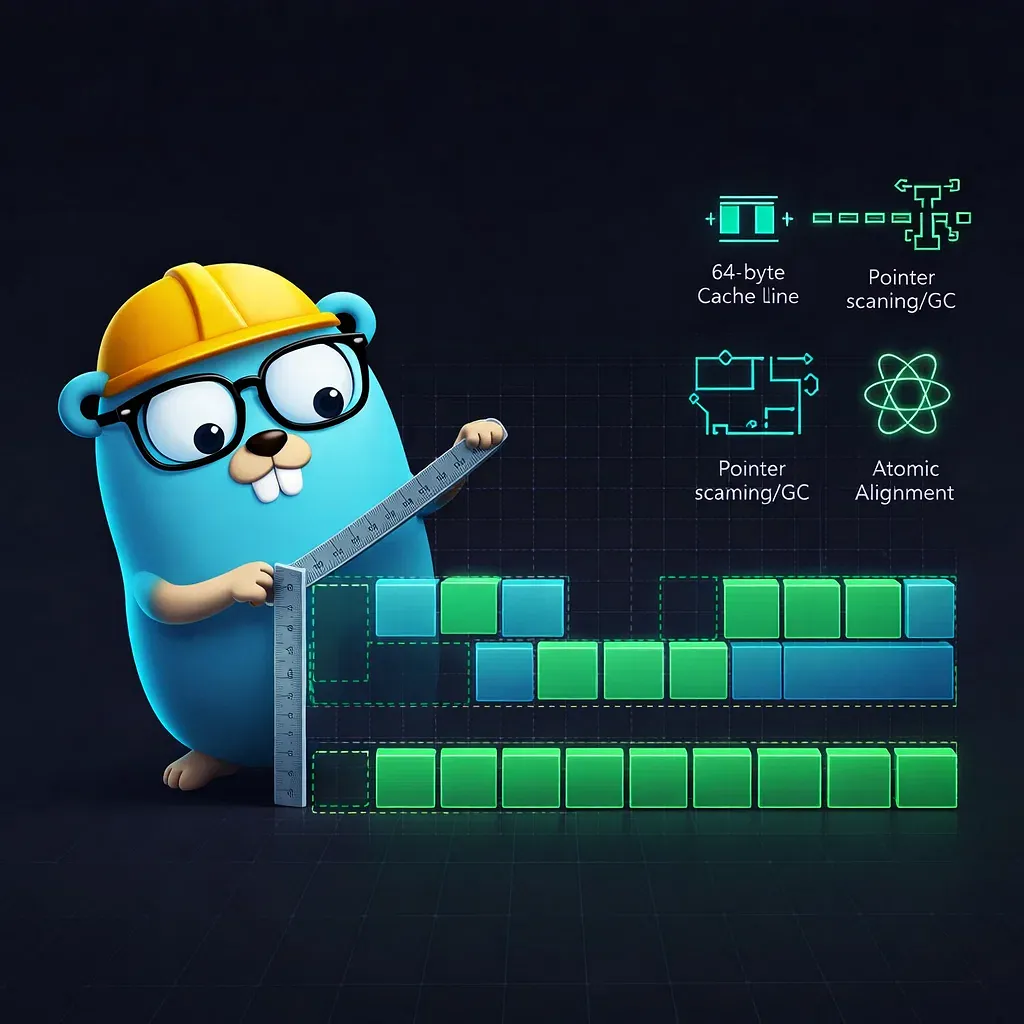
Go 1.27 introduces size-specialized memory allocation routines. The compiler now generates calls to type-specific allocators for small objects (under 80 bytes), rather than a single general allocator. Struct layout still matters for the same reason - we went through memory alignment in Go in a separate article.
According to the official Go 1.27 announcement, the result is up to 30% reduction in allocation cost for these small objects in the corresponding microbenchmarks, and roughly 1% overall improvement in allocation-heavy programs. The trade-off is a fixed binary size increase of about 60 KB, independent of workload.
If you encounter unexpected behavior, you can opt out at build time:
GOEXPERIMENT=nosizespecializedmalloc go build ./...This opt-out will be removed in Go 1.28, so it is only available for troubleshooting during the transition.
For most backend services, this improvement is transparent. You may notice it if you profile allocation-heavy paths - JSON parsing, protobuf unmarshaling, request struct creation in high-throughput HTTP handlers.
HTTP testing improvement
net/http/httptest.NewTestServer creates a test HTTP server backed by an in-memory fake network instead of a real TCP stack. It is designed for use with testing/synctest, which provides deterministic time control in tests.
server := httptest.NewTestServer(handler)
defer server.Close()

// Test HTTP interactions without real network overhead
resp, err := server.Client().Get(server.URL + "/path")
This is useful when testing HTTP handlers that involve time-sensitive logic - retries, timeouts, rate limiting - where you want deterministic behavior rather than real-time delays.
UUID Without Third-Party Packages
Until Go 1.27, generating UUIDs required a third-party dependency. The most common choice was github.com/google/uuid. Now there is a standard library package:
import "uuid"

id := uuid.New()        // UUID v4 (random)
idV7 := uuid.NewV7()    // UUID v7 (time-ordered)
UUID v7 is particularly relevant for database-heavy systems. Unlike v4, v7 encodes a timestamp in the first bits, which means UUIDs are monotonically increasing within a second. This makes them better primary keys in databases with B-tree indexes - new rows are appended near the end of the index rather than inserted at random positions, which reduces write amplification.
For ERP systems, B2B platforms, and any application generating large numbers of records, UUID v7 as the default is a practical improvement over v4.
The package also supports parsing:
id, err := uuid.Parse("550e8400-e29b-41d4-a716-446655440000")You can keep using github.com/google/uuid if you have existing code - there is no requirement to switch. But for new services, the stdlib package removes one dependency.
Post-Quantum Security: ML-DSA and TLS 1.3
Go 1.27 adds crypto/mldsa, implementing ML-DSA (Module-Lattice-Based Digital Signature Algorithm) as specified in FIPS 204. This is a post-quantum digital signature scheme - resistant to attacks from quantum computers, unlike current RSA and ECDSA signatures.
Three security parameter sets are available, corresponding to different security levels:
| Package constant | NIST security level | Signature size |
|---|---|---|
mldsa.ML_DSA_44 |
2 (AES-128 equivalent) | ~2.4 KB |
mldsa.ML_DSA_65 |
3 (AES-192 equivalent) | ~3.3 KB |
mldsa.ML_DSA_87 |
5 (AES-256 equivalent) | ~4.6 KB |
The scheme is integrated into:
crypto/x509- ML-DSA private keys, public keys, and certificate signatures are now supportedcrypto/tls- ML-DSA works in TLS 1.3 through three newSignatureSchemevalues:MLDSA44,MLDSA65,MLDSA87
Why this matters now
The practical threat is "harvest now, decrypt later" - adversaries recording encrypted traffic today, planning to decrypt it once quantum computers become powerful enough. For financial data, health records, long-lived API keys, and corporate communications with long regulatory retention periods, the exposure window can exceed a decade.
Most organizations are not deploying post-quantum TLS today, but planning for it is increasingly a compliance requirement in regulated industries. Having ML-DSA in the standard library removes the barrier of needing a third-party cryptographic implementation.
For most backend developers: nothing changes yet. You do not need to reconfigure TLS. But if you manage TLS configuration manually - particularly for internal service-to-service communication with strict security requirements - this is worth tracking.
TLS compatibility note
ML-DSA signatures in TLS 1.3 require both the client and server to support the scheme. Standard TLS clients (browsers, mobile clients) do not yet support ML-DSA. This is relevant for server-to-server TLS in controlled environments, not for public-facing APIs.
Testing and Tooling Updates
testing/synctest.Sleep: A new helper that combines time.Sleep and synctest.Wait. When writing tests with deterministic time using synctest, you often need to advance fake time and then wait for any goroutines triggered by that time advance to complete. Sleep does both in one call. It pairs well with the service-level checks we described in our notes on API testing in Go.
func TestRetryWithBackoff(t *testing.T) {
    synctest.Run(func() {
        // Advance fake time by 2 seconds and wait for goroutines to settle
        synctest.Sleep(2 * time.Second)
        // Assert retry happened
    })
}
go fix for automated migrations: The go fix tool, rewritten in Go 1.26 and extended in 1.27, applies automated code modernization. For the encoding/json/v2 migration, it can identify and transform common patterns automatically. After running go fix, review the changes before committing - automated transforms are generally correct, but always worth a manual review on production code.
go fix ./...The broader vision for go fix is a self-service migration tool - module maintainers can encode migration logic that their users can apply with a single command.
Smaller Changes Worth Knowing
Experimental SIMD support: Two new packages are available under GOEXPERIMENT=simd:
simd- portable, vector-size-agnostic SIMD. Provides types likeInt8sandFloat32swithout specifying vector width. Falls back to scalar on architectures without hardware support.simd/archsimd- architecture-specific SIMD. Supports 128-bit vectors on amd64, arm64 (Neon), and WebAssembly; 256-bit and 512-bit on capable amd64 processors.
These are explicitly experimental - the API is not yet stable. Do not use in production without accepting that the API may change in 1.28.
Struct literal field selectors for embedded types: You can now initialize fields of embedded structs directly in composite literals:
type Habitat struct {
    Burrow string
}

type Gopher struct {
    Name    string
    Habitat // Embedded
}

// Works in Go 1.27
g := Gopher{
    Name:   "Gopher",
    Burrow: "Burrow #42", // Previously required Habitat: Habitat{Burrow: "..."}
}
Generalized function type inference: Generic functions can be assigned to variables of matching function type without explicit type arguments, in composite literals, type conversions, and channel sends. This is an edge case improvement that makes certain patterns cleaner.
Linker changes on macOS: The linker now accepts -macos and -macsdk flags to control the LC_BUILD_VERSION load command. This is relevant if you are building Go binaries for macOS in CI/CD pipelines that target specific macOS versions.
Upgrade Checklist for Production Systems
Before updating go.mod to Go 1.27 in a production service:
Verify the latest patch release. Check go.dev/doc/devel/release for the current go1.27.x. Always run the latest patch, not just the minor version.
Audit nil slice serialization. Search for all types with slice fields that pass through encoding/json. If any downstream consumer of your API depends on null for empty slices, you cannot switch to encoding/json/v2 without coordinating with that consumer first.
Enable the goroutine leak endpoint. If you import net/http/pprof, the /debug/pprof/goroutineleak endpoint is already active. Run your service under realistic load before and after the upgrade, capture profiles, and compare. If goroutine counts differ, investigate before promoting to production.
Test the binary size increase. The size-specialized allocator adds ~60 KB to binaries. If you have tight constraints on binary size (container images, embedded systems), account for this.
Review TLS configuration. If you configure tls.Config.CipherSuites or tls.Config.CurvePreferences manually, check whether the new MLDSA signature schemes interact with your setup. For most services using default TLS configuration, no changes are needed.
Run go fix and review. Running go fix ./... after upgrading identifies deprecated patterns and applies safe transformations. Review the diff before committing.
Test in staging first. Even with full compatibility guarantees, behavioral changes in JSON serialization and stricter validation make a staging test run essential for any service handling external APIs.
Go 1.27 Through the Lens of B2B and Enterprise Development
For teams building B2B platforms, ERP systems, and high-load backend infrastructure, Go 1.27 delivers in three areas. In our own web development practice, these are exactly the points that change upgrade planning:
API contract stability and JSON v2. In B2B integrations, API contracts are often fixed by SLA. If your service produces null today and an integration partner tests for it, switching to v2's [] output is a breaking change at the integration level. Go 1.27 gives you the tools to make this migration safely and on your own schedule - v1 and v2 coexist, you can migrate endpoint by endpoint, and the internal v2 engine means even v1 users get faster unmarshaling.
Observability in high-load systems. Goroutine leaks are a common source of degradation in systems that process concurrent workloads - batch jobs, event-driven processors, ERP connectors polling external systems. The goroutine leak profiler surfaces these problems without requiring any pre-planned instrumentation. It works with the pprof infrastructure you likely already have in place.
UUID v7 for database-heavy applications. Corporate applications - ERP modules, CRM components, document management systems - generate large numbers of records with UUID primary keys. Switching from v4 to v7 is a schema decision (new tables can use v7 from the start), not a migration risk, and it improves write throughput on B-tree indexes.
Post-quantum readiness. Enterprise and government clients increasingly ask about post-quantum security in due diligence processes. Having ML-DSA available in the Go standard library means it can be adopted without external dependencies when the operational need arises. The groundwork is there; deployment timelines depend on client requirements and regulatory direction.
Shared library ergonomics. Generic methods improve the design of internal platform libraries - the kind that large engineering teams build to share database access patterns, logging conventions, or validation logic. Before 1.27, generic behavior had to live at package scope; now it can live as a method on the relevant type, which makes the API more discoverable and reduces the chance of misuse.
None of this requires an immediate action. But these are the changes most likely to come up in architectural decisions, client conversations, and sprint planning over the next 6-12 months. At Webdelo we track them as part of our web design and development services, so upgrade decisions are made with the whole system in view.
Conclusion
Go 1.27 is a substantive release. It does not change the feel of writing Go - the language stays the same - but it expands what the standard library can do and improves the runtime in measurable ways.
The changes to plan around: encoding/json/v2 behavior differences for nil slices, and the goroutine leak profiler as a new production monitoring tool. The changes to adopt freely: UUID in stdlib, faster allocations, improved test tooling.
The post-quantum crypto additions (crypto/mldsa) and SIMD experiment are worth tracking for their trajectory rather than immediate adoption in most cases.
The recommended approach for production services: upgrade one non-critical service first, run it for a week, check goroutine profiles and error rates, then roll out to the rest. The compatibility guarantees are solid, but behavioral changes in JSON handling deserve a careful look before upgrading services with external API consumers.
Migrating, scaling, or building a production Go system takes time to get right - especially when the codebase spans integrations, ERP modules, and high-load components. Teams working on complex Go backends often find that having an experienced engineering partner to review architectural decisions and migration plans accelerates the process significantly.
Frequently Asked Questions
What are the main new features in Go 1.27?
Go 1.27, released in August 2026, introduces generic methods on concrete types, the encoding/json/v2 package with stricter defaults, a goroutine leak profiler available in production, UUID generation in the standard library, and post-quantum ML-DSA signatures integrated into crypto/tls. The runtime also gets faster small object allocation (up to 30% for objects under 80 bytes).
How do generic methods in Go 1.27 differ from generic functions?
Generic methods in Go 1.27 allow a method on a concrete type (struct) to declare its own type parameters, similar to how generic functions work. The key difference is that generic methods belong to the type's namespace rather than the package namespace, making APIs more discoverable. Important constraint: interface methods still cannot be generic, and generic methods cannot implement interface methods - only non-generic methods participate in interface satisfaction.
Is it safe to migrate from encoding/json to encoding/json/v2 in production?
Migration requires careful planning because encoding/json/v2 has behavior differences: nil slices marshal as [] instead of null, invalid UTF-8 in strings is rejected, and duplicate JSON object keys are rejected. If your downstream API consumers test for null specifically, switching will break them. The safe approach is to audit all nil slice serialization points, test in staging, and migrate endpoint by endpoint. The old encoding/json package remains fully supported and already benefits from v2 performance internally.
How does the goroutine leak profiler work in Go 1.27?
The goroutine leak profiler in Go 1.27 is available as the goroutineleak profile type in runtime/pprof. If you import net/http/pprof, it is automatically exposed at /debug/pprof/goroutineleak with no additional code changes required. It detects goroutines that are permanently blocked - ones where the condition needed to unblock them can never be met. The profile returns stack traces pointing to the exact code location where each leaked goroutine is stuck.
Why should I use UUID v7 instead of UUID v4 in Go 1.27?
UUID v7 encodes a timestamp in the first bits, making generated UUIDs monotonically increasing within a second. This is significantly better for database primary keys because new rows are appended near the end of B-tree indexes rather than inserted at random positions, reducing write amplification and improving insert performance at scale. UUID v4 generates fully random identifiers which scatter across the index. For ERP systems and high-throughput applications generating large numbers of records, UUID v7 is the better default.
What is ML-DSA in Go 1.27 and why does it matter for enterprise applications?
ML-DSA (Module-Lattice-Based Digital Signature Algorithm, FIPS 204) is a post-quantum digital signature scheme now included in Go 1.27 via the crypto/mldsa package. It is resistant to attacks from quantum computers, unlike RSA and ECDSA. In Go 1.27, ML-DSA is integrated into crypto/x509 for certificates and crypto/tls for TLS 1.3, with three security levels: MLDSA44, MLDSA65, and MLDSA87. For enterprise applications with long data retention periods or strict compliance requirements, adopting post-quantum cryptography is increasingly a planning priority.
What should I check before upgrading a production Go service to version 1.27?
Before upgrading, verify the latest patch release on go.dev/doc/devel/release. Audit all types with slice fields that go through encoding/json to identify nil slice serialization points that might break API consumers. If you import net/http/pprof, enable the goroutine leak endpoint and run a load test to capture a baseline profile. Test the ~60 KB binary size increase if you have container size constraints. Run go fix ./... and review the changes. Always test in a staging environment first before rolling out to production.