




The Short Answer for Website Owners
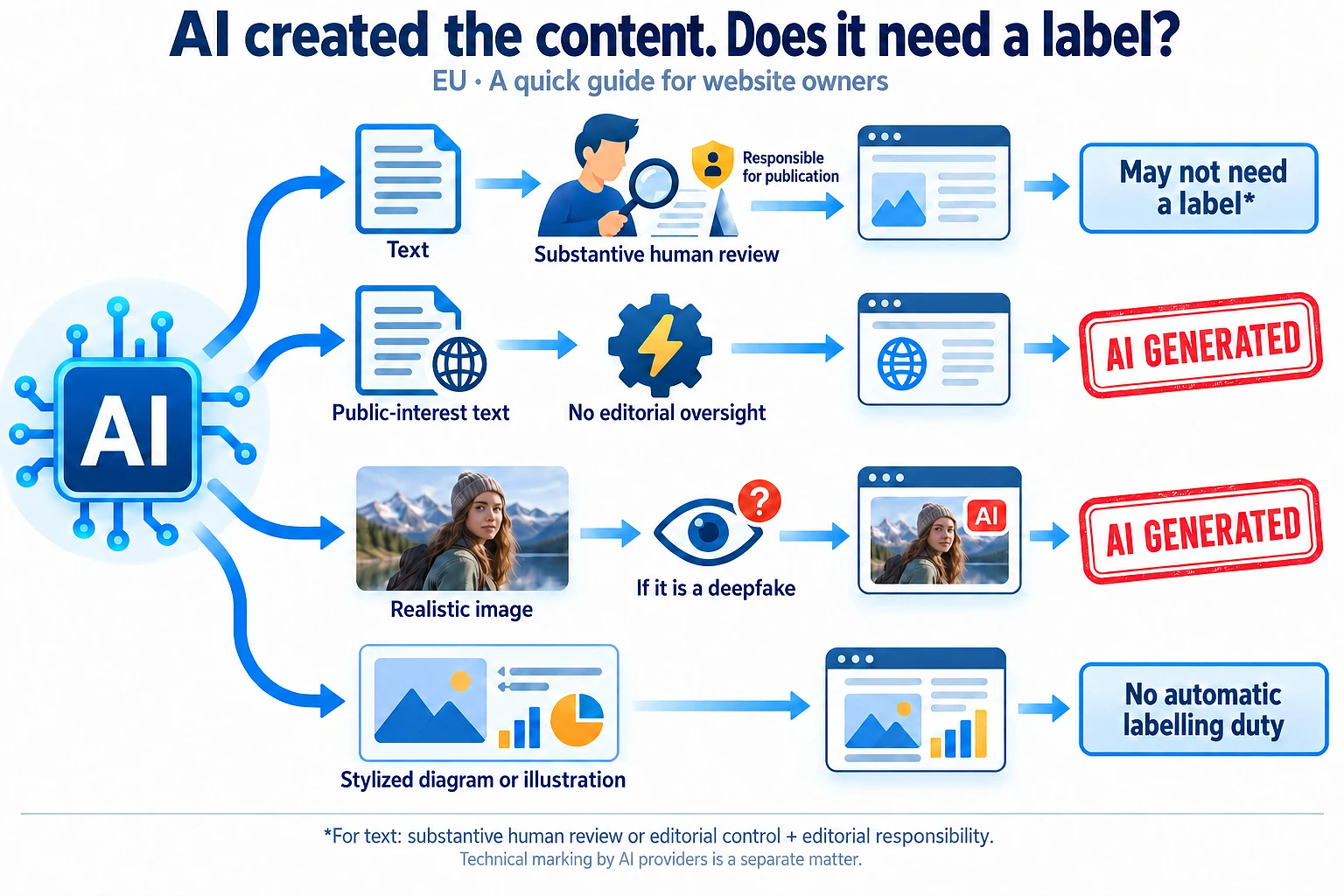
AI content disclosure requirements do not mean every AI-assisted page needs a label. In the EU, public-interest AI text needs disclosure unless it meets the human-review or editorial-control exception and someone takes editorial responsibility. EU rules also require disclosure for deepfakes, which are realistic AI-made or AI-altered media that falsely appear authentic. The US has no general federal labeling rule for website text, but rules against deception and specific state laws still apply.
2022 Q4 4.60%
2023 Q4 35.92%
2024 Q4 47.04%
2025 Q4 50.90%
2026 Q1 49.94%
Estimates from three AI detectors in a sample of English-language articles. Figures cover selected quarters.
The estimated share rose quickly, then stayed around half. These figures come from Graphite's study of 55,400 articles and its published quarterly data. They do not measure all websites or show which articles needed a label. The study did not validate detection of AI drafts later edited by people.
If you dictate your ideas and AI writes and publishes the article, the legal question is what happens before publication. For EU public-interest text, good source material alone does not establish the review exception.
At Webdelo, we use AI for text, covers, and diagrams, so these questions affect our own work. We base our assessment on official rules and reliable sources. This article explains our reading of the rules, not legal advice or a guarantee of full compliance.
How Content, Your Role, and Location Affect Disclosure
Whether you need an AI generated content label depends on the content, your role, and the law that applies. A business using another company's AI tool is usually a deployer, meaning a user of the system. A provider develops or markets the AI system under its own name.
A corporate website can contain several different cases. Its service description, health article, and realistic AI spokesperson need separate checks. The website owner's location alone does not settle which law applies, especially when content reaches another market.
Visible labels and technical marking
AI Act Article 50 separates two duties:
- Article 50(2): providers must make covered AI output identifiable in a machine-readable form, subject to the provision's exceptions and technical requirements. This can involve information embedded in the file.
- Article 50(4): deployers must disclose deepfakes and certain public-interest AI text to the people viewing it.
- Article 50(5): required disclosures must be clear and distinguishable, and provided no later than the first exposure.
Hidden file information alone does not meet a duty to inform viewers. The text-review exception also does not remove a provider's technical marking duties.
EU dates and guidance
Article 50 applies from August 2, 2026. The European Commission's FAQ explains that content created before that date does not need retrospective labeling, although it encourages disclosure. The limited transition until December 2, 2026 concerns Article 50(2) duties for providers of systems already on the market before August 2.
That transition does not give website publishers a general delay. For the legal text, use the consolidated AI Act. The Commission's Code of Practice is a voluntary way to support compliance, not a replacement for the law.
When AI-Assisted Website Text Needs Disclosure in the EU
Article 50(4) covers AI text published to inform the public about matters of public interest. Its text exception has two conditions: meaningful human review or editorial control, and a person or company taking editorial responsibility for publication. The law sets no minimum amount of human writing and no maximum AI percentage.
You dictate the ideas, AI writes the article
You can supply your knowledge and let AI write every sentence. If a competent person checks the final content and a person or company takes editorial responsibility, the text can qualify for the exception. It is available to ordinary businesses as well as media publishers.
If the article goes live automatically, your original research does not establish that the final version was checked. For public-interest text, disclosure is required unless the review or editorial-control condition and editorial responsibility are both satisfied.
Mixed human and AI 71.7%
Human only 25.8%
AI only 2.5%
Ahrefs detector estimates for 900,000 English-language pages first discovered in April 2025.
Mixed content was the largest category in the Ahrefs study, which sampled one page per domain. These are detector classifications, not proven authorship or evidence of human review. This study and Graphite's use different samples and measures.
What meaningful human review involves
The Commission describes review as a deliberate examination by people with relevant knowledge who use their judgment. Editorial control includes the power to approve, change, or reject the content on substance. A spelling check or an automatic approval step is not enough.
| What was checked? | Enough for the text exception? |
|---|---|
| Reliable source material supplied to AI | Not alone. The final text may still contain errors. |
| AI checks another AI's output | Not alone. This does not establish human review or editorial control. |
| A person fixes spelling and grammar | Not alone. The content itself has not been examined. |
| A person clicks "approve" without examining the text | No. A formal approval does not establish meaningful review. |
| A knowledgeable person checks the final facts, figures, and conclusions | Can qualify when a person or company also takes editorial responsibility. |
At Webdelo, we use reliable source material, AI-assisted fact checks, and a final human read-through. The first two steps help with quality. Whether the legal exception applies depends on the substance of the human review or editorial control and who takes responsibility.
Why a company blog can cover public-interest topics
A company blog can inform the public about health or financial risks. Those subjects can fall within Article 50(4), even when the article also promotes a service. Writing an article for seo does not change what its content is about.
Public-interest topics can include:
- Economic and financial issues.
- Science and cultural matters.
- Health and consumer safety.
- The environment and people's rights.
A straightforward service page or product description is usually commercial text. Check its actual claims and purpose before deciding that Article 50(4) does not apply.
When AI-Generated and Edited Images Need a Label
In the EU, Article 50(4) requires visible disclosure when an AI-generated or edited image is a deepfake. The assessment considers resemblance to real people or things, an existing or plausibly existing subject, and a false impression of authenticity. Human review does not exempt a deepfake image from disclosure.
Context matters. Ask what a viewer would think the image shows and whether that impression is true. Deepfakes can involve products, places, and events as well as people.
Diagrams and clearly unrealistic covers
A plain diagram or clearly unrealistic illustration usually does not claim to show a real scene. At Webdelo, we currently leave our own diagrams and clearly unrealistic AI illustrations without an AI label. That practice still needs to be assessed against the image's content and use.
An image looking obviously artificial is not a universal exemption. For deepfakes within clearly artistic or fictional works, Article 50(4) allows disclosure that does not disrupt the work's enjoyment. It does not remove disclosure altogether.
Realistic scenes and products
A realistic picture can falsely suggest that a place or product exists as shown. An AI-furnished apartment photo, for example, may lead viewers to believe the furniture is actually there. A short disclosure should make the relevant alteration clear.
On an ecommerce website, an image must also represent the product truthfully. An AI label does not make it acceptable to show features the buyer will not receive.
Edited photos and removed people
We sometimes use AI to improve photos or remove people who entered the frame. Check whether the edit changes what the photo appears to document. Removing a person from an event photo can change its meaning.
Removing a face also does not settle every privacy, consent, or copyright issue. Those questions need their own assessment.
AI video and platform rules
The deepfake test also applies to realistic AI video reviews and inserts. Check the publishing platform's rules before uploading them. Platform disclosure requirements are separate from the law and may cover additional situations.
AI Content Disclosure in the USA: Federal and State Rules
The US has no general federal rule requiring every AI-written website page to carry a label. Federal rules still prohibit deceptive conduct, including certain fake reviews. State laws add duties for particular uses, such as synthetic performers in New York advertising.
The proposed H.R.3831 AI Disclosure Act from the 118th Congress was a bill, not an enacted general labeling law. University policies, scientific publishing rules, and agency policies also do not create a universal legal duty for websites.
FTC rules on deception and fake reviews
16 CFR §465.2 prohibits businesses from creating or selling reviews and testimonials that materially misrepresent:
- Whether the reviewer exists.
- Whether the reviewer used the product or service.
- What experience the reviewer actually had.
For buying or using covered false reviews, the rule includes knowledge conditions, such as whether the business knew or should have known they were false. Merely hosting reviews is treated differently from creating or buying them.
The FTC's guidance confirms that AI-generated fake reviews are covered. AI can help format a real customer's review without making it fake, provided the customer's experience remains accurate. An "AI-generated" label does not make an invented customer testimonial acceptable.
In September 2024, the FTC announced Operation AI Comply, including action involving tools for fake reviews. That is a practical reason to check the truth of the content alongside any disclosure duty.
New York: synthetic performers in ads
New York General Business Law §396-b requires conspicuous disclosure when a person commercially produces or creates an advertisement containing a synthetic performer and actually knows it does. The governor's office confirmed that the law took effect on June 9, 2026.
A synthetic performer is an AI-made or altered digital figure that appears to perform as a human but is not recognizable as a particular real performer. This rule does not cover ordinary AI text or diagrams. Exceptions include audio-only ads, certain ads for expressive works, and changes used solely to translate a human performance.
For digital marketing involving New York, check whether a synthetic presenter falls within this rule. Do not assume that a fictional spokesperson avoids disclosure simply because no real person's likeness was copied.
California: separate provider rules
California's AI Transparency Act includes duties aimed at covered AI providers. Business and Professions Code §22757.2 should not be read as a blanket labeling requirement for every website using an AI tool.
The Act's amendments, covered businesses, and operative dates need a current California-specific assessment. This article does not give a definitive California labeling conclusion for a particular business. If you provide an AI system or operate a platform, check the current provisions and their start dates before relying on guidance for ordinary publishers.
Practical Website Examples and a Publishing Checklist
Start with the specific content and the rule that covers it. Some cases require disclosure, some allow voluntary disclosure, and deceptive claims may remain unlawful even with a label. The examples below concern ordinary website publishing, not the separate duties of AI providers.
| Situation | EU | US: federal level and relevant state | Conditions to check | Official source |
|---|---|---|---|---|
| You dictate ideas and review the final AI-written article. | The text exception can apply. | No general federal AI-text label requirement. Deception rules still apply. | Meaningful review or editorial control, plus editorial responsibility. | AI Act Article 50(4), Commission FAQ. |
| You supply research, then AI publishes automatically. | Public-interest text needs disclosure unless the exception is otherwise satisfied. | Automation alone does not trigger a general federal text-label duty. | Reliable input does not establish review of the final version. | AI Act Article 50(4), Commission FAQ. |
| Another AI checks the article. | AI review alone does not establish the text exception. | AI checking does not excuse false claims or fake reviews. | Check for meaningful human oversight and responsibility. | Commission FAQ, 16 CFR §465.2. |
| A person only corrects spelling. | This alone is insufficient review for the exception. | No general federal label duty arises from AI authorship alone. | For public-interest AI text, examine whether substantive editorial control exists. | Commission FAQ. |
| AI writes a service or product page. | Usually outside the public-interest text duty, depending on its content and purpose. | Claims must be truthful. Fake customer testimonials remain prohibited. | Check factual claims and any public-interest advice. | AI Act Article 50(4), FTC guidance, 16 CFR §465.2. |
| You publish your own diagram or an unrealistic cover. | No automatic deepfake disclosure duty. | No general federal AI-image label rule. A plain diagram is outside New York's performer rule. | Check whether the image falsely appears authentic in context. | AI Act Article 50(4), New York GBL §396-b. |
| You publish a realistic AI scene or edited photo. | Disclosure is required if it meets the deepfake test. | Deception rules apply. New York disclosure may apply to an ad containing a synthetic performer. | Check authenticity, advertising use, actual knowledge, and applicable exceptions. | AI Act Article 50(4), New York GBL §396-b. |
Before you publish
- Check the final text. Has someone with relevant knowledge examined the facts, figures, and conclusions?
- Confirm responsibility. Which person or company takes editorial responsibility for publication?
- Identify public-interest content. Does the text inform people about subjects such as finance, health, or safety?
- Inspect images and video. Could viewers mistake an invented or changed scene for reality?
- Verify reviews. Do they reflect real customers and their actual experiences?
- Check location and channel. Do New York's advertising rule, other applicable state rules, or platform policies cover the publication?
If your crm triggers publication, place any required human check before the content goes live. An approval field only helps when someone actually examines the content.
Webdelo supports, improves, and promotes websites. Contact us about handing over website support, Web Development, or promotion. We will gladly assess the task or answer your questions.
What to Remember Before Publishing
The decisive questions are what the content shows or says, who publishes it, and which law applies. For EU public-interest text, meaningful human review or editorial control must come with editorial responsibility to use the exception. Deepfake images need a separate assessment, while US publishers must check deception rules and applicable state duties.
Frequently Asked Questions
Does my website need an "AI-generated" label in the EU?
Not every AI-assisted page needs one. Under AI Act Article 50(4), you must disclose AI text that informs the public about matters of public interest, such as health, finance, or safety. The exception applies if a person reviews it or has editorial control and a person or company takes editorial responsibility. Realistic AI images that falsely appear authentic, called deepfakes, need a visible label whether or not a person reviewed them.
Can I publish AI-written articles automatically without a label?
In the EU, it depends on the topic. If the article covers a public-interest topic and goes live with no human check of the final version, it needs an AI disclosure. Good research or your own dictated ideas do not count as a review of the final text. To publish without a label, add a real human check before the article goes live and decide who takes editorial responsibility.
What counts as meaningful human review of AI text?
A person with relevant knowledge checks the final version, including facts, figures, and conclusions. This person can approve, change, or reject the content. Fixing spelling, clicking "approve" without reading, or letting another AI check the text is not enough on its own.
When does an AI-generated image on a website need a label?
In the EU, a visible label is required when the image is a deepfake. That means it looks real and gives a false impression of an existing or plausibly existing person, place, product, or event. A plain diagram or a clearly unrealistic cover usually does not meet this test. A realistic product shot or a photo with removed people can, so check what viewers would believe the image shows.
Do AI-written service pages and product descriptions need a label?
In the EU, a plain service page or product description is usually commercial text and falls outside the public-interest text duty. This can change if the page gives advice on health, finance, or safety. In both the EU and the US, claims must be true, and invented customer testimonials are prohibited with or without an AI label.
Does US law require labeling AI content on websites?
There is no general federal rule requiring a label on every AI-written page. The FTC still bans deception, including fake reviews and testimonials created with AI under 16 CFR §465.2. Some states add specific duties: New York has required disclosure of synthetic performers in ads since June 9, 2026. California's AI Transparency Act mainly targets AI providers, so check its current provisions if you provide an AI system or run a platform.
When did the EU AI labeling rules start to apply?
Article 50 of the AI Act applies from August 2, 2026. According to the European Commission's FAQ, content created before that date does not need a label retroactively, although disclosure is encouraged. The transition period until December 2, 2026 covers only technical marking duties for providers whose systems were already on the market. It gives website publishers no general delay.
