


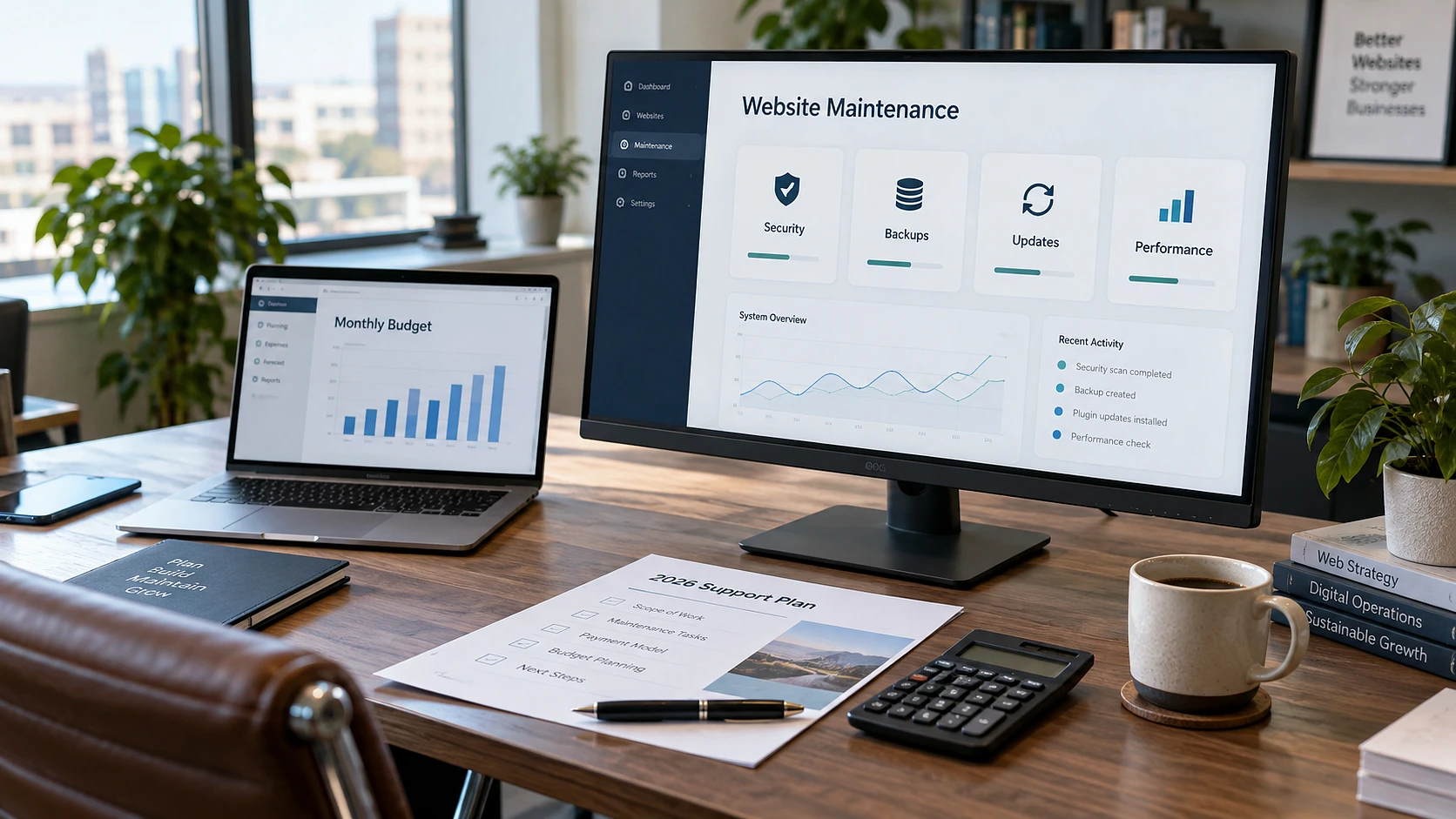
Website maintenance cost depends not on the size of your company or even the size of your site - it depends on how critical that system is to your business, how your integrations are structured, and what level of guarantees you need. Before comparing numbers from vendor proposals, it's worth understanding exactly what you're buying and what drives the price.
Quick Answer: What Budget Should Your Company Plan For
Benchmarks vary significantly by region and service level. The table below contains examples from public sources gathered in September 2026. These are not market averages - they are price ranges from specific providers, included to show the order of magnitude and help you understand the spread.
Table 1. Website Maintenance Cost Benchmarks by Region (September 2026)
| Region | Service Level | Price Range | Typical Scope | Limitations |
|---|---|---|---|---|
| US (USD) | Basic | from $100-300/mo. | Updates, uptime monitoring, basic security | No guaranteed availability or SLA |
| US (USD) | Managed support | $500-2,000/mo. | Support + incidents + reporting | Limited hours, emergency work billed extra |
| US (USD) | Enterprise | from $2,000/mo. | Full managed support + development | Requires detailed scope definition |
| Germany (EUR) | Basic Wartung | from 100-200 EUR/mo. | CMS updates, backups, basic monitoring | No dedicated specialist or SLA |
| Germany (EUR) | Managed Betreuung | 300-800 EUR/mo. | Full management, SLA, dedicated contact | Limited hours, development billed separately |
| Germany (EUR) | With development | from 800 EUR/mo. | Betreuung + planned improvements | Higher ongoing budget required |
| Russia (RUB) | Basic | from 15,000-25,000 RUB/mo. | Updates, uptime monitoring, backups | Often no staging, manual QA, or development work |
| Russia (RUB) | Managed support | 30,000-80,000 RUB/mo. | Maintenance + staging + incidents + reporting | Limited service window and hours |
| Russia (RUB) | With development | from 80,000 RUB/mo. | Managed support + planned development | Requires backlog and prioritization |
Provider examples: OuterBox (US) lists a range of $100-2,500/mo. and a development rate of $200/hr. Rheinspace (Germany) publishes packages at 119, 229, and 399 EUR/mo., with the top tier including SLA and a dedicated specialist. Pixel Plus (Russia) lists a basic support package from 29,000 RUB/mo. and post-pay billing at 3,800 RUB/hr (data as of September 2026). All three are examples of specific company pricing, not market norms.
Prices across regions cannot be directly converted: package contents, team caliber, scope, and SLA differ substantially. For an accurate estimate, compare what's included in each package - not just the numbers.
What Your Company Is Actually Buying: Maintenance, Support, Development, or Marketing
One of the main reasons website maintenance pricing varies so widely is that vendors use one phrase to describe four fundamentally different categories of work. A $500/mo. package and a $2,000/mo. package may carry the same label but cover entirely different scopes. The same applies to digital marketing services: they are a separate budget line with their own KPIs.
Table 2. Four Work Categories Under the "Website Maintenance" Label
| Category | What's Included | Typical Provider | How It's Billed |
|---|---|---|---|
| Technical maintenance (maintenance/Wartung) | CMS, plugin, and dependency updates; backups; uptime monitoring; SSL; basic security | Agency, DevOps engineer | Typically included in the package |
| Reactive support | Incident response, bug fixes, consultations, SLA management | Agency, dedicated engineer | Often included, but with an hours cap |
| Development | New features, UX changes, integrations, A/B tests | Developer, development team | Usually separate - billed by hours or retainer |
| Marketing | SEO, content, advertising, analytics, email | Digital agency, marketer | Always separate from technical support |
Bundling these categories in a single package makes comparison nearly impossible. When one proposal includes monitoring, updates, SEO, and ad management together, you can't tell what each part costs or what happens if you want to switch vendors for one area. Ask directly: "Which of these are included in the package, and which are billed additionally?" Marketing work such as SEO belongs in its own contract with its own performance metrics.
What Professional Website Maintenance Services Actually Include
Professional website maintenance is not just "monitoring and updates." It's the managed operation of a working business system with predictable outcomes. Here's what every serious monthly website maintenance plan should cover.
Monitoring for Forms, Checkout, and Critical Integrations
Checking HTTP response codes and SSL certificates is the minimum necessary - but it's not sufficient for a B2B site. A site can return 200 OK while its lead capture form silently sends data nowhere.
For business-critical sites, monitoring should cover:
- All lead forms and their CRM integrations
- Checkout and payment processor
- Catalog sync with ERP or PIM
- Data flow to analytics and call tracking
- Key user journeys (via synthetic monitoring)
- SSL and domain expiration - with adequate lead time
A solid managed website support team configures monitoring for business functions, not just infrastructure uptime. This distinction matters most for e-commerce stores, lead generation sites, and customer portals.
CMS, Plugin, and Dependency Updates via Staging
Outdated components are one of the most common attack vectors. OWASP Top 10:2025 lists vulnerable and outdated components as a standalone risk category, and secure configuration plus dependency control are baseline requirements for running web applications.
The WordPress Advanced Administration Handbook: Security describes updates, hardening, and monitoring as standard WordPress operations - not optional extras, but required processes.
Running updates without a staging environment creates direct risk: a plugin or CMS core update can conflict with custom code or another module. A professional process looks like this:
- Deploy the update to staging
- Run QA - key scenarios, forms, integrations
- After sign-off, promote to production
- Monitor for the first 24-48 hours
Packages without staging save the vendor money but transfer incident risk to you.
Backups, Restore Testing, and Rollback
The WordPress Advanced Administration Handbook: Backups is explicit: a full site restoration requires backing up both files and the database. Either component alone won't restore a working system.
More importantly, it's critical to periodically verify that your automated backup process actually works. A backup no one has tested may be corrupted or incomplete at exactly the moment you need it.
A solid backup strategy includes:
- Daily incremental backups and weekly full backups
- Storage in at least two physically separate locations
- Regular restore tests with documented results
- The ability to roll back to a prior version after a failed update
- A documented RTO - planned recovery time objective
Security, Bug Remediation, and Performance Monitoring
The OWASP Vulnerability Management Guide treats vulnerability management as a continuous organizational process, not a one-time scan. A single automated tool is not enough: risk assessment, prioritization, remediation, and verification are all required.
Security within a website support retainer should include:
- Regular vulnerability scanning with severity assessment
- Access and privilege controls
- Suspicious activity monitoring
- Core file integrity checks
- Tracking and resolving errors from application logs
Performance is a separate area of oversight. Core Web Vitals, page load times, 404 errors, broken links, and speed degradation all affect conversion rates and search indexing. Managed website support should include periodic monitoring of these metrics and documentation of any anomalies.
Documentation, Reporting, and Minor Development Work
Transparency is not optional for professional managed website support - it's a baseline requirement. You should know what was done, how many hours were used, and what's planned for the next month.
Beyond reporting, most managed support packages include a small volume of development work within the contracted hours: text edits, banner updates, minor form or content changes. Make sure your contract clearly defines what counts as a "minor change" versus what requires a separate scope agreement.
What Is Typically Billed Separately
Before comparing proposals, clarify what's not included. Common line items billed on top of the package:
SEO, advertising, and redesign. Search optimization, launching and managing ad campaigns, and new design work are independent disciplines with their own specialists and budgets. If they appear in a "maintenance package" without clear separation, that's a reason to ask for a breakdown.
Large development projects and new features. Adding a new site section, integrating a new CRM, or building a client portal - anything outside the current scope is billed separately, either by the hour or as a standalone project.
Initial audit when switching vendors. A new team cannot take over a site without first assessing its condition. The audit covers CMS and module inventory, codebase review, integrations, and access credentials. This is a one-time engagement billed before monthly maintenance begins.
Onboarding: staging setup, monitoring configuration, and critical technical debt. Setting up a staging environment from scratch, connecting a monitoring system, and fixing critical vulnerabilities uncovered in the audit are often one-time tasks not covered by the monthly plan.
Content translation and localization. For multilingual sites, translation and content adaptation are a separate budget line.
What Drives Website Maintenance Cost
Pricing is not calculated by site type. Two "corporate websites" can cost five times as much to maintain if one has three forms and a static catalog while the other integrates with SAP, requires ERP synchronization, and needs incident response on Sunday nights.
Table 3. Website Maintenance Cost Drivers
| Factor | Why It Affects Price | What to Tell Your Vendor for an Estimate |
|---|---|---|
| CMS and technology stack | A niche or custom stack requires specialized engineers | CMS, framework, version, volume of custom code |
| Technical debt | High debt raises update risk and extends diagnostic time | Date of last CMS/plugin update, known issues |
| Number of sites and language versions | Each site and each version requires separate maintenance | Number of domains, languages, CMS installations |
| Integrations (CRM, ERP, PIM, payments) | Integrations complicate QA and expand the monitoring surface | Full list of integrations with criticality ratings |
| Business criticality | High-criticality sites require stricter SLA and higher team readiness | Approximate volume of leads or revenue generated through the site |
| Traffic and change frequency | High traffic intensifies monitoring demands; frequent edits mean more QA cycles | Traffic volume, average number of updates per month |
| Service window | 24/7 support costs more than business-hours coverage | Required response time and coverage hours |
| SLA and response time | Aggressive SLA targets require reserving team capacity | Acceptable downtime and target recovery time |
CMS, Technology Stack, and Technical Debt
WordPress with popular plugins costs less to maintain than a custom system built on a niche framework - simply because it's easier to staff and easier to automate checks. A custom PHP monolith from a decade ago, or a project on an outdated CMS version with heavy custom code, adds labor costs and risk at every step.
Technical debt directly affects price: a site with outdated dependencies takes longer to test with each update, and incident diagnostics take more time. A good vendor documents this in their report and proposes a phased remediation plan.
Number of Sites, Brands, and Language Versions
Every domain, every CMS installation, and every language version is a separate maintenance scope. A company with three sites on different platforms cannot expect to pay one-site pricing multiplied by 1.2.
Multilingual sites add complexity beyond content - there's the technical layer too: hreflang tags, form testing in each locale, and separate monitoring for each language version.
CRM, ERP, PIM, Payment, and Other Integrations
Integrations are the most commonly underestimated cost driver when planning a maintenance budget. Every external connection is an additional failure point and an additional monitoring surface. If a CRM updates its API and the site stops routing form submissions into the pipeline, that's not always immediately obvious.
For an accurate estimate, your vendor needs to know: which systems are connected, how critical each integration is, and who is responsible for handling API updates on the external system's side.
Business Criticality, Traffic, and Change Frequency
A site that drives 80% of a company's leads requires a different level of readiness than a five-page informational resource. Business criticality affects your target uptime, required response time, and whether on-call coverage outside business hours is justified. This applies to small local businesses too: a salon that relies on beauty salon SEO to fill its booking calendar sits closer to the first case than its page count suggests.
High traffic raises the stakes of monitoring and amplifies the impact of incidents. Frequent content updates and releases require more QA cycles and create a higher regression risk.
Service Window, SLA, and Response Time
Business-hours support (for example, 9 AM - 6 PM local time) costs significantly less than 24/7 coverage. If your site serves customers across time zones or is critical on weekends, establish that in your requirements from the start. The same goes for businesses whose inquiries peak on weekends, such as companies investing in appliance repair SEO: form monitoring has to cover Saturday and Sunday as well.
Target first response time and target resolution time are different metrics (covered in the SLA section below). Both affect price: a team that commits to a 15-minute response at any hour is reserving capacity for that - and that readiness costs money.
Payment Models: Time and Materials, Hour Blocks, Retainer, or Dedicated Team
The billing model determines not just how you pay, but how your vendor behaves: how motivated they are to be proactive, whether they keep capacity on standby, and how predictable your budget is from month to month.
Table 4. Website Maintenance Billing Models
| Model | Best For | Advantages | Limitations | Overage Risk |
|---|---|---|---|---|
| Time and Materials (T&M) | Infrequent one-off tasks, no steady workload | No recurring cost, pay only for work done | No guaranteed team availability, slower response | Low (for infrequent tasks) |
| Hour block package | Irregular but somewhat predictable volume | Spending control, flexible hour usage | Clarify expiration policy for unused hours | Medium (if volume is underestimated) |
| Retainer (monthly maintenance plan) | Steady task flow, predictable budget | Team is reserved, predictable costs, often includes SLA | Unused hours may expire, requires backlog discipline | Low (with correct scoping) |
| Dedicated team | Mission-critical or actively developed systems | Speed, deep product knowledge, full availability | Higher ongoing budget | Low (budget is fixed) |
Most B2B companies with an active site choose a retainer or an hour block package. A website support retainer gives you predictability and a reserved team; hour blocks give flexibility for irregular workloads. A dedicated team is justified when criticality is high, integrations are complex, and there's a constant flow of changes.
How Budget Scales by Project Type
Project type is one of two inputs for estimating your maintenance budget. The second is the required service level. The following breakdowns help establish order of magnitude - a specific price is determined after an audit.
Corporate Site and B2B Lead Generation Website
A corporate site with a lead generation function is the most common scenario. The site's core value is a steady stream of inbound inquiries, so monitoring for forms, CRM integrations, and analytics is critical. Part of those inquiries now arrive through AI search, which is why some companies budget for GEO alongside classic SEO.
With moderate traffic, one to three integrations, and a regular but not daily volume of updates, basic managed support covers most needs. Budget at the managed-package level from Table 1, plus a reserve for emergency development work. If a redesign is on the roadmap, agree with your web design agency in advance on who maintains the site during the transition.
Multilingual Product Catalog
A multilingual catalog adds several dimensions to standard maintenance: monitoring each language version, verifying hreflang and language switchers, and QA-ing updates in every locale. If the catalog syncs with a PIM system, that's an additional monitoring point.
A reasonable surcharge over the base cost is 20-40% per additional language version, depending on the degree of content isolation and CMS architecture.
E-commerce
E-commerce requires the most rigorous monitoring: checkout, payment processor, order notifications, inventory, and ERP or warehouse integrations. Any failure in that chain means direct revenue loss.
Additional requirements include regular load testing before peak periods (promotions, seasonal spikes), tighter SLA targets, and performance monitoring as a business metric. Business website maintenance cost for e-commerce is typically higher than for an informational site of comparable scale.
Customer or Partner Portal
Portals are the most complex category from a maintenance standpoint. Authentication, role-based access control, backend system integrations, personalized content, and often a custom technology stack - all of these are in play. Uptime matters, but so does the correctness of business logic: a wrong discount calculation or incorrect permissions are S1-level incidents.
For portals, a dedicated team or an expanded retainer with an explicit scope and severity matrix is often the right model.
Custom Web Platform
Custom platforms have the widest maintenance cost range. A well-structured, well-documented codebase can actually be cheaper to maintain; a legacy monolith without tests or documentation costs significantly more.
The key question when onboarding a custom platform is: what does the initial audit cost, and how much technical debt needs to be resolved before stable ongoing maintenance can begin?
Why the Cheapest Package Can End Up Costing More
A basic package at minimum cost is a reasonable choice for a non-critical informational site. But for a B2B site that generates leads or revenue, skimping on website maintenance services creates risks that easily outweigh any savings.
Common hidden-cost scenarios:
No staging - every update goes directly to production. A plugin conflict takes down your lead capture form. Over two days before the next business-hours engineer slot, you lose inquiries that cannot be recovered.
No manual QA - automated checks don't test business scenarios. The site shows as "available" in HTTP monitoring, but the form stops routing submissions due to a CRM API change.
No documented SLA - response time is unspecified. During an incident, the vendor has no formal obligation. Response is "as soon as possible."
Emergency work billed at a premium rate. Some packages cover only planned tasks. Any incident is billed at an "urgent" rate that may run 1.5-2x higher than the standard rate.
Onboarding was not budgeted. Taking the site onto a maintenance plan required an audit and critical debt remediation. All of that was billed separately, and the first six months cost more than a managed retainer would have.
Before choosing on price alone, answer this question: what does three days of site downtime or 100 lost leads cost your business?
Website Maintenance SLA Without the Marketing Spin: What to Check
A website maintenance SLA is not a set of impressive-sounding numbers in a proposal. It is documented, measurable commitments that can be verified against a report. Google Site Reliability Workbook: Implementing SLOs articulates the principle: a strong SLA is built on SLOs (Service Level Objectives) - specific, measurable targets that define what "normal operation" means for the system.
Severity Levels and Coverage Hours
A professional SLA categorizes incidents by severity. A typical model:
- S1 (Critical): site is completely unavailable or a business-critical function is broken (checkout, primary lead form)
- S2 (High): significant degradation, some features unavailable
- S3 (Medium): non-critical error, a workaround exists
- S4 (Low): cosmetic issue, task is scheduled
For each level, the SLA defines coverage hours (business hours, extended, or 24/7) and corresponding targets. Ask upfront: does the package cover S1 incidents outside business hours and on weekends?
Response Time, Workaround Time, and Resolution Target
These are three distinct concepts that are frequently conflated in vendor proposals:
Response time - time from submitting a ticket to the vendor's first substantive reply (not an auto-acknowledgment). This means confirmation of receipt and initial diagnosis.
Workaround time - time to deliver a temporary solution that restores the business function, even if the root cause hasn't been resolved yet.
Resolution target - time to fully resolve the issue, including the root cause.
A promise of "20-minute response" covers only response time. Ask separately about workaround and resolution. DORA metrics complement this picture: DORA: A History of Software Delivery Metrics tracks time to restore service after an incident as one of the key indicators of team maturity.
Escalation, Communication, and Responsibility Boundaries
An enterprise website maintenance SLA should define not just the numbers but the process:
- Who is the named contact on the vendor's side, and what happens when that person is unavailable
- Which channel is used to file a ticket and how time is logged
- What the escalation process looks like when SLA targets are missed
- What falls within the vendor's responsibility versus the client's (for example, access to third-party APIs)
The responsibility boundary is a critical clause. If an incident is caused by a third-party service - a payment processor, CDN, or partner API - SLA targets may not apply. This must be explicitly documented.
How to Compare Vendor Proposals
When you receive several proposals, compare scope - not bottom-line totals. Two identical price tags can conceal fundamentally different scope and guarantee levels.
Table 5. Vendor Proposal Comparison Checklist
| Criterion | What to Check |
|---|---|
| Scope | What exactly is included in the package, full list of deliverables |
| Exclusions | What is explicitly not included and billed separately |
| Hours | How many hours per month, can unused hours roll over |
| Service window | Business hours, extended, or 24/7 |
| SLA by severity | Is there a severity matrix with targets for each level |
| Staging | Is a staging environment provided, how are updates managed |
| Backups | Frequency, storage locations, restore tests - are verifications included |
| QA | Is manual testing performed after updates |
| Business function monitoring | Are forms, checkout, and CRM/ERP integrations monitored |
| Reporting | Format, frequency, which metrics are included |
| Hour rollover policy | Do unused hours expire at the end of the month |
| Emergency work | How is out-of-scope urgent work billed |
| Documentation | Is documentation transferred if you switch vendors |
| Onboarding | Is the initial audit included or billed separately |
Ask the vendor for a sample monthly report. If they don't have one - that's a signal about the maturity of their processes.
What a Monthly Report Should Include
The monthly report is the primary transparency tool between client and vendor. It should answer three questions: what happened, what was done, and what's planned next.
Table 6. Monthly Website Maintenance Report Structure
| Report Section | What to Show |
|---|---|
| Reliability | Uptime for the period, list of incidents with response and resolution times |
| Changes | List of updates, releases, fixes, and rollback operations |
| Security | Vulnerabilities found, actions taken, status of open risks |
| Backups | Backup status, restore test results for the period |
| Performance | Core Web Vitals trends, anomalies detected |
| Business functions | Status of forms, checkout, CRM/ERP integrations (OK / warning) |
| Budget | Hours used, remaining balance, breakdown by task |
| Roadmap | Identified risks and recommended tasks for the next month |
The report doesn't need to be long - specificity matters. Incident date, response time, resolution time, root cause - that's useful information. "Everything was fine this month" is not.
How to Calculate Annual Budget and Website TCO
Total cost of ownership for a website is always higher than the monthly maintenance package fee. Planning only for the retainer leaves several significant cost categories unaccounted for.
TCO Formula and a B2B Example
Annual website TCO breaks down as:
Annual TCO = hosting and infrastructure
           + licenses (CMS, plugins, third-party services)
           + monthly maintenance plan x 12
           + planned development (backlog work)
           + initial audit / onboarding (if applicable)
           + reserve for major incidents and technical debt
Example for a B2B lead generation website (simplified, US market):
- Hosting and infrastructure: $1,800/year
- Plugin licenses: $2,400/year
- Managed support retainer: $1,200/mo. x 12 = $14,400/year
- Planned development (backlog): $6,000/year
- Reserve (10% of maintenance + development): $2,040/year
- Total estimated TCO: ~$26,640/year
The cost of downtime or lost leads is not included as a fixed figure in this example - it depends on the specific business and should be evaluated separately when building the budget justification.
Initial Audit and the Cost of Taking Over Someone Else's Site
If a site was built by a different vendor or hasn't been professionally maintained, the first step is a technical audit. It establishes the condition of the codebase, the currency of component versions, the presence of vulnerabilities, and the volume of technical debt.
A typical onboarding engagement includes:
- Inventory of CMS, plugins, dependencies, and their versions
- Access credentials review (hosting, domain, analytics, CRM)
- Integration audit and documentation review
- Technical debt assessment
- Staging environment setup from scratch
- Monitoring and backup system configuration
Onboarding cost is scoped separately and depends on the site's condition. It's a one-time investment that reduces ongoing risk and lowers monthly maintenance cost over time.
Reserve Fund for Major Development and Technical Debt
Technical debt doesn't resolve itself. Every month without planned remediation of aging components is accumulated risk - risk that, when it materializes, demands disproportionately large investment.
A sound approach: allocate 10-15% of the annual maintenance budget as a reserve. Part of the reserve goes to scheduled technical debt work (incremental code modernization, migrations); the rest covers unforeseen incidents.
When Basic Maintenance Is Enough, and When You Need a Development Team
The right support level must match the business role of your site. Overpaying for enterprise-grade coverage on a static brochure site doesn't make sense; cutting corners on managed website support for a revenue-critical system is a real risk. At that point the budget shifts from maintenance toward ongoing web development, and the contract should reflect that.
Basic maintenance is sufficient when:
- The site is informational and does not directly generate leads or revenue
- Traffic is modest, integrations are absent or non-critical
- Content updates are infrequent (once every few weeks)
- One to two days of downtime has no meaningful business impact
Managed support is needed when:
- The site generates leads or is a point of sale
- There are CRM, ERP, or payment system integrations
- Updates and changes happen regularly (weekly or more frequently)
- You need a documented response time commitment for incidents
A development team is needed when:
- The site is actively growing: new features, A/B tests, integrations
- High criticality and a constant flow of changes
- Complex architecture (portal, custom platform, e-commerce with a large catalog)
- Speed of releasing changes is a competitive advantage
How Webdelo Manages B2B Website Maintenance
Webdelo is an international B2B software development company founded in 2006, with operations in the US, Germany, and the CIS region. Over 15+ years and 200+ projects, the company has developed a maintenance approach that treats a website as a functioning business system - not just a set of files on a server.
For B2B clients, Webdelo offers:
Audit before maintenance begins. Before signing a retainer agreement, a technical audit is conducted: codebase condition, component versions, access credentials, integrations, and documentation quality. The audit produces an honest baseline and allows scope to be agreed on without hidden risks.
Transparent SLA with a severity matrix. The team works under an S1-S4 model. A typical target first response time for critical incidents during business hours is around 20 minutes. The target resolution time for S1 incidents is up to 4 hours, when the cause is within the team's scope of responsibility. Final targets are defined in the SOW individually for each client.
Staging and QA as standard practice. Updates are tested on staging before being promoted to production. Key business scenarios are verified manually after every significant change.
Monthly reporting. Clients receive a monthly report structured along the lines of Table 6: uptime, incidents, updates, security, hours used, and roadmap.
Support and development as one continuous process. Webdelo does not create an artificial divide between "maintenance" and "development": within a retainer agreement, the team can handle both ongoing site maintenance and planned improvements from an agreed backlog.
For companies considering switching vendors or planning systematic support for the first time, Webdelo offers a complimentary audit of your current site and a support plan with transparent SLA. This gives you an honest assessment before making any commitment.
FAQ
How much does website maintenance cost per month on average?
The range is too wide to quote a single average. Based on public data from individual providers (September 2026): in the US, managed support packages start at $500-2,000/mo.; in Germany, at 300-800 EUR/mo.; in Russia, at 30,000-80,000 RUB/mo. Basic packages cost less but come with significant limitations on scope and SLA. The specific price is determined after auditing your site.
What does a monthly website maintenance plan include?
A standard managed support package includes: CMS and plugin updates via staging, backups with restore testing, uptime and business function monitoring, bug fixes, basic security, and a monthly report. Feature development, SEO, advertising, and content marketing are separate services.
What's the difference between maintenance, technical support, and managed support?
These terms are used inconsistently in the market. Maintenance (or Wartung) typically means technical tasks: updates, backups, monitoring. Managed website support is a broader tier that includes communication, changes, and ongoing development. The right question isn't what the service is called - it's what's included.
Why does staging matter if updates usually go fine?
Updates go fine until they don't. A plugin conflict, a CMS core update, or a PHP version change can break a form or an entire section of your site. Staging lets you catch the problem before visitors do. For a B2B site that generates leads, one hour of form downtime can cost more than a full year of staging environment hosting.
What is a website maintenance SLA, and how do I know if a vendor's is any good?
An SLA (Service Level Agreement) is a set of documented service commitments: response time, resolution time, uptime. A solid SLA includes a severity matrix, separate targets for business hours and off-hours, an escalation process description, and clearly defined exclusions. If a proposal says "we respond quickly" with no figures - that's not an SLA.
How do I know if I need managed support with development, or just basic maintenance?
If your site is regularly growing with new features, sections, or integrations, if you have a steady backlog of improvements, and if you want the team to know your product from the inside out - you need a model with included development. If the site is stable and changes are infrequent, managed support is most likely sufficient.
Is an audit necessary when switching vendors?
Yes - and it's in your interest. Without an audit, the new team inherits unknown risks, which typically shows up in the price or the quality of service. The audit establishes a baseline: component versions, vulnerabilities, access credentials, documentation, technical debt. That baseline is what makes an accurate scope and realistic SLA possible.
Frequently Asked Questions
How much does website maintenance cost per month?
Website maintenance cost depends on your service level, location, and scope of work. In the US, basic maintenance starts at $100-300/month, managed support runs $500-2,000/month, and enterprise-level coverage starts from $2,000. In Germany, basic Website-Wartung starts at 100-200 EUR/month, with managed Betreuung from 300 EUR. These are vendor examples, not market averages - your actual cost depends on your tech stack, integrations, and required SLA.
What is included in professional website maintenance?
Professional website maintenance includes: uptime monitoring and checks for forms, checkout, and key integrations; CMS, plugin, and dependency updates via a staging environment; backup and recovery testing; security vulnerability management and bug fixes; performance monitoring and Core Web Vitals tracking; and monthly reporting. It's important to distinguish technical maintenance from operational support, development work, and marketing services - they're often bundled together, which makes price comparison difficult.
What is the difference between response time and resolution time in an SLA?
Response time is the period from when an incident is reported to when it's acknowledged or investigation begins. Resolution time is the time until the issue is fully resolved or a workaround is provided. A promise of '1-hour response time' does not mean your site will be restored within an hour. A proper SLA should specify both metrics separately for each severity level.
How do I choose between a retainer and pay-as-you-go website support?
Pay-as-you-go works well for infrequent, unpredictable tasks - you only pay for work actually done, but there's no guaranteed team availability or priority response. A retainer (monthly subscription) is better for a steady stream of work: it provides a predictable budget, priority support, and project continuity. An hours package is a middle ground - you buy a block of hours at a reduced rate, but check the expiration policy. For business-critical B2B sites or e-commerce, a retainer or dedicated team is generally preferable.
How do I calculate the annual total cost of ownership (TCO) for my website?
Annual TCO formula: hosting and infrastructure + CMS and plugin licenses + monthly retainer x 12 + planned development work + initial technical audit (when switching vendors) + reserve for major incidents and technical debt. For example, a mid-size B2B site might include: $800-1,200/month retainer + $200-400/month hosting + a 10-15% reserve. Keep SEO, advertising, and redesign as separate budget lines - bundling them into 'maintenance' makes cost analysis unreliable.
When do I need a dedicated support team instead of a standard maintenance package?
A dedicated team is needed not because of site size, but due to business criticality: active lead generation or sales through the site, complex integrations (CRM, ERP, PIM, payment systems), frequent releases and development work, or SLA requirements faster than 4 hours during business hours. A basic maintenance package is sufficient if your site is primarily informational, traffic is not critical to revenue, updates are infrequent, and you have no complex integrations.
Why can the cheapest maintenance package end up costing more?
A cheap maintenance package often doesn't include a staging environment, manual testing of forms and integrations, business function monitoring, or monthly reporting. You only discover these gaps during an incident - when unplanned work at premium rates kicks in. Hidden costs also include urgency surcharges, overage rates, and onboarding costs when switching vendors. Compare not just the price, but the comparable scope: what's included, what's excluded, and what the overage rate is.
