



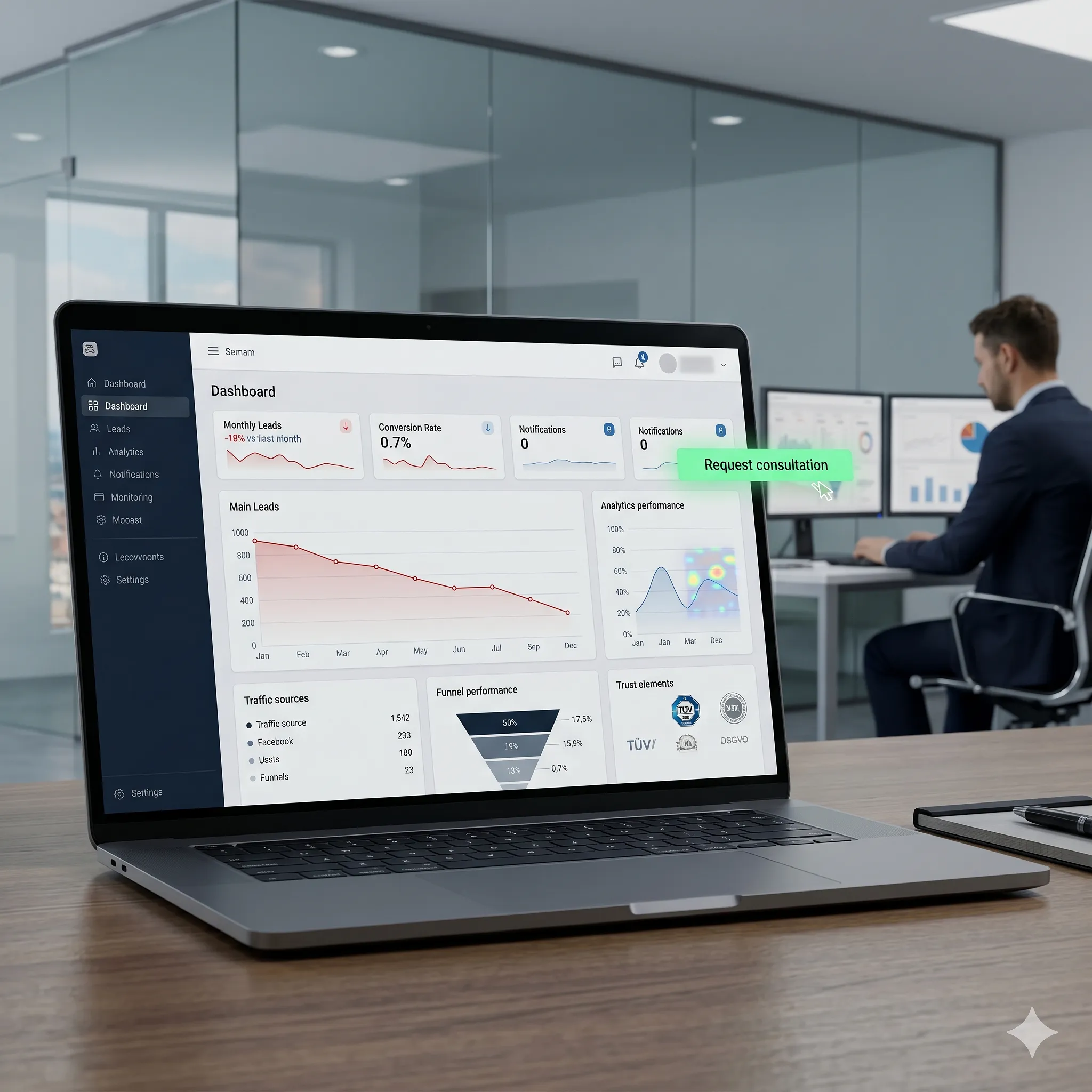
Many B2B companies invest substantial resources in their websites - and then wonder why inquiries never come in. The problem is rarely traffic: it's structure, trust signals, and the way visitors are guided through the site. A website that generates no leads does inform visitors - but it doesn't drive decisions. This article explains why that happens and what you can concretely do to change it.
According to Eurostat, 19.49% of EU company revenue already comes from e-commerce, and 85.65% of companies with online sales use their own website or app to do so. A digital presence is no longer an optional extra - it's an active sales channel. Failing to fulfill that function means losing business quietly and continuously.
The Real Problem: Informing Instead of Converting
A website that attracts visitors but generates no inquiries has a conversion problem - not a traffic problem. The distinction is fundamental: an information page shows who you are. A sales system leads the visitor step by step toward a decision.
87% of B2B buyers prefer to research independently before making contact. 90% look at 2 to 7 websites in the process. Anyone who fails to serve a clear purpose during that phase - offering no orientation, proposing no next step - simply gets skipped. Silently, without feedback.
The median B2B conversion rate is 2.9%. Raising that rate to 4-5% doubles your inquiries at the same traffic level. That's not a theoretical figure - it's the measurable difference between a website that works and one that doesn't.
What Turns a Website Into a Lead Machine
Three factors determine whether a visitor becomes a prospect:
- Clear user journey: The visitor knows at every point what the logical next step is.
- Immediately recognizable relevance: The offer must be clear within seconds - not after three paragraphs.
- Trust before the ask: Building trust only after prompting contact has the order backwards.
These three factors aren't design details. They're architectural decisions that shape the entire conversion structure of your website.
The 5 Most Common Reasons Your Website Stays Silent
When a B2B website generates no inquiries despite having visitors, there are usually identifiable causes. In our experience working with business websites in Germany and across the EU, nearly every case falls into one of five categories - individually or in combination.
Cause 1: Unclear Positioning
The visitor lands on your homepage and doesn't understand within five seconds what your company does and for whom. 42% of users leave a website for exactly this reason - unclear offering or outdated web design.
A clear value proposition above the fold is not a design decision - it's a sales decision. It answers three questions: What do you offer? For whom? Why should the visitor trust you specifically?
Cause 2: Missing or Poorly Placed CTAs
Only 30% of small B2B websites have a call-to-action on the homepage. That's a structural failure: if the visitor doesn't know what to do next, they do nothing.
Personalized CTAs convert 202% better than generic phrases like "Contact" or "Learn more." Landing pages with a single, clearly formulated CTA achieve an average conversion rate of 13.5%. The call to action must be specific, relevant, and visible - on every important page.
Cause 3: Weak Trust Signals
Missing case studies, no recognizable team, no client testimonials - these aren't cosmetic gaps. Familiar brands and companies that appear trustworthy win the business in 81% of cases.
Trust is built through concrete signals: verifiable reference projects, complete team pages, client testimonials with names and industries, visible certifications. Generic claims like "We are experts" don't replace these elements.
Cause 4: Poor User Experience (UX)
80% of B2B purchase decisions are influenced by user experience - not price or product. 88% of online users don't return to a website after a bad experience.
Well-designed UX can increase qualified leads by 200-400% without additional traffic. That's the biggest silent revenue lever for B2B companies: investing in UX and digital marketing means you don't need extra ad spend.
Cause 5: No Measurable Tracking and No Optimization
A website without tracking is a sales system without a data foundation. If you don't know which page visitors drop off on, which CTA is being ignored, or where the user journey breaks down, you can't make targeted improvements.
Missing analytics tools aren't a technical problem - they're a strategic gap. Without data, optimization remains guesswork.
What B2B Buyers in the DACH Region Actually Expect
B2B buyers in Germany and the broader DACH region differ from other markets in one important way: trust is not a nice addition - it's a prerequisite. The decision to choose a partner - especially in IT and professional services - is rarely made impulsively.
B2B buyers spend only 17% of their total buying journey in conversations with sales. The remaining 83% they spend on independent research - on websites, in trade publications, through references. Anyone who doesn't convince during that phase won't make the shortlist.
These buyers expect structured, clear information. No glossy promises without substance. Clear service descriptions. Verifiable references. Recognizable points of contact. And above all: legal compliance.
Legal Compliance as a Trust Factor
Imprint and privacy policy pages are legally required in Germany. Section 5 of the DDG (Digital Services Act, formerly TMG) governs the imprint obligation. For all websites reaching EU users, the GDPR additionally applies.
According to IHK guidelines on websites, complete mandatory disclosures are a basic requirement for legally sound business operations. When these elements are missing or difficult to find, two problems arise simultaneously: a legal risk and a loss of trust. Particularly in the B2B segment, where due diligence before contract signing is standard, that's an eliminating factor.
GDPR compliance - including functioning cookie consent and a complete privacy policy - is both a legal obligation and a trust signal. Implementing it correctly signals professional handling of data. That counts in the German market.
Transparency in Service Presentation
B2B buyers in Germany are skeptical of vague promises. What convinces them is concrete service descriptions, understandable processes, and measurable results from reference projects.
A recognizable team with names and roles increases willingness to convert. The visitor wants to know who they'll be working with - not just which services are offered. This transparency isn't an end in itself; it's a conversion factor.
Technical and Structural Factors
Technical shortcomings are the silent conversion killers: invisible to the website owner, clearly noticeable to the visitor. A website can be compelling in content - but if it loads slowly or doesn't function on mobile, it still loses inquiries.
Google measures three core performance parameters with Core Web Vitals: loading speed (LCP), interactivity (INP), and visual stability (CLS). These metrics influence both organic search rankings and user behavior directly.
Loading Speed: Every Second Costs You Leads
According to the Google Mobile Speed Study, 53% of mobile users abandon a page that takes longer than three seconds to load. Every second of delay reduces the conversion rate by up to 20%.
The consequences are measurable: when loading time increases from 1 to 3 seconds, the bounce rate rises by 32%. At 6 seconds, it's already 106%. Real case studies confirm the flip side: Rakuten 24 increased its conversion rate by 33% through Core Web Vitals optimization. Vodafone achieved 8% more revenue through 31% faster LCP.
Mobile Optimization
More than half of all B2B research now happens on mobile devices. B2B websites with a one-second load time have a five times higher conversion rate than pages with a ten-second load time.
Non-responsive design effectively excludes a growing portion of your target audience. That's not a technical detail - it's a structural decision about which visitors your website can actually serve.
Technical SEO and Discoverability
SEO generates 76% of all measurable B2B website traffic. Organic search has a close rate of 14.6% - compared to 1.7% for outbound efforts. Without a solid professional SEO foundation, even the best conversion structure reaches no visitors.
Technical SEO includes correct meta tags, structured data (Schema.org), clean URL structures, functioning crawling, and sufficiently fast load times - all of which depend on quality web development. These fundamentals are a prerequisite for your website being found at all.
How to Turn Your Website Into a Sales System
The critical mindset shift: a website is not a digital brochure. It's an active sales channel - the only one that works around the clock without asking questions. That function must be actively designed.
Three pillars form the foundation of a functioning website sales system: clear conversion architecture, systematically built trust, and continuous data-driven optimization - supported by strong GEO and AI SEO to maximize discoverability.
Step 1: Build a Clear Conversion Architecture
The homepage must show three elements above the fold: a clear value proposition, a primary CTA, and initial trust signals. The visitor decides within seconds whether to stay.
Service pages follow a problem-solution structure: What problem does the service solve? How? With what specific results? Secondary CTAs guide the visitor further - not just anywhere, but to the next logical step.
The contact page is often the weakest point: too complex, too vague, with no expectation management. Clear forms, a stated response time, and a described next step reduce friction.
Step 2: Build Trust Systematically
Trust isn't built through individual statements but through the sum of consistent signals:
- Reference projects with measurable results instead of generic project lists
- Client testimonials with complete details: name, company, industry
- Team page with real contacts, not anonymous photos
- Legal pages complete, current, and easily findable
- Certifications and memberships prominently displayed
Each of these elements is an independent trust-building block. When one is missing, gaps emerge that visitors feel - even if they can't articulate it.
Step 3: Measure, Analyze, Optimize
Without measurement, no improvement. The setup consists of a few, but consistently deployed tools:
- Analytics (Google Analytics or Matomo): visitor flows, bounce rates, page behavior
- Goal tracking: every inquiry, every form completion recorded as a conversion
- A/B tests: CTAs, headlines, form design - tested systematically, not by gut feeling
- Core Web Vitals: regular review through Google Search Console
- Monthly conversion review: What's working? What's blocking?
Optimization is not a one-time project. It's a continuous process that improves with every data point.
Quick Audit: 10 Questions for Your Website
Before seeking external help, an honest self-assessment is worthwhile. These ten questions cover the most common weaknesses - and give a first indication of where the biggest levers are.
The 10 Audit Questions
- Is your value proposition recognizable within 5 seconds? Not for you as the operator - but for someone seeing the website for the first time.
- Is there a clear CTA on every important page? Every page should offer an obvious next step.
- Is the website mobile-optimized and fast? Test with Google PageSpeed Insights, target under 3 seconds load time.
- Are the imprint and privacy policy easily findable and complete? Not buried in footer fine print, but clearly accessible.
- Are there reference projects or client testimonials with specific results? Not just "We did X" - but "With the result Y."
- Is the team recognizable and approachable? Names, roles, contact options - visible, not hidden behind an anonymous "Team."
- Are inquiries and conversions being tracked? If no one knows how many inquiries the website generates, there's no basis for improvement.
- Is there a clear user journey? From first visit to contact - are the steps logical and low-friction?
- Is the design current and trustworthy? An outdated design signals: this company doesn't invest in its external appearance.
- Are Core Web Vitals regularly reviewed? Technical performance is not a one-time topic.
Anyone who answers "no" or "not sure" to more than three of these questions has concrete starting points for improvement.
When It Makes Sense to Bring In External Experts
Not every website problem can be solved internally - and that's not a weakness, it's a realistic assessment. There are clear situations where external support is faster and more cost-effective than internal effort.
Typical scenarios:
- The website has run for years without measurable inquiries, with no clear cause identified.
- Internal expertise for conversion optimization, UX analysis, or technical SEO is lacking.
- Technical problems (Core Web Vitals, structured data, crawling errors) can't be diagnosed internally.
- A repositioning or rebrand requires a complete website overhaul.
- The company is growing and the website isn't keeping pace - the conversion structure no longer matches the offering.
What a Professional Website Audit Delivers
A structured audit diagnoses - it doesn't recommend blindly. It covers four areas:
- Technical: load times, Core Web Vitals, crawling, indexing, structured data
- UX: user journey, navigation structure, CTA placement, form design
- Content: clarity of value proposition, quality of service presentation, trust signals
- Conversion structure: tracking setup, goal definitions, funnel analysis
The result is a prioritized list of concrete actions - no vague recommendations. With a clear assessment of what takes effect immediately and what should be addressed in the medium term.
At Webdelo, we start with analysis before recommending any action. No implementation without a data foundation - that's our core principle.
Typical Results After Professional Optimization
The case studies are consistent: structured conversion optimization typically leads to 30-50% more inquiries. The technical dimension illustrates this clearly: Vodafone achieved 8% more revenue through faster LCP. Rakuten 24 increased its conversion rate by 33% through Core Web Vitals optimization.
The ROI perspective is decisive here: how many inquiries are being lost every month due to the current state? With an average B2B contract value, professional website optimization often pays for itself within a few months.
Frequently Asked Questions
Why does my website get traffic but no inquiries?
Traffic and conversion are two separate problems with different causes. Traffic means visitors are arriving - conversion means visitors are taking action. A website can rank well and still generate no inquiries if it informs but doesn't guide. The most common causes are missing or poorly placed CTAs, weak trust signals, and unclear positioning above the fold.
How quickly can I expect to see improvements?
First measurable results after technical optimization - load times, Core Web Vitals - are often visible within 4 to 8 weeks. Structural changes to UX and content show their effect after 2 to 3 months. Importantly: continuous optimization is not a one-time project but an ongoing process.
Is a redesign enough to generate more leads?
A new design alone rarely solves the problem. What matters is the conversion strategy, the user journey, and the quality of trust signals - not the visual presentation. A redesign without a strategic foundation can actually make things worse if it removes elements that were working.
What does professional website optimization cost?
Costs vary significantly depending on scope: a standalone audit differs considerably from a complete restructuring with ongoing optimization. More important than the absolute cost is the ROI perspective: how many qualified inquiries are being lost per month? What is an average contract worth? That relationship determines whether the investment makes sense. Webdelo offers an individual analysis as a first step - with no obligation to proceed with implementation.
Is SEO or conversion optimization more important?
Both are necessary and complement each other. SEO brings visitors to the website. Conversion optimization turns visitors into inquiries. Investing only in SEO while neglecting conversion structure means bringing more visitors to a site that doesn't work. The sensible order: establish the conversion foundation first, then scale traffic.
What role does GDPR play in conversion?
GDPR compliance is a legal requirement - and simultaneously a trust signal. Missing cookie consent or an incomplete privacy policy create legal risks and direct trust losses. Particularly in the German B2B market, data handling practices are evaluated before contract signing. Correct GDPR implementation signals professional handling of sensitive information.
How do I measure the success of my website optimization?
Primary KPIs are number of inquiries, conversion rate, and cost per lead. Secondary KPIs include bounce rate, average session duration, and pages per session. Importantly: measure your baseline before making changes. Without a starting point, no improvement can be demonstrated.
Conclusion
A website that generates no inquiries has a clear job - and isn't doing it. The problem is rarely traffic. It lies in conversion structure, trust signals, and the way visitors are guided through the site.
The median B2B conversion rate is 2.9%. Even raising that to 4-5% doubles results at the same visitor volume. That shows how large the lever is - and how much potential remains untapped in most B2B websites.
The first step is diagnosis. Knowing the causes enables targeted action - without flying blind, without burning budget.
Contact Webdelo for a structured analysis of your website. We identify the concrete conversion blockers and give you a prioritized recommendation - what takes effect immediately and what should be addressed in the medium term. Get Your Website Analyzed
